
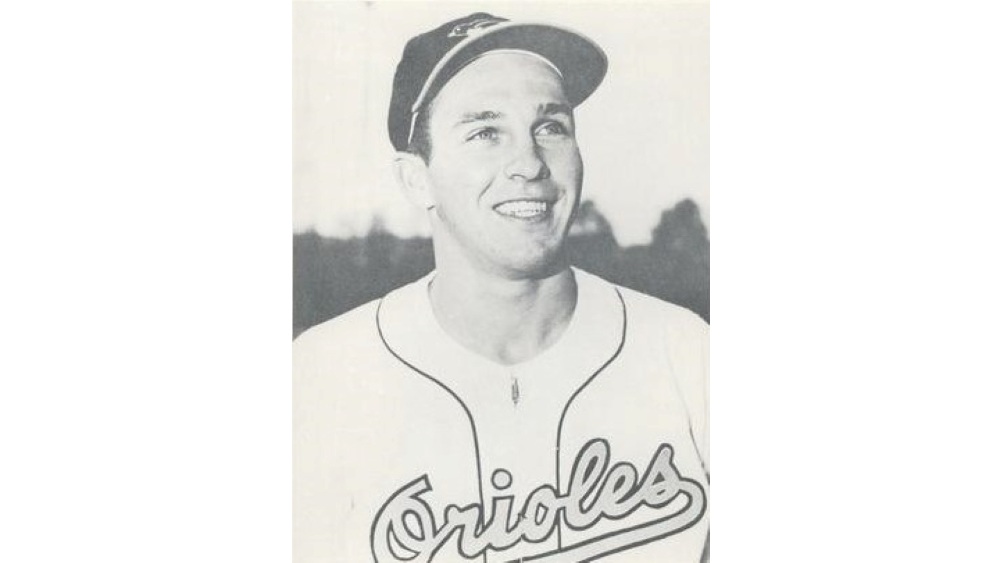
As someone who has measured each summer’s happiness by the victories and defeats of the Baltimore Orioles ever since I was half the size of Clint “Scrap Iron” Courtney, can I say a few things here that separate many of us amateurs from a professional such as Mike Elias?
Elias runs the team, while the rest of us merely sit in the stands (or watch the TV set) and suffer. As we hit the quarter-post of a long season this week, these Orioles are a major disappointment.
And like it or not, they are Elias’s babies.
He drafted them, usually right off the very top of the vast list of baseball’s alleged future stars.
Or he traded for or signed them as free agents, lately with the blessings and big bucks of the O’s majority owner, David Rubenstein.
And what have we got but a team floundering beneath .500 once again and opening the weekend by throwing away a winnable game, which is precisely what they did the night before.
And so, as a fan who grew up studying the morning newspaper box scores when they were dotted with such bygone names as Miranda and Triandos and Wilhelm, let me offer some historical perspective today.
Some people know the value of defense, and some don’t.
And some people know it because we’ve actually seen its value with our own two eyes.
Around here, we remember the ancient World Series days as the Robinson years of Frank and Brooks and Boog Powell pulverizing opposing pitchers, and Palmer and McNally and Cuellar mowing down the opposition.
The more discerning of us have an additional memory, though it’s not a real one.
We remember when nothing ever got through the Orioles’ defense. If opponents had a rally going, the instinctive thought was: Make ‘em hit it to Belanger or Brooks. You knew a double play was coming when that happened.
Or hit it somewhere in the outfield, where Paul Blair can track it down.
In fact, for years after Brooks Robinson retired, there was a lament you could hear ripple through the stands (in classic Bawlamer patois) whenever a ground ball found its way through the left side of the infield: “Brooksie woulda ate that up.”
But let’s be honest about this, folks.
A lot of us were judging that era by the voice of Chuck Thompson and Bill O’Donnell, the O’s primary broadcasters back then. They were our instigators of legend. They told us the things we didn’t actually see ourselves.
In those days, the Orioles were life-and-death to reach a million fans each year. And only a few dozen games were televised back then.
We knew the greatness of those championship players — and the importance of defense! — mainly because we heard about it on the radio and read about it in the newspapers and passed the legends among ourselves for the generations that followed.
But we came to see the real thing, with our own eyes, in the years when Buck Showalter managed the Orioles, because every game was on television (and attendance at Oriole Park doubled the numbers from the Memorial Stadium days.)
Under Showalter, we were so stunned at the abilities of third baseman Manny Machado that some fans dared ask the subversive question: Is he better than Brooksie?
Then, at short and second, J.J. Hardy and Jonathan Schoop were as good as any double play combo since, well, since Belanger and Davey Johnson, or Belanger and Bobby Grich, or Belanger and anybody.
And any ball that reached the outfield went there to die in the glove of Adam Jones or Nick Markakis.
Marvelous defenders, every one of them, the kind of defenders around which winning baseball teams are built.
The kind that resulted in three playoff appearances in those Showalter years.
Every night, we saw the magic we’d previously only heard about.
And now we have this truly disappointing Orioles team that finished last a year ago and seems, for the moment, headed toward no particular distinction this year.
And what’s lacking? Pitching, of course. But these pitchers are hampered by one of the most pathetic defenses in Orioles history.
They were put together by Elias, and seem to have a few consistent characteristics: the lugs came up through the minors producing lots of home runs, but they can’t seem to catch a moving baseball.
If the third baseman manages to stop a ground ball, he throws it away, as he did to cost the Orioles last Thursday night. Then on Friday, the talented but erratic shortstop muffs a grounder that should have been a double play and cost a run that decided the game.
We could go on in this vein, except that you’ve seen it with your own eyes since these games are all on TV, and we’ve watched the nightly carnage. Is there a player out there with above-average defensive abilities, the kind that can stop a rally in its tracks?
Go ahead, name one.
Some of us have watched some magnificent defensive players here over the years — Willy Miranda, Al Bumbry, Rick Dempsey, Brady Anderson, Mike Devereaux, Chuck Diering, Cedric Mullins.
Can you name an Oriole today you’d rank with such guys?
Go ahead, name one.

A former Baltimore Sun columnist and WJZ-TV commentator, Michael Olesker is the author of six books, including “Journeys to the Heart of Baltimore” (Johns Hopkins University Press) and “Michael Olesker’s Baltimore: If You Live Here, You’re Home” (Johns Hopkins University).

At its annual meeting this year, the Baltimore Jewish Council will honor the late Harford County educator and longtime Holocaust education champion.
The former Colt, who passed away on May 25 at age 93, achieved immortality during a cold December day in 1958, writes Michael Olesker.
A new biography on the creator of "Doonesbury" misses the mark, writes Michael Olesker.
What does it mean to be fully present with each other and the sacred, asks Maryland-born cultural anthropologist Alanna E. Cooper.