
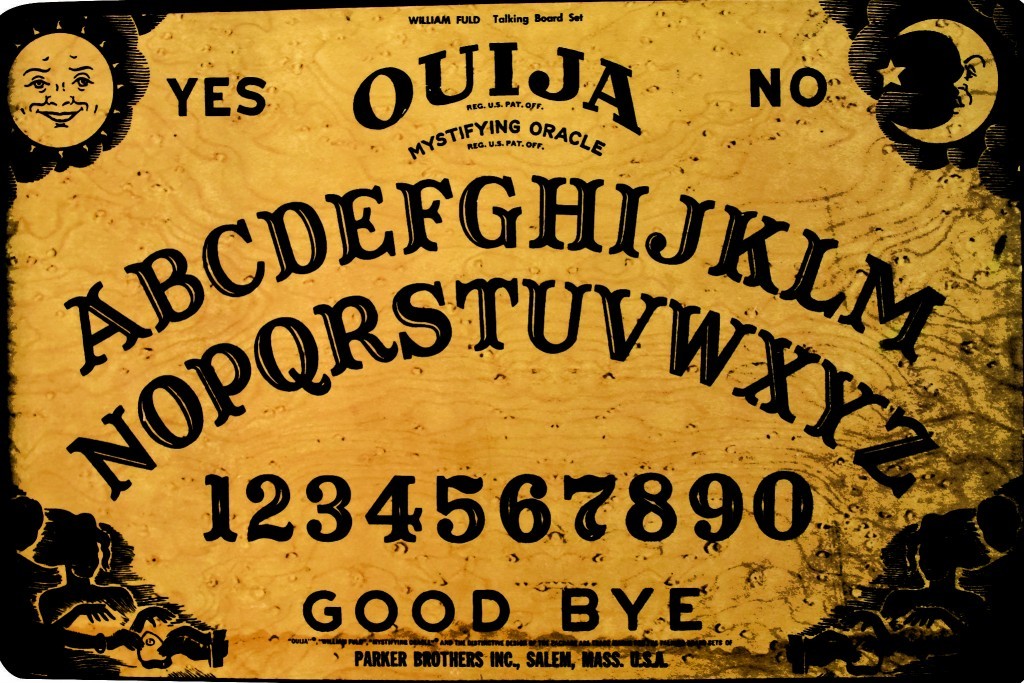
In recent years, Charm City’s critical role as the birthplace of the Ouija board – that classic parlor game and alleged divining tool enjoyed by generations of Americans — has been well-chronicled with a Baltimore Museum of Industry exhibition, the 2015 installation of a downtown historical marker and myriad articles. (It’s also the subject of the new film, “Ouija: Origin of Evil.”)
But few people know of its Jewish connection.
The story begins with the Jewish immigrants who came here from Germany in the 19th century.
One German-Jewish immigrant, Lazarus Fuld, who arrived here from Hesse-Darmstadt in 1854 with his wife and children, was not a successful clothing magnate. At age 63, he still worked as a peddler.
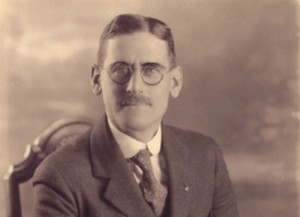
But his grandson, William Fuld, would become known as “Father of the Ouija Board,” an achievement to rival that of the most notable schmatte maker.
William Fuld didn’t exactly invent the Ouija board; “talking boards” or “spirit boards” reportedly have been around since the 12th century. And truth be told, Fuld wasn’t 100 percent Jewish, since his father, Jacob, married out of the faith.
But his story’s blend of assimilation and entrepreneurialism resonates with the German-Jewish experience of the time. And his devotion to the Ouija turned it into arguably the world’s most-used instrument for attempting to communicate with the great beyond, certainly a fact worth celebrating in JMORE, a publication devoted to highlighting Jewish Baltimore in all its diversity.
Born in Baltimore in 1870, Fuld apparently had the entrepreneurial bent that somehow eluded his grandfather and father, a shoemaker. As a teenager, he became a wood finisher and was hired by the fledgling Kennard Novelty Co. at age 20.
Charles Kennard launched the company in 1890 after hearing about a mysterious device for communicating with the spirit world: a talking board that, in homemade form, was “setting whole communities of eminently sober and respectable people on their heads,” according to one newspaper account. Keep in mind that this was during the heyday of the spiritualist movement.
Located on South Charles Street, Kennard’s firm was the first to patent and manufacture the board, and gave it the “Ouija” name (reportedly after asking the board itself what it should be called).
In 1892, two investors wrestled the company away from Kennard, renamed it the Ouija Novelty Co., and installed young William Fuld as manager.
Fuld added some patented improvements of his own, such as perfecting the needle that moved the planchette around the board. The Ouija had already proved popular, but under Fuld’s direction it became wildly successful. Soon, Fuld and his brother, Isaac, formed their own firm, which manufactured the Ouija board along with other novelty items that the brothers dreamed up.
The Baltimore Sun celebrated Fuld’s success in a 1920 article titled, “William Fuld Made $1 Million on Ouija but Has No Faith in It,” in which the entrepreneur laughingly admitted, “Believe in the Ouija board? I should say not, I’m no spiritualist. …”
But shortly thereafter, his luck turned.
According to legend — and in direct contradiction to his statement — the Ouija board “advised” Fuld to “prepare for big business.” In response, he constructed a large factory on Harford Road at Federal Street, a three-story, 30,000-square-foot plant “unlike anything built in Baltimore at that time,” according to talking board historian Robert Murch.
One February day in 1927, Fuld climbed to the roof to oversee the replacement of a flagpole. An iron support he was leaning on gave way and he fell to the ground. He died soon after, when one of his broken ribs pierced his heart. He was 56.
As for Fuld’s legacy, he “took the Ouija board from obscurity to the No. 1 game in America,” says Murch. Ownership of the board remained in the family, based in Baltimore, until being sold to Parker Bros. on Feb. 24, 1966, the 39th anniversary of Fuld’s death.
Today, a historical plaque — in a 7-Eleven convenience store at 529 N. Charles St. — marks the spot where, according to legend, the term “Ouija” was coined in April of 1890 in what was then a boardinghouse.
Fuld is buried in Anne Arundel County.
Dr. Deborah R. Weiner is co-author of “On Middle Ground: A History of the Jews of Baltimore,” to be published by Johns Hopkins University Press. She served for many years as research historian at the Jewish Museum of Maryland.

The BCO, founded in 1984, will perform the works of Frank Zappa, Beethoven, Mason Bates and Karena Ingram.

Led by local Israel-American cellist Amit Peled, the Mount Vernon Virtuosi aims to inspire people beyond musical enjoyment.

A former college campus activist, Veksler will speak at Chizuk Amuno on June 8 at the Ruth and Jay Lenrow Visiting Scholar-in-Residence for Combating Antisemitism.

Container vegetable gardening is a terrific option for people with limited space and/or time. Rebecca Brown and Norman Cohen share some tips.