
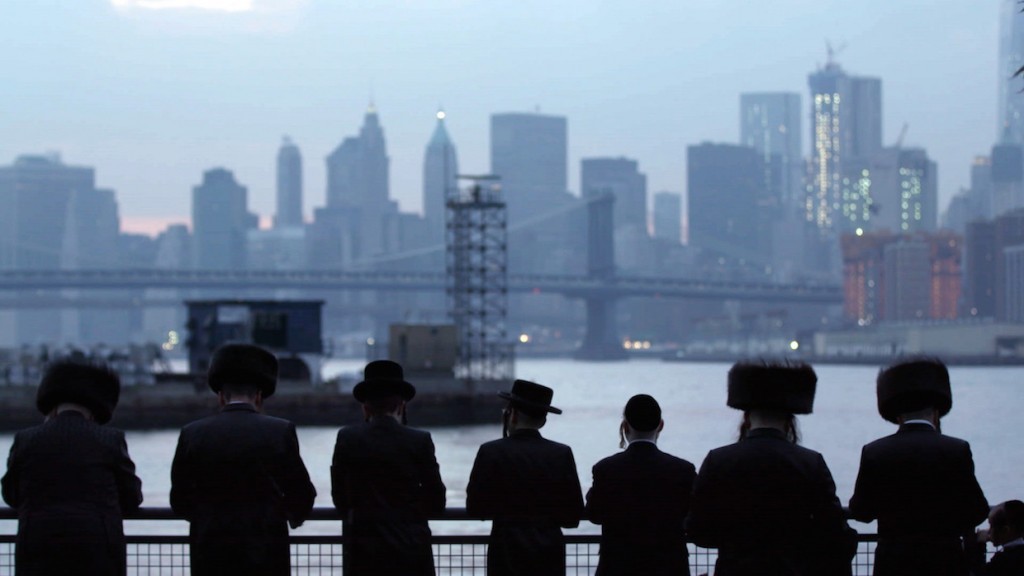
A new documentary by Heidi Ewing and Rachel Grady, founders of New York-based Loki Films, offers a rare and intriguing glimpse into the insular Chasidic world of Brooklyn, N.Y. “One of Us” premiered on Oct. 20 on Netflix and will be screened on Nov. 22 for one night only at Baltimore’s Parkway Theatre at 5 W. North Ave.
The 95-minute film profiles the experiences of three former members of the Chasidic community: Etty, a 32-year-old mother of seven attempting to divorce her abusive husband without losing custody of her children; Ari, an 18-year-old boy who was sexually abused at a Jewish summer camp, and Luzer, who left his wife and children to break out of the constraints of Chasidism and pursue an acting career.
The characters in the film are all at different points in their journeys of transitioning out of the ultra-Orthodox community to the mainstream world. Grady, the film’s co-director, will share her insights in a question-and-answer session following the Parkway screening.
She recently spoke with Jmore about the new documentary.
Jmore: How did you come to make this film?
Grady: There’s a huge Chasidic community in New York City, including where I live in Crown Heights, Brooklyn. The secular community interacts with the Chasidim in public spaces every day. But only in public spaces.
I think all New Yorkers have profound interest in the Chasidim. I always knew I would make a film about them, and Heidi shared my interest. Once we learned about Footsteps [a nonprofit that provides support to people who have left or want to leave ultra-Orthodox communities] and got entry, we had a satisfying point of access. Footsteps has gotten lots of press, but had never allowed filmmakers to document their work before. We persuaded them, but it took nine months. …
They already knew about “Jesus Camp” and “The Boys of Baraka,” [Grady and Ewing’s previous well-received documentaries]. Eventually, they gave us the green light to meet their members. No cameras, but we were invited to come to an event.
What was it like meeting their members?
I first got Ari’s name from a friend of a friend, another “OTD” guy. OTD means “Off the Derech'” [off the path]. It’s a name that people leaving the community have taken as a self-identifying label. The label started out derogatory, but then they took it back.
We met him in a coffee shop. He sat down and like any compulsive teen, he said, “Where’s the camera?” We did talk about him being in the film and how it would affect him since he was a kid and was half in and half out of the community. Ari is still half in and half out. But he’s started school. That’s causing more trouble for him than being in the film caused because his mother is very upset about him going to college. She says, ‘No son of mine is going to college!’
We met Etty at a Footsteps event. She was still dressed religiously. [The process of transitioning] hadn’t really started yet. But it all happened very quickly. We took her to lunch and she said, “My life is kind of crazy. I’m trying to get separated. I’ve been in an abusive relationship for 12 years.” She said, “I think people should know about [her situation] but I’m shy and I have to think about [being part of the film].”
A couple of weeks later, everything started falling apart. Her world just crumbled. She said, “I want you guys to come and document this.” She had a very clear purpose for her participation … letting us film her was part of reclaiming herself. We filmed her for about a year. Her situation is horrible. The kids were farmed out to different neighbors. The case is almost over but she will probably lose her kids. It will be a burden for the rest of her life.
But on the positive side, she’s enrolled in community college, has a 4.0 and has won every award. She’ll be ready to transfer to a four-year college in the fall. She wants to be a lawyer focusing on criminal justice. I believe she’ll be an excellent lawyer. She’s fearless and smart.
Luzer is in his third Yiddish play and getting experience as a stage actor. Only in New York City do opportunities like this even exist! He’s struggling because the actor’s life is hard. But I think he has an amazing attitude and is grateful for his life.
What was it like to make this film?
All journalists and filmmakers and documentary photographers have the experience of becoming engaged with people’s stories, and I’ve done a lot of films about religious fundamentalists. But this is the first time I made a film about Jews. And it was a different kind of experience.
In the back of my mind, I kept thinking, “I have ancestors from Eastern Europe. This could have been me if, a few generations ago, a different grandmother in a different shtetl had married a different grandfather.” That was constantly spinning around in my head. Also, I was worried about Etty and Ari.
Making the film hasn’t made me more religious, but I am more cued into the Jewish religion.
To purchase tickets to the Nov. 22 screening of “One of Us” hosted by Rachel Grady at the Parkway, visit mdfilmfest.com.
Top photo: “One of Us” (Photo courtesy of Netflix)
Also see:
‘Menashe’ Offers Rare Look Into Brooklyn’s Chasidic World
Filmmaker Amanda Lipitz Follows Baltimore Step Team in New Doc

The Jerusalem Orchestra East & West, which arranged the program for young musicians, blends Western orchestral music with Middle Eastern traditions.

Pikesville resident and entrepreneur Luna Rosendorff discusses what she's seeing these days in the world of contemporary interior design.
Jewish Community Services' upcoming "Future-Ready Workplace" event will feature a keynote address from workplace expert and bestselling author Liz Fosslien.
The BCO, founded in 1984, will perform the works of Frank Zappa, Beethoven, Mason Bates and Karena Ingram.