
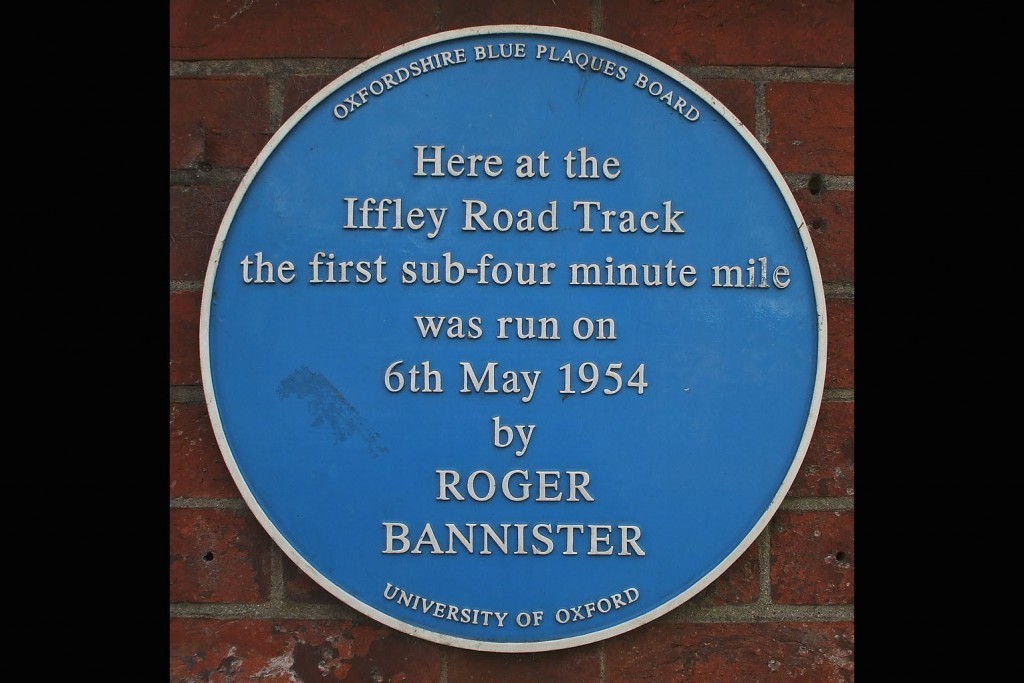
Is the romance of the four-minute mile dead and gone in this high-tech age?
I can’t say that I sit around and think an awful lot about the lost art of running against time. But since reading about the recent death of Sir Roger Gilbert Bannister, the Englishman who was the world’s first recorded person to run the mile in under four minutes, I have revisited his feat and the utter loss of the romance for the miler.
As fast as technology pushes us today, maybe there really isn’t time to reflect on the speed of things. But back in the post-World War II era, the world was a far different place, a place where man often tried to achieve great things competitively against the clock.
From culling over multiple obituaries on Bannister, I learned that at the time of his world record in May of 1954, two other runners — an American named Wes Santee and an Australian named John Landy — appeared to be on the verge of breaking the four-minute mile mark.
According to his memoir, Bannister, who was a medical student at the time, credited “fear” born out of WWII for making him run his fastest. “I imagined bombs and machine guns raining on me if I didn’t go my fastest,” he wrote.
To put Bannister’s 3:59.4 record in 1954 in some context, milers had flirted with the idea of a sub-four-minute mile for nearly a decade. In 1944, a Swedish runner Arne Andersson ran the mile in 4:01.6; then in 1945, his fellow Swede Gunder Hagg took a scant two-tenths of a second to record a 4:01.4. But there the record stood for close to a decade.
Bannister’s mark of 3:59.4 only stood up as the record for about 5½ weeks when on June 21, 1954, Landy dropped the mark to 3:57.9. Bannister and Landy would race against each other later that summer in Vancouver in a race dubbed “The Miracle Mile” and “The Race of the Century” on Aug. 7. With 35,000 in attendance, Landy would run his second sub-four-minute mile, but Bannister won with his fastest time ever of 3:58.8.
Landy would call that race his most satisfying because he was racing against a human competitor and not just a clock. By the end of 1954, Bannister retired from running to dedicate the rest of his life to medicine.
The great runner Sebastian Coe — who on three different occasions held the world record and once ran a 3:47.33 — said of Bannister and his record-setting race, “He was running 28 miles per week. With limited scientific knowledge and running in leather shoes with the spikes alone weighing more than the tissue-thin shoes today, on tracks at which speedway riders would turn up their noses. So as far as I’m concerned, that was one of the great runs of all time.”
Not that Bannister was alone in this endeavor but it needs to be noted that for years before and after Bannister broke the four-minute mile, these athletes spent their time and energy for the love of the sport and the thrill of the chase. Placed today against the almost impossible notion of pure amateurism, Bannister’s achievement and other achievements have taken on added significance and allure.
The oldest recorded world record-holder for the one-mile run was by Englishman Charles Westhall, a professional runner, who in 1855 ran a 4:28 mile. The most recent world record, set in Rome in July 1999, was by Moroccan runner Hicham El-Guerrouj at 3:43.13.
While three Americans had held the world record mark before Bannister’s history-making run — John Paul Jones, Norman Taber and Glenn Cunningham — only one American, Jim Ryun, has held the world mark under 4 minutes.
On July 17, 1966, Ryun set a world mark of 3:51.3, and then nearly a year later he passed that by two-tenths of a second in Bakersfield, Calif., coming in at 3:51.1.
Since Ryun’s mark was bested in in May of 1975 by Tanzanian Filbert Bayi at 3:51, no American has ever held the world one-mile mark.
While everything around us moves faster and faster every day, the current mark set by El-Guerrouj has now stood nearly 19 years, by far the longest that the one-mile mark has been held since the records have been kept.
 Stan “The Fan” Charles is the founder and publisher of PressBox.

Israeli-Americans Rachel Goldberg-Polin and Jon Polin talked about the pain of losing their 23-year-old son, who was kidnapped and later murdered in the Oct. 7th tragedy.

The remaining 6,000 members of the community are expected to immigrate by 2030.

Israel is increasingly reliant on foreign workers, hundreds of whom moved into the dilapidated building during the Iran war.

Colorectal cancer rates are climbing among young people and Ashkenazi Jews.