
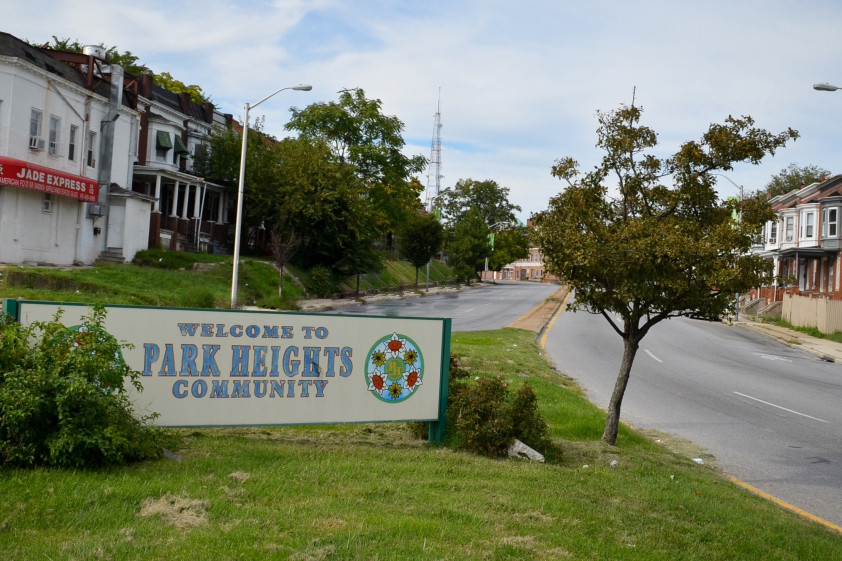
Eighteen months ago, I took a little trip down “Memory Lane” — otherwise known as lower Park Heights Avenue — from Garrison Avenue by the old Pimlico branch of the Pratt Library down to Park Circle, where we once found the delights of Carlin’s Park.
You want to have your heart broken, take the same journey today. Along the broad boulevard once considered among Baltimore’s proudest middle-class stretches, I counted roughly 150 abandoned houses that day, with roofs caving in, windows busted, trash all over the place and human inhabitants long gone.
“Forty years of bad public policy,” said the outgoing Baltimore Ciity Councilwoman Rochelle “Rikki” Spector (D-5th), when I reported the story.

“We’re going to do something about it,” said the incoming mayor, Catherine E. Pugh, over coffee that same week.
Good luck with that.
Now, we see just how widespread the problem of abandoned homes really is. In the April 29 edition of The Sun, reporter Ian Duncan details a citywide catastrophe — more than 16,000 vacant homes across Baltimore, despite roughly $80 million in government spending over the past decade that has reduced the blight by only a few hundred structures.
How could so much money be spent on so little improvement?
Over the last eight years, The Sun reports, the city has demolished about 2,700 buildings and rehabilitated another 4,200. But for all the places that are demolished and sometimes rebuilt, more and more houses continue to be abandoned. Sometimes, they just fall apart with age and nobody takes care of them. Sometimes, people die and nobody new wants to move in. Sometimes, people simply move away and nobody wants to move in.
The city continues to lose population month after month, spurred by violence in impoverished, drug-plagued neighborhoods – and by the look of abandonment on entire blocks, which then feeds on itself. Who wants to move onto a block that seems teetering on the edge of death?
In her annual State of the City address last month, Mayor Pugh said the city is on a pace to demolish 1,000 buildings this year. At such a rate, the city might rid itself of abandoned buildings by the year 2034 – assuming no more buildings fall apart between now and then.
Good luck with that.
At mid-20th century, the city of Baltimore was home to more than 900,000 people. Today, just over 600,000. With every battered, abandoned, rotted building, a message is sent: something is dying here.
Now, even the undertakers can’t keep up with it.
 A former Baltimore Sun columnist and WJZ-TV commentator, Michael Olesker is the author of six books. His most recent, “Front Stoops in the Fifties: Baltimore Legends Come of Age,” has just been re-issued in paperback by the Johns Hopkins University Press.

In Italy, the Jewish Brigade's flag has unfairly become a flashpoint in today’s battles over Zionism and anti-fascism, writes Dr. Ginaluca Fantoni.
At its annual meeting this year, the Baltimore Jewish Council will honor the late Harford County educator and longtime Holocaust education champion.
The former Colt, who passed away on May 25 at age 93, achieved immortality during a cold December day in 1958, writes Michael Olesker.

A new biography on the creator of "Doonesbury" misses the mark, writes Michael Olesker.