
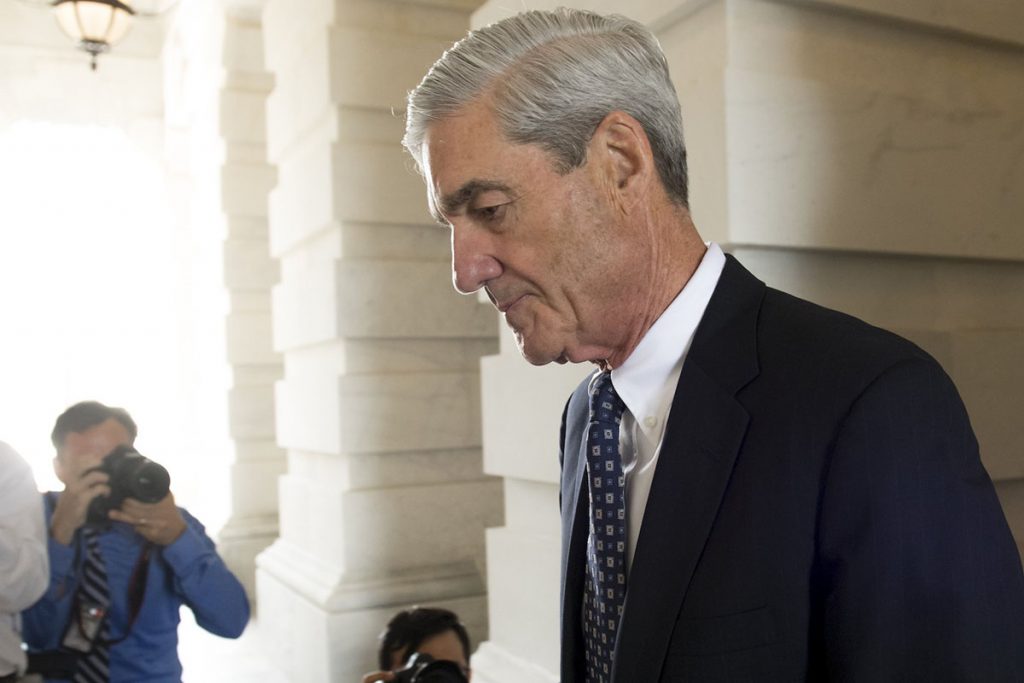
Over the past two years, in the absence of seeing the real Robert Mueller, maybe we created somebodywho wasn’t there. We imagined a larger-than-life authority figure, part combatMarine, part Judge Hardy, part avenging Old Testament patriarch who would leadAmerica out of its political desert.
Instead, in long, labored hours before two congressionalcommittees on Wednesday, July 24, the special counsel investigating Russia’sinvasion and the Trump campaign’s embrace of it turned out to be somebody else.
Mueller was a whispery 74-year old man who had to be coaxedout from behind a protective curtain and occasionally seemed a little doddering.
Maybe he didn’t want to testify because sometimes he seemed vaguelyunfamiliar with material that bore his signature. Sometimes, given a directquote from the report, he’d say, “If it’s from the report, I support it” – asthough needing to make that verbal connection in the absence of actualfamiliarity.
He declined to answer questions 198 times by one count, or206 by another. Sometimes he needed questions to be repeated. He said he couldn’thear, but sometimes it felt like maybe he couldn’t concentrate.
President Trump, seizing on our national inclination tonotice form over substance, called it “one of the worst performances in thehistory of our country.”
The usual Trump hyperbole, of course. As theater, though, theMueller debut would have closed after one night.
But we’re dealing with more than theater here, aren’t we?
Aren’t we?
Could we please react to the Mueller hearings as anelectorate instead of an audience?
Were we not paying attention when Rep. Jerry Nadler,chairman of the House Judiciary Committee, listed some of the awful, indisputablefacts?
Nadler laid out the “sweeping and systematic Russian attack …designed to benefit the Trump campaign,” the indictments and convictions ofTrump intimates, the attempts to subvert Mueller’s investigation.
If this was too vague, Nadler then made it explicit: Trumpordered his White House counsel to have Mueller fired, “and then to lie anddeny that it ever happened … and attempted to prevent witnesses from cooperating”with the investigation.
Were we not paying attention when Mueller, in hisperfunctory way, agreed with every allegation Nadler laid out?
Were we not paying attention when Rep. Adam Schiff, chairmanof the House Intelligence Committee, opened the afternoon hearing with all thepassion that we once imagined Mueller might bring?
Schiff called the 2016 election “a story about disloyalty tocountry, about greed, and about lies,” and said the Trump people “knew that aforeign power was intervening in our election and welcomed it, built Russianmeddling into their strategy and used it.”
And then, he started making it personal.
It was “about a campaign chairman” – named Paul Manafort –“indebted to pro-Russian interests who tried to use his position to clear hisdebts and make millions. About a national security advisor” – named Gen. MikeFlynn – “using his position to make money from still other foreign interests.
“And about a candidate” – named Donald Trump, just for therecord – “trying to make more money than all of them, through a real estateproject that, to him, was worth a fortune, hundreds of millions of dollars, andthe realization of a lifelong ambition — a Trump Tower in the heart of Moscow.A candidate who, in fact, viewed his whole campaign as the greatest infomercialin history.”
Was Robert Mueller a disappointment to millions hoping hisappearance would enlighten those denying the Trump national disgrace?
Yes.
Was he a disappointment for all those who didn’t read his 448-pagereport but, in the current phrase, “didn’t read the book, but ought to enjoythe movie”?
Yes.
But this isn’t a movie. It’s history. It’s not aboutperformance. It’s about the awful truth – and how it’s still out there in thedark, waiting to attack us all over again.

A former Baltimore Sun columnist and WJZ-TV commentator, Michael Olesker is the author of six books, most recently “Front Stoops in the Fifties: Baltimore Legends Come of Age” (Johns Hopkins University Press).

Cruel, inappropriate, egomanical, outrageous and bullying are all attributes that pass for presidential these days, writes Michael Olesker.
Commemorations of the Holocaust must transcend the past to include concerns about the present and future, writes Menachem Z. Rosensaft.

Someone needed to tell Donald Trump that his appearance at a UFC fight over the weekend was not a good look, writes Michael Olesker.