

I haven’t had such a sad Passover season since the mid-1950s, when Stanley Nusenko, Larry Carson and I went to the New Theatre in downtown Baltimore to see the ultimate Hollywood Old Testament extravaganza, “The Ten Commandments,” whose running time was longer than your grandfather’s seder.
Up on the big screen, there was Charlton Heston, starring as Moses. I can still hear my friend Stanley muttering, out of the side of his mouth, “Hey, Moses, what’s with the rug?”
The thing sat there atop Heston’s head and looked like it might take flight across the Red Sea.
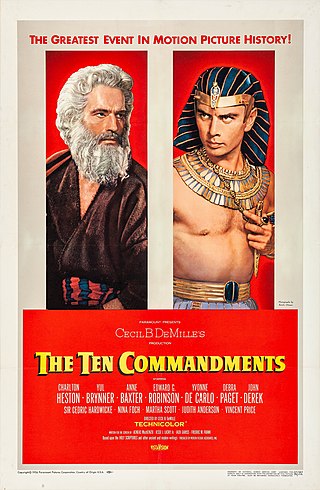
Not once, in all the endless afternoons we’d sat through Hebrew school lessons, had the learned rabbis of Northwest Baltimore ever mentioned to us that Moses sported a toupee for 40 years across the blistering sands of the Sinai.
So right away, Stanley and Larry and I were disappointed.
Not disappointed like today, when this coronavirus has so many of us isolated on nights we once happily gathered for seder.
But saddened enough to look for a few smiles to get us through a dreary holiday season.
And “The Ten Commandments” — televised every year around this time for the past several decades — supplied more than a few unintended smiles as it told its campy version of the ancient Hebrews’ flight from Egypt.
How about Anne Baxter, Yvonne De Carlo and Debra Paget? They played royal Egyptian women. Who knew that women back then wore nighties like the road company from Victoria’s Secret?
And how about Edward G. Robinson? In our eyes, he would always be the mob guy Caesar Enrico Bandello in “Little Caesar,” crying, “Mother of Mercy! Is this be the end of Rico?”
Why, in the name of God, was this classic Hollywood gangster showing up now in a flouncy outfit playing Dathan, the Hebrew who plots against Moses?
“Hey, Dathan, what’s with the little skirt?” my friend Stanley hollered at the screen. For this, Little Caesar turned in his lifetime union card with the mob?
In “The Ten Commandments,” Ramesses II (Yul Brynner) tells the traitorous Dathan, “You have a rat’s ears and a ferret’s nose.”
“To use in your survival, son of Pharaoh,” Dathan meekly replies.
Would Little Caesar say such drivel? Mother of mercy, no! He’d have gone after this pharaoh with a gun straight out of Charlton Heston’s NRA collection.

What we had here was not only campy language but confusion of image.
In Hebrew school, when our teachers recited the story of the great Exodus, we were free to create heroic images in our minds. In fact, faith is built on image. Lose the image, lose the possibility that such things could ever have occurred.
The most powerful image in the Exodus story is the parting of the Red Sea. I can still hear my Hebrew school teachers telling us the story every spring. My head would fill with powerful images of the sea dividing, and Moses leading his people across the clearing an instant before the waters descended and swallowed up pharaoh’s army.
But what was this Red Sea we beheld upon our movie screen?
It wasn’t the image we’d carried in our minds, that’s for sure. In fact, as we later learned, director Cecil B. DeMille had two large tanks flooded with 350,000 gallons of water and then dumped into a dry bed. Then, he showed the footage in reverse.
Whatever it was, it wasn’t the stuff of our dreams.
The parting of the Red Sea is one of the great, iconic biblical stories, so familiar that it’s noted in a new book, “A Field Guide to the Jewish People,” (Flatiron Books) by the comic writers Dave Barry, Alan Zweibel and Adam Mansbach.
In it, Barry writes of his wife, whose family members are Jews from Cuba, “They didn’t come here on rafts. They parted the Caribbean.”
Now there’s a smile to carry us through a sad holiday season.

A former Baltimore Sun columnist and WJZ-TV commentator, Michael Olesker is the author of six books. His most recent, “Front Stoops in the Fifties: Baltimore Legends Come of Age,” has just been reissued in paperback by the Johns Hopkins University Press.

At a time when many Jews fear appearing Jewish in public, seeing Judaism depicted correctly onscreen is reassuring, writes Jewish content creator Rabbi Yael Buechler.

Cruel, inappropriate, egomanical, outrageous and bullying are all attributes that pass for presidential these days, writes Michael Olesker.


Commemorations of the Holocaust must transcend the past to include concerns about the present and future, writes Menachem Z. Rosensaft.