
By Ruthy Wolman
What’s in a glass? Half-empty or half-full, it’s still just a glass.
While fascinating in origin and construction (sand, torched and blown), there’s little to contemplate about glass. Or so I thought, until I started craving my mother’s flaky dough apple turnovers.
Tucked away safely in the back of my baking cabinet is my mother’s old recipe notebook. I have yet to meet anyone who can match my mother’s cooking and baking talents. And try as I may, I, too, have not come close to mastering her recipes.
Nevertheless, I still take great comfort in just reading through her recipes and the wonderful memories they evoke.
So what do these memories and apple turnovers have to do with glass?
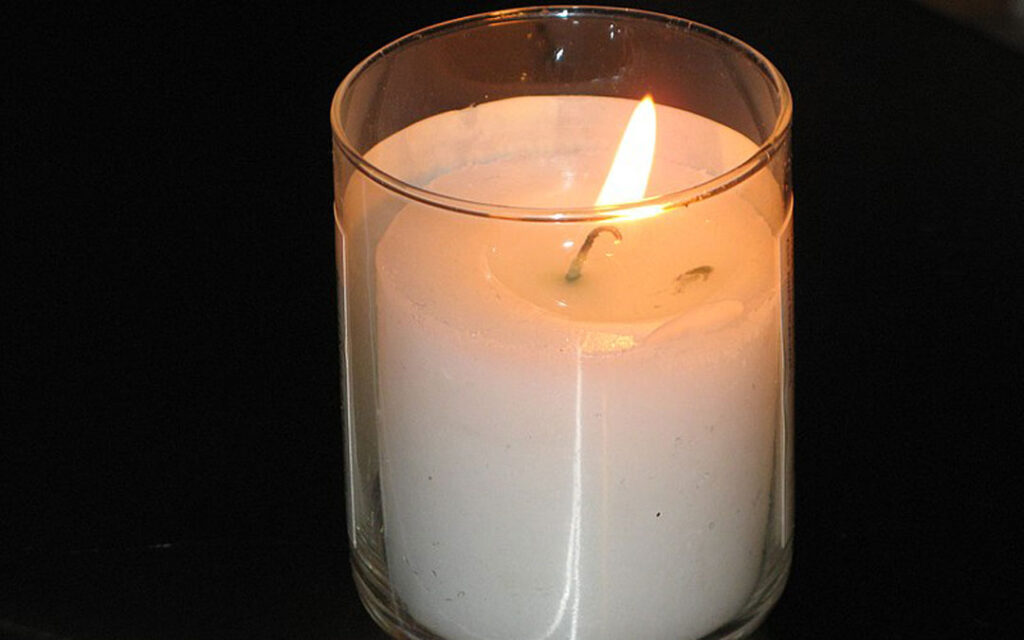
Perhaps the most outstanding feature of a recipe written by mothers like mine — who came to America more than 60 years ago after leaving their Eastern European homelands — is that they never measured anything with a cup. Their “measuring device” was a glass — and not just any glass. It was a recycled yahrzeit glass, a glass filled with a candle and wick that burns for 24 hours to commemorate the anniversary date of the death of an immediate family member.
How do I know about this “cup replacement”? That’s what the recipe calls for. For the perfect apple turnover, one is instructed to use “four yarzheit glasses of flour.” A glass that, when finished with its intended purpose, is washed, toveled (immersed in a mikvah), and used over and over.
I remember the glasses clearly, with their exterior scalloped bumps, standing side by side on a paper-lined shelf.
Of course, what fascinates me is that my contemporaries and I from similar backgrounds grew up and perceived this as perfectly normal. Didn’t everybody have multiple yahrzeit candles burning at one point or another throughout the year?
Never did it occur to me to feel embarrassed or even creepy about recycling these glasses. But why was it OK then, when we know today it would never fly?
Yes, necessity is the mother of invention and the hardships of those times did necessitate invention. But could it be more? Was this a result of poverty, practicality at its fullest? Was it just another survival technique, a stroke of brilliant creativity?
Or could a simple yahrzeit glass teach us the victory of the human spirit? Was this not another example of the strength of that generation, picking itself up, brushing off the dust and starting all over?
From the ashes, they survived. They did not choose to forget. That yahrzeit glass was there to remind them. Yet they did not linger in the ashes. They moved forward, and they took that yahrzeit glass with them, not as a constant reminder of what they lost but as a testament that they will go on.
Maybe deep down — although I was too young to have understood then — this is why the reconstituted yahrzeit glass leaves me not only with a deep sense of nostalgia but also of humility for an inner strength far greater than I could ever possess.
And the humble glass continues to present itself in other aspects of our Jewish life: remembrance of Kristallnacht, the 1938 night of shattered glass marking one of the darkest times in Jewish history, and the shattering of the glass at wedding ceremonies, reminding us of the destruction of the Temple and our longing for its rebuilding.
The custom of shattering the glass reminds me of my friend, Sara. Twenty-five years ago, Sara gave birth to her first child, a son. At the bris, Sara brought a glass. While traditionally the mohel drinks from a silver goblet, Sara requested that he drink from this simple, unadorned glass.
After the ceremony, Sara took that glass and put it away. On the day of her son’s bar mitzvah, during the Shabbat meal, she took out that glass, and both her son and husband recited the kiddush over it. After the bar mitzvah, Sara once again put away this glass.
During a recent summer, standing under the chuppah with her first-born son, future daughter-in-law and husband, Sara held that same glass. It was to be the glass that her son shattered under the chuppah. Once again, glass played a part in a rite of passage.
As a people that so often felt as broken and unfixable as shattered glass, we continue to piece ourselves together. Perhaps the key to that survival — that tenacity — is that although we forge ahead with conviction, we never let ourselves forget.
Our history is replete with splendor and tragedy, glory and defeat. Our calendar marks those days, and we celebrate and mourn them. “Lest we forget” is our mantra. We believe that as we continue to make history, we will strive to regain that eternal splendor by imparting to our children what our mothers taught us — to always live our lives with “a touch of glass.”
Ruthy Wolman is a life coach living in Baltimore. This article originally appeared on the website of the Macks Center for Jewish Education.

Allow me a few paragraphs of time travel, and let’s go back to Johnny Carson’s monologue the night after Neil Armstrong became the first man to set foot on the moon. I’m paraphrasing here, but I think the joke still works 57 years after Carson first delivered it. “The good Read more

As he gets ready to leave for California, Rabbi Daniel Cotzin Burg looks back on his time in Baltimore and his 10 years writing for Jmore.


Michael Olesker pays tribute to WJZ’s retiring Marty Bass, a longtime fixture on local TV screens.