
When Passover approaches, we find ourselves super busy with preparations. We spend hours scrubbing and kashering, checking and burning. And at the seder itself, we are occupied with its manifold laws and customs: the seder plate, Haggadah, matzohs, four cups and much more.
Then to our surprise, seven weeks later as Shavuot arrives, the experience is completely different.
There isn’t much prep work, aside from our Omer counting every day. And we only have three customs that stand out: consuming milk products, placing greenery and flowers around shul, and staying up all night learning Torah.

There is no comparison whatsoever between the two holidays in terms of the time, effort and attention that goes into them. I once heard a rabbi explain this lack of Shavuot customs as a quest for detached spirituality.
“The spirituality, the kedusha [holiness], of this special day is something detached from this world. That is why we have so little customs,” he explained. “It’s also why we stay up all night and learn — to connect to this ‘otherworldly’ holiness.”
That’s true. And I, too, will stay up all night on Shavuot with the help of HaShem … and a lot of caffeine.
However, it’s not the whole truth. Shavuot — which this year will be observed May 16-18 — is also about connecting to nature. Before I explain, I’d like to share with you what I mean by nature and what nature means to me.
Sacred Spaces
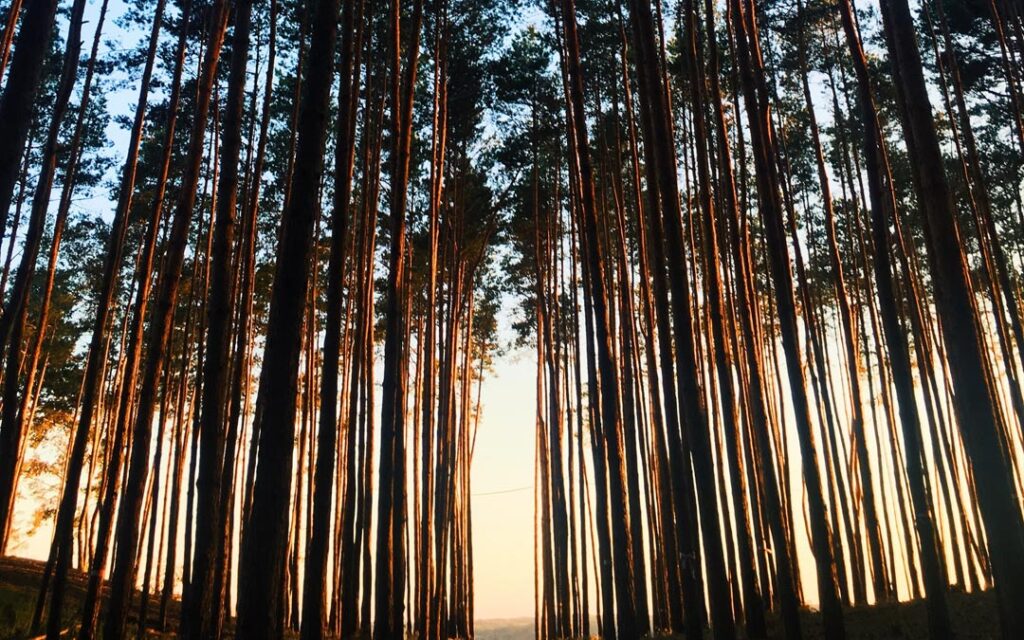
I spent much of my childhood with my siblings in the wooded area surrounding our home. It’s difficult to count the hundreds, if not thousands, of hours we spent climbing trees, going on nature walks and playing in the adjacent creek. Those were special times.
As I got older, the woods remained a sacred space for me. I walked through them and listened to the tall, swaying trees, smelled the damp fall leaves and watched the creek water flowing gently over the rocks — pondering life.
The woods allowed me to discover myself and find God during my high school years.
That’s why when I came closer to Judaism after high school, I was pleased to find that it has a lot of positive things to say about nature. Just open the Torah. Our forefathers pastured their flocks in green pastures. Rachel met Jacob in front of the well as she shepherded her flock. Moshe and King David were shepherds as well, spending many hours meditating in nature.
Nature is also central in the story we read on Shavuot, the Book of Ruth: “And Ruth said … ‘I will go now to the field, and I will glean among the ears of grain’ … [A]nd she gleaned in the field after the reapers, and her chance was to come to the field that belonged to Boaz.”

Pay attention: Ruth doesn’t meet Boaz in a restaurant or a bar — they meet in a field! And Boaz later promises to redeem her at the threshing floor of the barley.
Nature’s Immensity
Jewish texts guide us in serving HaShem through nature. Rambam lauds nature’s ability to draw us close to HaShem (Yesodei HaTorah 2:2); Rabbi Kook reminds us to learn from nature’s immense stability and strength (Shemonah Kevatzim 3:240).
Nature imagery is all over our siddur as well: from Pesukei DeZimra Psalms to the blessings of the Shema and even the morning blessings, Birkot HaShachar.
Jewish texts speak a lot about nature. That’s why it’s unfortunate that today’s Judaism has shifted away from this ideal.
Rabbi Dr. Marc Angel bemoans this fact, sharply contrasting the “indoor Judaism” of today with the “outdoor Judaism” of years past:
“By urbanizing religion and by placing its most important events indoors, we have lost touch with the original religious insight that connected us with the rhythms of nature. … The notion that ideal piety can be found in a pale, scholarly, undernourished saint who spends his days and nights studying Torah in a study hall is not true to the original Jewish religious vision. The biblical heroes and prophets, the Talmudic sages, the medieval pietists and mystics — all were involved in outdoor Judaism.”
Beyond Blintzes
On Shavuot, we place a lot of emphasis on cheesecake, blintzes and all-night learning, but we forget that in the Torah, Shavuot was about nature.
On Shavuot, we bring a sacrifice of grains to the Temple, called shtei ha-lechem, enabling us to use our new grain in the Temple. On Shavuot, the Mishna tells us, the world is judged on the upcoming year’s fruits. And just reading the Mishna’s depiction of the families’ march to Jerusalem in song with their bikkurim, the first fruits, a ceremony which began on Shavuot, reminds us of this deep nature connection:
“Those who lived near Jerusalem would bring fresh figs and grapes, while those who lived far away would bring dried figs and raisins. An ox would go in front of them, its horns bedecked with gold and with an olive-crown on its head. The flute would play before them until they would draw close to Jerusalem. … The rich would bring their bikkurim in baskets overlaid with silver or gold, while the poor used wicker-baskets of peeled willow-branches, and the baskets and the bikkurim were given to the priest.”
Rabbi Berel Wein sums this up nicely: “Even though all of the holidays revolve around the natural and agricultural year in the Land of Israel … it is the offerings of the holiday of Shavuot that are most intertwined with nature and agriculture.”
Today, without our Temple, we do not enjoy this full array of nature experiences. This may be the reason why we experience Shavuot as lacking in customs.

With this is mind, my challenge for this upcoming holiday is to take a break and return to nature. Go for a walk outside, take in the sights and smells, and discover what I found in my backyard as a child — the great serenity, stability and divinity of nature.
Rabbi Dr. Eli Yoggev serves Beth Tfiloh Congregation.

Jmore Publisher Scott Rifkin, M.D., reacts to President Donald Trump's latest poll numbers and the real force behind the growing decline of the Trump movement.

Last weekend's Flower Mart once again demonstrated that there's nothing to fear about downtown Baltimore, writes Michael Olesker.

A junior at Roland Park Country School, Katie Grossman writes about a recent experience that spurred her to take action to fight antisemitism.

At a time when many Jews fear appearing Jewish in public, seeing Judaism depicted correctly onscreen is reassuring, writes Jewish content creator Rabbi Yael Buechler.