
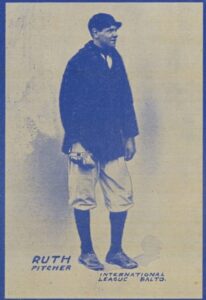
I see by the big national media coverage that a 1914 Babe Ruth rookie season baseball card is now valued at roughly $6 million.
I wonder what a 1958 Foster Castleman is worth.
George Herman “Babe” Ruth, the wunderkind out of West Baltimore’s Emory Street, famously hit 714 home runs, 60 of them in one season.
Castleman, the inept shortstop traded from the old New York Giants team, infamously hit .170 with three home runs and 14 runs batted in for the ’58 Orioles.
He made Willie Miranda look like Cal Ripken.
The news about “The Bambino” comes now from the Babe Ruth Birthplace and Museum at 216 Emory Street, where Ruth made his earthly debut back in 1895 and thereafter went on to godlike status.
This came not only for his ball playing skills, which were prodigious, but for his approach to life. The Babe never quite grew up. Some of us hold onto our inner child; Ruth held onto his child, inner and outer.
As John Updike once wrote, “A man, in America, is a failed boy.”
Or as Robert W. Creamer wrote in his classic biography, “Babe: The Legend Comes to Life” (Simon & Schuster), Ruth had “a carefree attitude toward moral and social codes.”
Ruth spent his manhood catching up on his boyhood. I once interviewed his sister, Mamie Ruth Moberly, who said her assignment — even though she was younger than Babe — was to escort young brother George to school and make sure he went in the front door.
“But he always went right out the back door,” she said.
For such reasons, his parents shipped him out to St. Mary’s Industrial School in Southwest Baltimore, where Ruth spent the rest of his youth until signed by the old International League Orioles, who got him started in organized baseball.
But his life had been so cloistered, Creamer wrote, that when Ruth went to his first spring training, it was his first-ever ride on a train. He’d never even seen one.
When they got to the hotel where the club was staying, Ruth “rode the elevator up and down like a small boy and bribed the elevator operator to let him run the thing.” He’d never been on an elevator before, nor even seen one.
He was a kid at heart, and would stay that way all his life.
As baseball brings out the kid in all who take it seriously, the $6 million estimated value of Ruth’s rookie card makes a certain sense. Many of us recall a time of youth when baseball cards were not only considered collector’s items, they were a form of currency, a way to absorb math by studying hitting statistics on the back of the cards – and a way to pass lazy summer afternoons when you couldn’t find enough neighborhood pals to get up a decent ballgame.
Who doesn’t remember the various games involving baseball cards: flipping them against a wall or a front stoop to see who got closer; and who was skillful enough to make his card lean against the wall; and whose card could knock down a leaner?
And who doesn’t remember swapping those cards, with all the insight of stock exchange traders, and the usual laconic commentary as each new face was presented as trade bait: “Got him. Got him. Got him in doubles. Got him. Got him …”
Of course, nobody had Babe Ruth.

Some of us, including me, had a bunch of Foster Castlemans.
When the Orioles returned to the Major Leagues in 1954, we barely knew the names of the brand new home town players. Everybody wanted Mickey Mantle, Willie Mays, Ted Williams cards.
And as we grew into adolescence and found other passions, everybody who had those cards let them slip away.
It is the general lament every time we hear of the value of such cards today to say, “I had that card. Had him in doubles, I think.”
A 1952 Mantle card, for example, is said to be worth nearly as much as a Ruth card.
But nobody in our time had the Babe’s card. Lucky for us, that 1914 Ruth card will go on special display at the Babe Ruth Birthplace and Museum. That Emory Street museum is one of Baltimore’s treasures, honoring Ruth and his hometown and the game of baseball.
Just don’t look for Foster Castleman there.

A former Baltimore Sun columnist and WJZ-TV commentator, Michael Olesker is the author of six books. His most recent, “Front Stoops in the Fifties: Baltimore Legends Come of Age,” was reissued in paperback by the Johns Hopkins University Press.
As millions mourn the passing of Stephen Colbert from the airwaves, Michael Olesker looks back on the "institution" of late-night TV.

As he gets ready to leave for California, Rabbi Daniel Cotzin Burg looks back on his time in Baltimore and his 10 years writing for Jmore.
Michael Olesker pays tribute to WJZ’s retiring Marty Bass, a longtime fixture on local TV screens.