
Throughout the course of the pandemic, some people dealt with the stress and anxiety by catching up on reading, watching movies, learning needlepoint or starting home-based businesses.
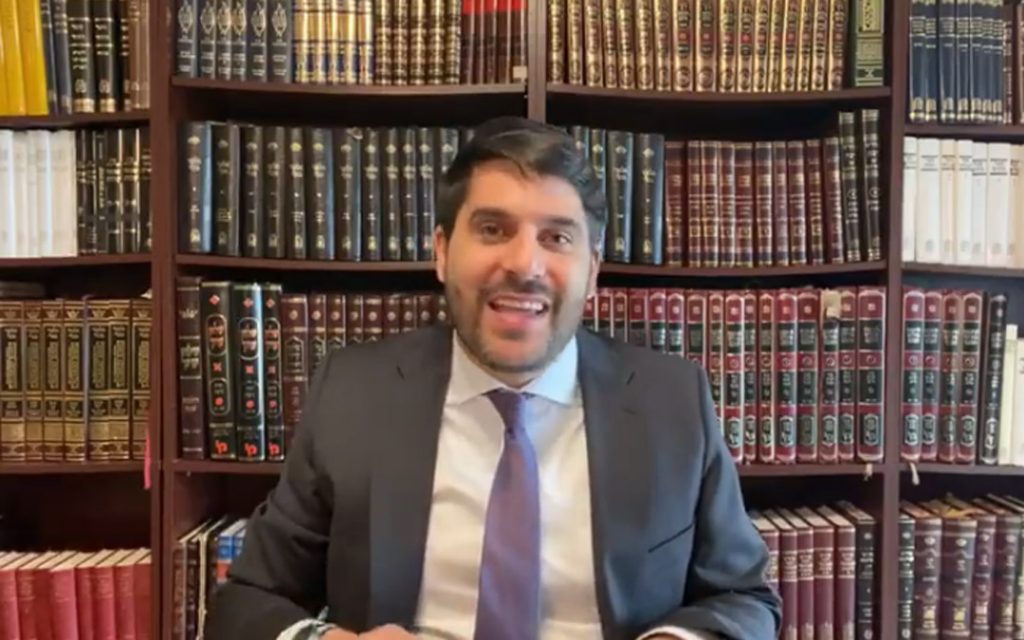
Beth Tfiloh Congregation’s Rabbi Dr. Eli Yoggev decided the time was right to author and self-publish his first book.
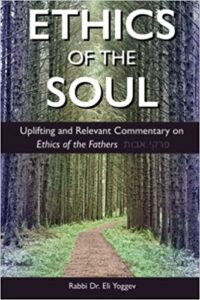
“Ethics of the Soul: Uplifting and Relevant Commentary on Ethics of the Fathers” is an examination of Pirkei Avot, the compilation of ethical teachings and maxims from the Rabbinical tradition.
Jmore recently spoke with Rabbi Dr. Yoggev about the book, which offers personal anecdotes and relevant life lessons to help readers find spiritual meaning in the modern world.
Jmore: What was the genesis of writing ‘Ethics of the Soul’?
Rabbi Dr. Yoggev: The book actually began back in 2008. I was living in Israel, far away from my family in Philadelphia. I wanted to keep up a connection with my father so we decided to learn Ethics of the Fathers – a close to 2,000-year-old rabbinic ethical treatise – weekly over Skype.
This learning was extremely enjoyable for both of us, and many of the ideas we discussed during our two years of distance-learning appear, almost verbatim, in the book.
The actual composition of the book began in 2020 when our community went into lockdown due to COVID-19. Members of our community were searching for a way to honor their loved ones’ yahrzeits absent an in-person kaddish option. I decided to write one commentary per day to a mishna [a concise rabbinic teaching] from Ethics of the Fathers that could be read for this purpose.
By the time we finally returned in person to shul, I had completed commentary on over a third of Ethics of the Fathers. I then decided to just stick with it and complete the full commentary.
Did the writing of the book evolve in a natural way?
It was more challenging than I had thought it would be. Although I am very passionate about Pirkei Avot, some of the mishnas are rather hard to understand. I like to say that they are like tweets, ancient tweets if you will. They are short teachings, of 140-280 characters or less. The only problem is, there is no comments section. So we don’t know exactly what the intent of the author was. And some of the mishnas are rather cryptic!
So it took time to really get to the bottom of the teachings. I also wanted my commentary to be original so that it would retain my congregants’ interest. So, each explanation took time
Add onto this that I was working a full-pulpit rabbi schedule without a lot of free time. Notwithstanding, I just knew this is what I wanted to do and continued with the writing – early in the morning, late at night, and even on planes and vacations.
How has the pandemic impacted you and your spiritual outlook?
On a technical level, it has made all of my teaching more concise and to the point, which is a good thing. We had a time when we were afraid to linger unnecessarily in shul due to COVID-19. We did not want people to congregate and be exposed for a long duration to a possible infection. At the time, we cut down our sermons from 15 minutes to five minutes, and our five-minute talks during the weekdays to two-minute talks. This trained me to get directly to the point and to measure my words.
Since then, I have continued with this more abbreviated direction and my congregants seem to appreciate it. Nobody ever complained that the rabbi’s sermon was too short!
On a deeper level, I think we all have been through so much during this pandemic. Putting aside all of the horrible deaths and illnesses, from which my community also suffered, we have been through a lot emotionally over these past two years. My Torah teachings have been adapted many times to fit these changes. I have done a lot, along with the rest of our clergy, to offer connection, encouragement, and meaning in these unprecedented times of fear and uncertainty.
Could you have written this book prior to the pandemic?
I don’t think so. It’s rather bold to present a commentary on Ethics of the Fathers as your first book. I am grateful it worked out this way, that I was almost forced to write the first part of the book due to the pandemic. Without that push, I don’t think I would have put out this commentary, at least not at this stage of my career.
Why did you decide to focus on Pirkei Avot and not other Jewish texts?
I specifically chose the mishnas of Ethics of the Fathers because I had been thinking about them ever since my study session with my father. This was a prime opportunity to put my ruminations down on paper.
The teachings of Ethics of the Fathers are also easy to learn and connect to, which was important for me at the initial stages of COVID, as I wrote for congregants who were at home, looking for something that would grab their attention.
In the book, you offer some personal anecdotes and insights. Can you give an example?
I now serve as an Orthodox rabbi. However, I did not grow up a fully observant Jew. So when I first became more observant in Israel at the age of 18, you can imagine how elated I was to finally find my path in life. I felt like I had been restored and wanted to share my love and happiness with everyone. I vividly remember, and I write about this in the book, walking in a very religious neighborhood and smiling and saying hi to everyone I came across. Sadly, nobody smiled back! From that point on, I decided to smile at people I meet. This is why I believe [1st-century Jewish scholar] Shammai says, “And receive all people with a pleasant countenance.”
Another anecdote. While editing the manuscript, I decided to remove all overt references to COVID-19. I left one in, however, and it includes a personal account from the first week of lockdown.
In the entry, I depict my feelings and fears upon being removed from shul and no longer being able to attend services. I describe how I was walking outside during the time when we would regularly meet for prayer and missing the public Torah reading, our cantor Chazzan Avi Albrecht’s voice, and my congregants’ beautiful smiles. I then shared a thought on how we can find God everywhere, not just in buildings with pews and armchairs.
This was an example of how the writing helped me as well to process everything that was happening and find inspiration in the present moment, even outside of synagogue.
Was this book cathartic for you in some respects?
Indeed! It, along with singing videos I put out of Facebook during the beginning of COVID-19, helped pull me through a turbulent and scary time.
One of the themes of the book is that through giving to others, you will be elevated in your own life. This was exactly what happened for me.
The writing was also empowering for me because it taught me that I can be an author. I love writing and creating new ideas. This project taught me that this is one of my roles in life.
What do you hope readers get out of the book?
The main thesis of the book, which I delineate in my commentary to the final mishna, is that Jewish ethics do not only help us become good people, an important agenda unto itself, but they also connect us to God and to our souls, to the inner dimension of life. This is indicated in the title of the book, ‘Ethics of the Soul.’ Jewish ethics, Ethics of the Fathers, can be used as a springboard for connection to our souls and to deep spirituality.
“Ethics of the Soul” is extremely grounded in the modern world, but it also speaks to those on a journey like myself, to seekers of something deeper.
My hope is that it will offer these individuals the spiritual nourishment they are looking for.
Do you have to be religious, Jewish or even a believer to benefit from “Ethics of the Soul’?
Nope! Each commentary is pretty short and to the point. So it makes for an easy read, at least this is what I have been told. And the messages are universal. This is the beauty of Ethics of the Fathers: each teaching is short but extremely powerful.
If you are open and interested in spiritual growth, I believe my book will speak to you and your life.
Do you plan to write more books?
Yes! I have a parsha [weekly Torah portion] book I would like to write. I deliver weekly talks on the Torah portion and would like to put my “top teachings” down on paper.
I have another really cool project in mind that I hope to make happen. I have 70 or so letters my cousin sent to me a few years ago while she served a two-year prison sentence. She kept the letters that I sent her as well. It’s all pretty inspiring. Her correspondences with me depict the tough life “inside” of prison, alongside a real internal teshuva process that she went through. It’s really beautiful and uplifting to read. I would like to put our correspondences down in book form, under the title “Letters to an Inmate.”
I would add rabbinic reflections and framing prior to each letter. I think this could be a really inspiring project.
I also have a children’s book that I am working on about a boy named Shimon and his favorite shofar. So there is a lot I’d like to get done. I pray that I will merit completing some of these projects!
For information about “Ethics of the Soul,” click here.

"Seeing the Essential" will showcase more than 100 art works collected for six decades by the local Jewish community philanthropists.

Reproductions of the murals, previously believed to have been lost, are now part of the Jewish Museum of Maryland's new permanent exhibition.

The donation will be directed to help foster research conducted by faculty at the University of Maryland School of Medicine and to advance innovative treatments.

Scholar Izabella Tabarovsky will speak at the “Generations of Courage” program on Apr. 26 at The Associated's Goldsmith campus.