
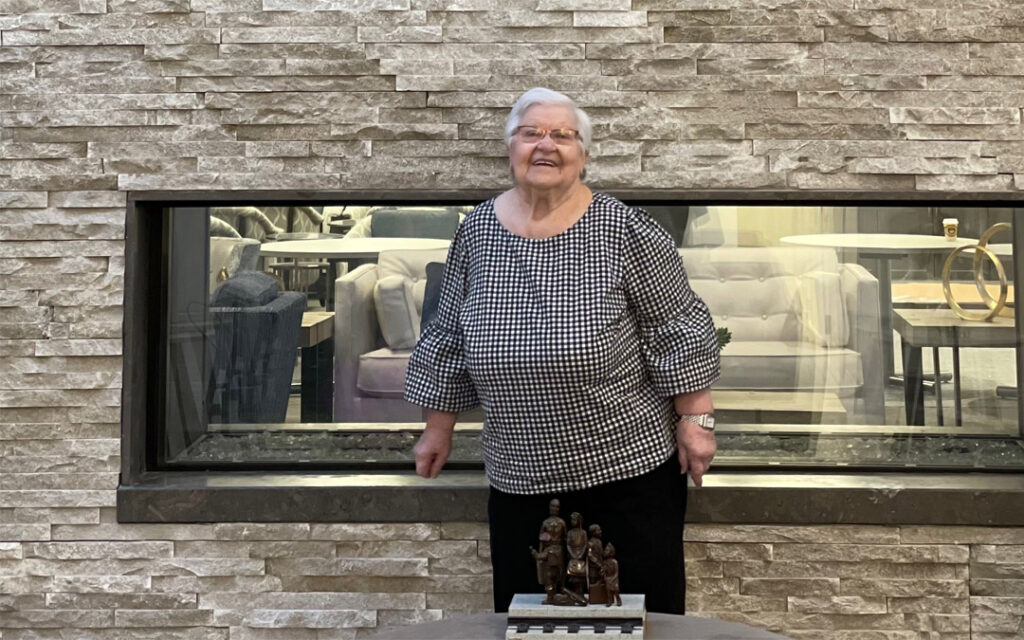
Eighty-four years ago, Sabina Suwalk Katz was one of the last Jewish children to board the Kindertransport, or children’s transport, from Poland to England.
Katz, who turned 96 on Mar. 3, was born in a small Polish town outside of Warsaw. She currently lives at Atrium Village in Owings Mills.
Both of Katz’s parents died during World War II. Her mother, Razel Suwalk, perished in a concentration camp while her father, Hertzel Suwalk, died in Buenos Aires.
After the war, Katz married an American soldier, Martin Katz, and came to the United States, where they raised their three children in Philadelphia.
Today, Katz is the grandmother of five and great-grandmother of three. She is described by her daughter, Baltimore resident Paula Diamond, as a woman of strength, compassion and fortitude.
Katz recently spoke to Jmore about her life and wartime experiences.
Jmore: What was your life like prior to the war?
Katz: I was an only child, and I was raised by my two loving and kind parents. We were a wonderful Jewish family.
I was never lonely as a child because there were always other children from my school and town close by. My mom would always make the Jewish holidays. We did not go to synagogue every week, but we kept Shabbat and lit candles every Friday night.
What is your earliest memory from the onset of the war?
I was seven years old when Kristallnacht happened [in November of 1938]. Things became very difficult and dangerous. My mom was attacked on the street, and things were thrown at her. We were very scared.
My dad left to get a visa in Buenos Aires. He was desperately trying to get my mom and me out of Poland and to the United States. My mom and I went to a seashore community between Germany and Poland called Danzig. It was considered to be a free state, and we felt that was the safest place for us while my father worked on securing visas.
How did you reach England?
My Jewish schoolmaster, Dr. Esh, was the one who brought me to England on the Kindertransport. Being on the train was exciting at the age of 12-and-a-half. I thought I was going to come back and see my mom.
Dr. Esh, who was the leader of the Kindertransport, pulled together 75 kids between the ages of 11 to 15, and we boarded the train to England. There were these two boys who fought with one another and broke a window on the train. After that, Dr. Esh told us not to go near any windows. He was extremely strict.
Once in Holland, Dr. Esh kept us away from everything because he was so afraid that there would be hatred for Jews and people would hurt us. We stayed overnight there and then took a boat into Liverpool.
What was life like while living in the English city of Birmingham?
The agency dispersed us kids to different English families, whoever volunteered to take refugees. It was supposed to be temporary, just until the war was over.
I lived with a family, the Fullers, for five years. They had two sons, and I was the only girl.
I did a lot of the domestic work for the family. I should have left, but I was too afraid. The Fullers were smart enough not to let me know where the refugee movement was. I knew nothing.
One day, I did something to displease Mrs. Fuller so she complained to Mrs. Smith, a woman from the refugee movement. After she finished complaining, I walked Mrs. Smith to the door and she said, “I am getting you out of here.” And she did. I went to a youth hostel with Dr. Esh and other refugees. In the bathroom, there were two kids sleeping in the sink, one in the bathtub, and one on the toilet.
This is how we lived, and I loved it because I was surrounded by Jewish people.
How has the Holocaust informed your perspective on humanity?
I never have become angry or mad. My whole life, I have been looking for the good in people. If I had not, who knows if I would have existed this long.
I had to take something very sad, and I did the best I could. We did the best we could.
Tomer Nusinov is a Jmore editorial staff intern.
A junior at Roland Park Country School, Katie Grossman writes about a recent experience that spurred her to take action to fight antisemitism.
Presented by Jews United for Justice and a consortium of local synagogues, "Beyond Welcoming the Stranger" offered a Jewish approach to helping immigrants.
John Singer wants to help Marylanders of all economic backgrounds to afford ankle foot orthoses.

At Krieger Schechter Day School, joining in the later elementary or middle school isn’t a setback -- it’s a launch pad.