
By Johns Hopkins Children’s Center
At Johns Hopkins Children’s Center, pediatric patients and their families seek care for a variety of reasons — some routine and others more serious. This week, patients and their families will share their Children’s Center experiences during Mix 106.5’s 33rd Annual Radiothon.
The Children’s Center’s largest fundraising event of the year aired on Thursday, Feb. 24, and will air on the Baltimore radio station on Friday, Feb. 25, from 6 a.m. to 7 p.m.
The contributions of Radiothon donors enable Children’s Center providers and staff members to offer world-class care to patients while supporting their families during times of need. During this year’s Radiothon, eight patients and their families will be featured.
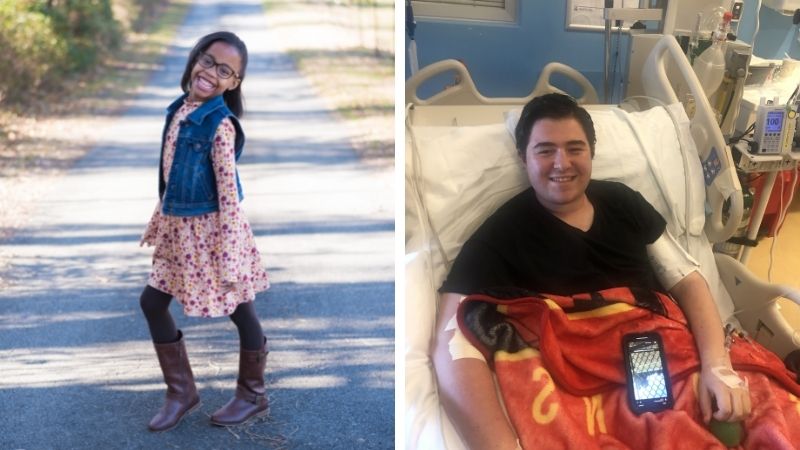
Among the patients are 17-year-old Noah Goldstein and 11-year-old Juliet Pace.
‘Strong and Resilient’
In 2011, Bel Air residents Bethany and Damon Pace brought home their baby girl, Juliet. That same day, they received a call with the news that Juliet had sickle cell anemia, a hereditary red blood cell disorder in which some blood cells are shaped like crescent moons, leaving a shortage of healthy red blood cells in the body and causing episodes of extreme pain and other severe complications.
“I was devastated because I honestly couldn’t process that this was really happening,” said Bethany Pace. “We saw our pediatrician, who said there is going to be nothing better than the care you are going to get from Johns Hopkins Children’s Center for Juliet.”
As an infant, Juliet began taking antibiotics and another medication daily to decrease the likelihood of a pain crisis or even a stroke. Because of the condition, Juliet is more prone to infections. When she was 6, Juliet had a high fever and developed pneumonia and acute chest syndrome, resulting in hospitalization for five days. Juliet needed a blood transfusion to give her body more healthy red blood cells to help her lungs get better.
More recently, she spent two days in the hospital for pneumonia and acute chest syndrome. She didn’t require a blood transfusion and is now doing better after a course of antibiotics. She continues to be monitored by Emily Rao, M.D., M.A., M.S., a pediatric hematologist at the Children’s Center. Juliet receives annual brain scans to monitor for strokes, and blood work is performed monthly to help ensure there are no other health concerns.
Her parents are hopeful that cures will become available to Juliet as she grows. In the meantime, Juliet “is absolutely living the life she is meant to have,” Bethany Pace said. “She is strong and resilient, and her illness doesn’t define her.”
‘I’m a Living Miracle’
In 2019, Northwest Baltimore resident Noah Goldstein was rushed to an area emergency room. After imaging determined he had a stroke, he was immediately transferred to the Children’s Center.
“That massive stroke took away the entire right side of his body, ability to walk, some of his cognitive abilities and also affected his speech,” said Noah’s mother, Jamie Goldstein.
With the help of physical, occupational and speech therapy, and visits with his physicians — including Ryan Felling, M.D., Ph.D., a pediatric neurologist and director of the pediatric stroke program at the Children’s Center — Noah’s condition improved.
Then, 19 months after the stroke, in April 2021, Noah experienced another stroke, causing double vision among other symptoms. Four weeks later, he had a third stroke, this time in his cerebellum, located in the back of the brain, causing swelling and possibly the need for brain surgery. The swelling soon subsided, and surgery was not necessary.
After several months of physical therapy, follow-up care with his physicians and the help of medication, Noah’s doctors say he is doing well.
Now 17 and a high school senior at the Boys’ Latin School of Maryland, Noah hasn’t returned to playing soccer and instead focuses on coaching elementary-school-age soccer players in his former soccer club.
He also hopes for a career in the medical field to help others with a condition similar to his. “I believe in miracles because I’m a living miracle,” Noah said. “Johns Hopkins Children’s Center has helped to give me my life back.”
Since beginning in 1990, the Radiothon event has raised more than $25 million for pediatric patients and their families.
In previous years, funds raised during the two-day Radiothon broadcast have helped purchase life-saving medical equipment, support patient care, fund important research, develop innovative tools and programs, and provide transportation to and from doctor’s appointments.
Funds have also been used to purchase books, toys, games, art supplies and more for young patients, to offer them an escape from what is anything but ordinary for a child.
To support this cause, please visit the donation website.
Presented by Jews United for Justice and a consortium of local synagogues, "Beyond Welcoming the Stranger" offered a Jewish approach to helping immigrants.
John Singer wants to help Marylanders of all economic backgrounds to afford ankle foot orthoses.
At Krieger Schechter Day School, joining in the later elementary or middle school isn’t a setback -- it’s a launch pad.
Steve Hofstetter, who will perform at Soundstage next week, recently made headlines for his social media post ridiculing some fans' warnings about Charm City's safety.