
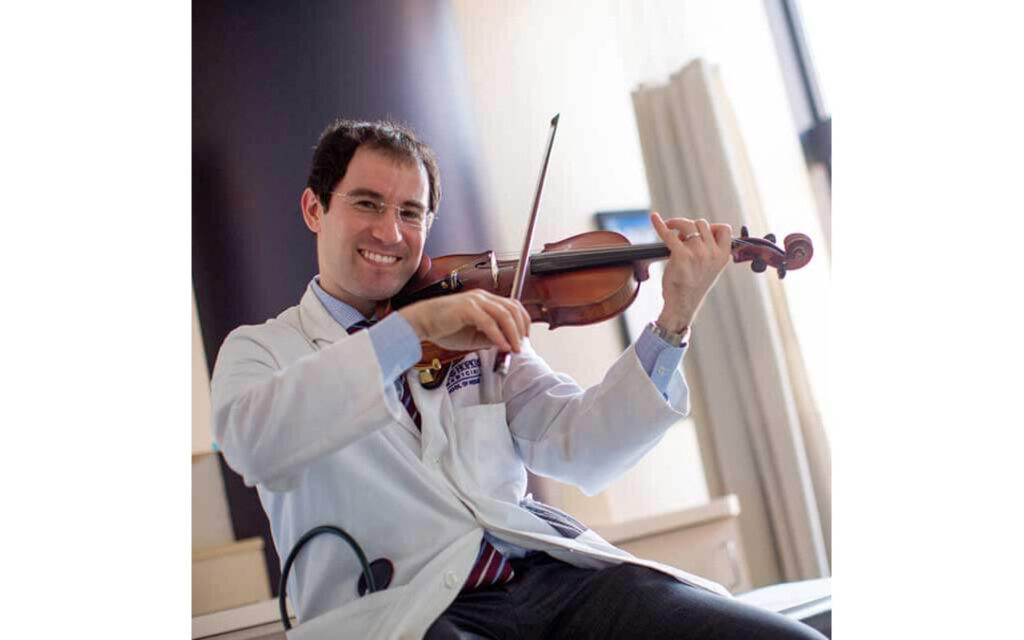
Not long ago, Dr. Alex Y. Pantelyat and his wife Brooke celebrated their wedding anniversary with a dinner at The Milton Inn in northern Baltimore County. While there, he couldn’t help but notice a Ukrainian flag proudly displayed at the upscale restaurant in between the American and French flags.
“It’s all a bit unreal,” Dr. Pantelyat said, “but unfortunately in a nightmarish way.”
A native of the Ukrainian capital of Kyiv, Dr. Pantelyat, who is an assistant professor of neurology at the Johns Hopkins University School of Medicine, has been closely monitoring events in his homeland since the Russian invasion began on Feb. 24.
He and his family moved to Philadelphia from Ukraine when he was 9. Dr. Pantelyat has lived in Baltimore since 2014.
Besides serving as director of the Atypical Parkinsonism Center at Hopkins, Dr. Pantelyat — an accomplished violinist who began studying the instrument at age 7 in Kyiv — is a co-founder and director of the Johns Hopkins Center for Music and Medicine.
A Pikesville resident and father of two young children, Dr. Pantelyat, 39, spoke with Jmore about his views on recent events in Ukraine.
Jmore: How would you sum up your feelings about what’s happening right now in Ukraine?
Dr. Pantelyat: Well, a lot of negative feelings. Scary words come to mind. It’s agonizing, terrifying, upsetting, because obviously [Russian President Vladimir] Putin has the capability of going well beyond Ukraine. It’s all pretty terrifying, and I do feel helpless here. You keep thinking, ‘What more can I do to help?’ It’s frustrating.
It takes a lot of my time just scrolling through all of the developments and getting information. I don’t know if I would say I’m losing sleep, but it’s all very upsetting and riveting. Patients have reached out to me and asked how they can help, and that’s been very heartening to me. People with absolutely no connection to Ukraine. It’s wonderful.
Did you anticipate this invasion?
No, I really didn’t think this would happen. I just thought it was a case of saber-rattling, since Putin was encouraged by the world’s inaction over Crimea in 2014.
Do you hear from family or friends in Ukraine?
No, I don’t actually have any friends and family left there. But my father, who lives in Australia now, certainly does and he’s very concerned about it all.
I always refer to myself as a Ukrainian Jew. My father’s Ukrainian identity in particular has grown a great deal since 2014 and the invasion of Crimea, and he has visited Ukraine in recent years.
Have you returned to Ukraine since immigrating here as a child?
No, I’ve not been back. My family has, but I haven’t. I came close when my wife and I went to Poland and we visited Krakow, which is right across the border from [the western Ukrainian city of] Lviv.
I guess there’s something to be said for looking back [at the past] with rose-colored glasses. But now a part of me wishes I’d gone back at some point.
Any memories of Kyiv?
Yes, it’s a beautiful city with many chestnut trees. I remember playing in a large park outside of my apartment building, running around with friends playing soccer. I do have a handful of fond memories. I remember the Black Sea and vacationing with my family in Crimea during the summer.
Your feelings about the international reaction to this crisis?
It’s been very heartening to see the positive reaction, especially here in America. [Actors] Mila Kunis and Ashton Kutcher have set up a GoFundMe page for Ukrainian refugees, and The Associated [Jewish Federation of Baltimore] has started a campaign, both of which I’ve donated to.
Clearly, it’s very important to support the Ukrainian people right now. They’re in the fight of their lives.
From your perspective, what does the average American not really understand about this conflict?
The key thing that people are missing — and this scares me a lot — is that the value of human life is very low in that region, especially if you look at Russian history and especially with Putin. He doesn’t care how many people die as long as he achieves his objective. It’s like a terrorist who blows themselves up and has no concern about death but wants to achieve their goal.
People not from that area of the world don’t understand that.
Is there any validity whatsoever to Putin’s claim that Russia and Ukraine are one nation?
There is some reasoning behind it, but it’s all been politicized. The ties do run very deep. This is like a civil war. But the Ukrainian people love their freedom, and the concept of an independent Ukraine goes back many centuries. There’s been a yearning for freedom there for centuries, a deep connection and strong sense of nationalism.
Ukrainians are a freedom-loving people. It’s been more than a generation of Ukrainians now who have experienced that freedom. They’re not just going to give that up. There is a strong sense of nationalism that goes way back.
Putin is not completely off-base when you look at the 70 years of Soviet rule. But 1991 [when the former Soviet Union collapsed] changed everything.
Does Ukraine’s long history of antisemitism affect your viewpoint about the country?
I think less so than my parents’ generation, but I do feel it. A deep antisemitism goes back to the pogroms and the Pale of Settlement, a deep-rooted antisemitism that was part of the populace and institutionalized throughout Ukraine’s history. Ukrainian nationalism has often been connected to antisemitism.
But at this point, it’s a humanitarian crisis we’re talking about here. No one has seen a crisis like this since World War II.
Do you agree with some observers and commentators that Putin is mentally unstable?
He knows what he’s doing, but I think he feels cornered now, with unrest at home and his need to hold onto absolute power. He always likes to say that Russia is alone and isolated in the world, and now Russia truly is isolated.
But I don’t think so far there is enough evidence [of mental instability].
Have you been as impressed with Ukrainian President Volodymyr Zelensky as the rest of the world?
It’s quite surreal how he was elected — a Jewish actor and comedian who played the Ukrainian president on TV and then won the presidency in a landslide against the incumbent.
I’m proud that he is Jewish. He has had multiple opportunities to leave and didn’t. I think he’s waging a very effective informational war with social media platforms against Putin and the Russians. He’s a hero to stand by his country the way he has, and he’s shown incredible resilience and true leadership. Nowadays, that’s rare.
But he was shortsighted. He ignored the reports from the West [about Russian plans to invade Ukraine]. Like me, he thought it was just saber-rattling.
Have you been impressed with the protests against the war inside of Russia?
It’s hard to say because you can’t believe all of the information coming out. There’s a lot of misinformation and propaganda out there.
I do get a sense that there are thousands of Russians protesting right now. But remember, it’s a country of 140 million. I don’t think that a real movement to remove Putin is remotely close. Brave people are speaking out. But what will it take to really stop Putin?
What can people here do to help Ukrainians?
We shouldn’t underestimate the smallest amount [of donations], even if it’s $20 or $25, because it all underscores the power of the many. It makes a difference. Also, people should stay informed and separate the propaganda from what’s actually happening on the ground.
What have you told your children about this conflict when they’ve asked?
They’re too young to understand, and I’m grateful for it. I’m glad they’re not aware of it, like with the pandemic itself.
Do you see any room for optimism in this crisis in the long run?
I am an optimist by nature, but I don’t think there’s much room for optimism here from a Ukrainian perspective. There’s not space for it right now. Thousands have perished, and there could be more unless it stops. Overnight, a new iron curtain has come down, a new geo-political reality.
But the European Union is now stronger than ever. They’re taking concrete steps, like lessening dependence on Russian energy sources. We need a strong Europe right now.
Your thoughts on the response of the Biden administration?
I think, for the most part, the response has been appropriate. But it all depends on what Americans are willing to deal with, especially at the pump. I do think that the sanctions [against Russia] and military aid [to Ukraine] have been the right general direction to support the Ukrainian people, while still avoiding World War III.

The nonprofit OneTable is reimagining its programming amid fiscal constraints and responding to what it sees as important shifts in how Jews gather.

The Jillian and Lindsay Wiener Short-Term Rental Safety Act requires rental companies to conduct annual fire inspections in Baltimore City and every Maryland county.

Reproductions of the murals, previously believed to have been lost, are now part of the Jewish Museum of Maryland's new permanent exhibition.
The donation will be directed to help foster research conducted by faculty at the University of Maryland School of Medicine and to advance innovative treatments.