
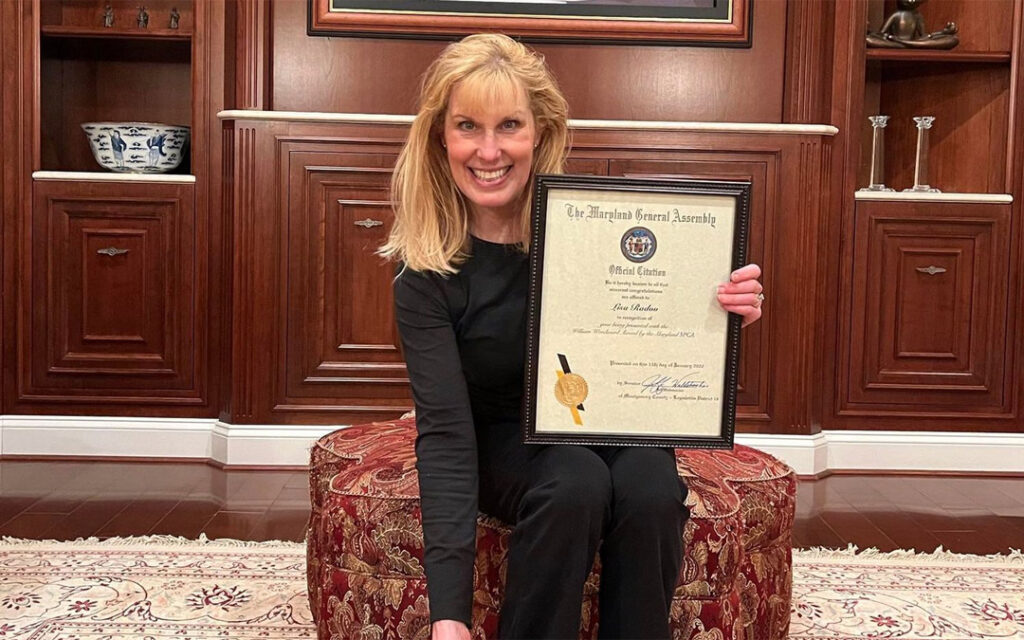
Lisa G. Radov has two primary passions in life: animals and public policy, all of which fit perfectly into her personal approach to tikkun olam, the Jewish precept of repairing the world.
“Animal issues don’t get too much of a spotlight, especially the legislative side,” says the Pikesville resident. “It’s so important to value the work between the communities and in Annapolis.”
For her work on behalf of lobbying for animal rights at the state level, Radov, president of the nonprofit Maryland Votes for Animals, was recently presented the William Woodward Award by the Maryland SPCA.
Named after the founder of the Maryland SPCA, the award was created in 2019 to mark 150 years of the organization’s service and dedication to pets and people.
“I am very honored to receive this award from the Maryland SPCA,” Radov says. “They are such a hard-working and dedicated group of people that do amazing work for animals and for the community at large.”
Radov, who grew up in Lutherville and is a mother of four, currently serves on the Mayor’s Anti-Animal Abuse Commission. She is also a board member of the nonprofits Civic Works and Common Cause.
Radov admits that her journey to becoming an impassioned animal rights activist was an unusual one. Earlier in her life, she was the co-owner and director of marketing at her family business, GEBCO Insurance Associates, from 1986 to 2016, as well as a certified yoga instructor.
She says her involvement in animal rights activism began at the age of 8 when learning of the slaughter of baby harp seals in Canada.
“I’ve always been an animal lover, always been active politically,” she says. “But my youngest daughter was interested in going into veterinary medicine and she started volunteering at BARCS [the Baltimore Animal Rescue and Care Shelter].”
In 2013, Radov and her daughter, Susan, attended an event in Annapolis called Maryland Humane Lobby Day sponsored by the Humane Society of the United States and Maryland Votes for Animals.
“I immediately thought, ‘Wow! I want to get involved at Maryland Votes for Animals,’” she recalls. “I got on the board and next thing I knew I was president and chairman interacting with those around the country to advocate for animal rights.”
Since 2016, Radov has worked tirelessly on various animal rights issues, most notably the Maryland Spay/Neuter Fund, which provides grants to local governments and animal welfare organizations to provide free spay and neuter services to low-income Marylanders and for the care of colonies of feral cats.
“It is the only program in the country like this and it’s funded solely by pet food companies,” Radov says. “We get almost a million dollars a year, and it costs the taxpayers nothing.”
This year, Radov hopes for the passage of a state law to provide shelters to dogs in extreme weather conditions. She has also been working on the Wildlife Trafficking Bill, which prohibits the sale of parts or products from endangered species within Maryland. Such sales are illegal by federal law between states, but the loophole is the items can be sold intrastate.
In addition, Radov was involved in statewide legislative efforts to prevent the declawing of cats by veterinarians unless it is medically necessary. In early March, the Maryland House of Delegates and State Senate passed the law, becoming the second state in the nation to take such a measure.
Radov says her passion for animal rights stems from “my philosophy that we are all related, we’re all creatures of the earth — people, animals, creatures of the earth.
“Whether a person is connected because they love their dog or their cat or care about wildlife and are concerned of chemicals and pesticides, it’s all related.”
Radov encourages those interested in animal rights advocacy to visit the website voteanimals.org or check out the social media platforms for Maryland Votes for Animals.
“If you care about animals and care about these issues, it’s a good way to see what kind of legislation is happening in Maryland, and your legislators want to hear from you,” she says. “This year is an election year, so it’s a really good time to let legislators know what’s important to you.”
Nicholas Elliott is a Jmore editorial staff intern.
A junior at Roland Park Country School, Katie Grossman writes about a recent experience that spurred her to take action to fight antisemitism.
Presented by Jews United for Justice and a consortium of local synagogues, "Beyond Welcoming the Stranger" offered a Jewish approach to helping immigrants.
John Singer wants to help Marylanders of all economic backgrounds to afford ankle foot orthoses.

At Krieger Schechter Day School, joining in the later elementary or middle school isn’t a setback -- it’s a launch pad.