
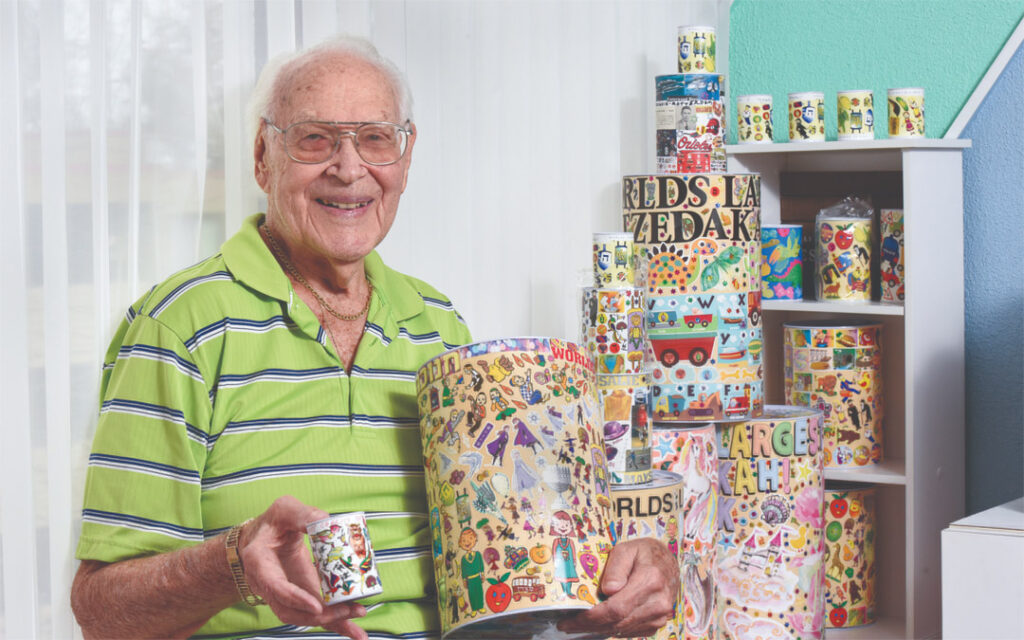
Maurice “Maysh” Fried has a system for producing his handcrafted tzedakah boxes at lightning speed. “I can watch TV and make 50 in one evening,” he says. “There’s a secret to making them that fast. But like I said, it’s a secret.”
Then, he pauses. “Well, I do drink every day,” the 95-year-old Pikesville resident says with a devilish gleam in his eye. “And I’m not talking about water either.”
Fried loves to kid around. But when it comes to creating customized charity containers, he’s all business.
A Beth El congregant and father of three, grandfather of seven and great-grandfather of 13, Fried has been making tzedakah boxes since the passing of his wife, Frona, in January of 2014. He estimates he makes between 400 and 800 annually and gives them away to synagogues, Jewish religious schools, sisterhoods, men’s clubs and other groups here and in Boynton Beach, Fla., where Fried lives part of the year with his girlfriend, Rosalie Raim.
Local beneficiaries include Chizuk Amuno Synagogue, Covenant Guild, Talmudical Academy and Hadassah. And that’s not including the people who receive his creations on an individual basis while Fried, an inveterate world traveler, is moving around the community and globe.
“Every time one of our kids comes over or someone else, he gives them something from that shelf,” says Raim, pointing to an area in the den/workroom where Fried keeps his tzedakah boxes lined up in assembly-line fashion.
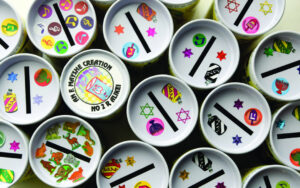
Most of the boxes are small, circular metal containers purchased by Fried in bulk from a Chicago distributor. He then artfully places stickers and decals – many of them featuring Jewish symbols and holiday themes – on the containers, as well as creative renderings of something personal for recipients. He laminates the wraparounds for the containers with assistance from his grandson, Cory Mindel, who works in the lamination field.
“What Maysh does is get information about people and researches them and puts it all on the tzedakah boxes,” Raim says. “Little things that people appreciate like their kids’ names, their colleges, something that shows a history of who they are.”
An example, she says, is Fried’s cardiologist in Florida, Dr. Michael L. Metzger, who received a tzedakah box from him recently featuring the doctor’s alma mater’s colors and insignia. Fried also gave a tzedakah box to Beth El’s Rabbi Steve Schwartz featuring a pair of his passions, the Grateful Dead and Scotch whiskey.
Raim says the tzedakah boxes are a manifestation of Fried’s spirit of generosity and gratitude.
“Maysh is the kind of person who wakes up every morning and the world is great. He’s an optimist,” she says. “He’s never boastful, a very unassuming person.”
Fried sums himself up this way: “I’ve been very lucky my whole life. Nothing bad has ever really happened to me. Well, bankruptcy once. But it wasn’t too bad.”
Good With Wood
A Baltimore City College graduate and World War II veteran, Fried grew up near West Baltimore’s Easterwood Park and attended the old Har Zion Synagogue on North Avenue. His father was a painter and wallpaper hanger, while his mother “was the neighborhood politician. She took care of the rich and the poor.”
Fried discovered his creative streak while attending Gwynns Falls Junior High School. “I was around 11 or 12, and my mother gave me my allowance of $2 for getting to school,” he recalls. “But instead, I got a little block of wood, sanded it down, painted it red, white and blue, stained it and put your name on it with letters from alphabet soup, and would sell them for $2 each. That’s how I made some extra money. I liked to fool around with woodwork and make corner cabinets, too. I’ve always been handy with tools and woodwork.”
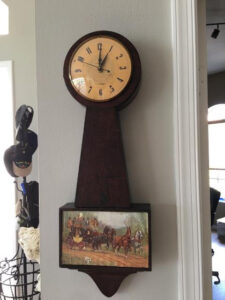
One time in woodshop class, Fried made a mahogany clock for his mother; it now hangs in the living room of his daughter, Denise, in Florida. “I was always the most artistic one in my family,” he says.
After getting married at a young age, Fried bought and took over a downtown furniture and variety store co-owned by his father-in-law. Fried decided to start selling toys as well, and the business boomed.
“It was a very good business to be in. Remember, there was no Toys ‘R’ Us back then,” he says. “It just clicked and I did well. I had 11 or 12 stores in the area at one point.”
After retiring, Fried immersed himself in making multi-layered three-dimensional collage art. What began as a hobby evolved into a fairly lucrative side business, with his recycled, customized Monopoly boards fetching top dollar from serious art collectors.
“I taught myself how to do it, and I started doing shows and they really started selling,” he says. “At the time, I was living in Florida and had a big garage with a worktable. I had museum exhibitions and art shows from Coconut Grove to Jupiter. I did it for fun, for about 20 years.”
But after the death of his wife, Fried quit his life as a semi-professional artist. “After Frona died, I just wanted to do something charitable for the community,” he says. “So I decided to make these tzedakah boxes and give them away to schools and different groups and shuls.”
Fried estimates he spends approximately $400 annually on his avocation, and he always gives away the tzedakah boxes for free.
“I don’t tell my accountant about it,” he says with a chuckle. “I do it because it’s fun for me and a good lesson for kids.”
‘Kind and Meaningful Gift’
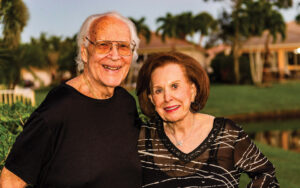
Maysh Fried and Rosalie Raim (Photo by Dr. Michael L. Metzger)
Occasionally, Fried drops by schools to observe the reactions among students to his creations. “I get a lot of great feedback from people,” he says. “The kids often send pictures and thank-you notes. Some people ask to have one for their grandchildren.”
One member of the community, Pikesville resident Cantor Shazy King, even made Fried a carrot cake after receiving one of his customized tzedakah boxes.
“I met him this past fall at a Beth El brotherhood event,” she says. “The thing that makes the boxes special is he finds out things about the person and designs them for the person. In my case, music, birds and Judaic symbols. … It was a very kind and meaningful gift.”
Fried says he hopes to pass on his knowledge of making personalized tzedakah boxes to someone younger to keep the tradition alive. But he shrugs off all lofty accolades or compliments.
“It’s just a mitzvah I do for the community,” he says. “I don’t do it for the glory. This keeps me busy and out of trouble.”
Who says it's ever too late to find love? Just ask Rosalie Raim, 91, and Maurice "Maysh" Fried, 94, who started dating three years ago.
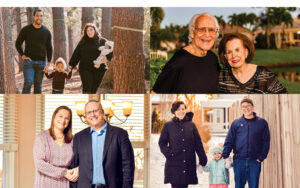
Since February is the month when folks tend to think about relationships, romance and love, Jmore offers its annual "Love Issue," profiling four couples who somehow make it all work and embody the Jewish proverb, "Only love gives us the taste of eternity."