
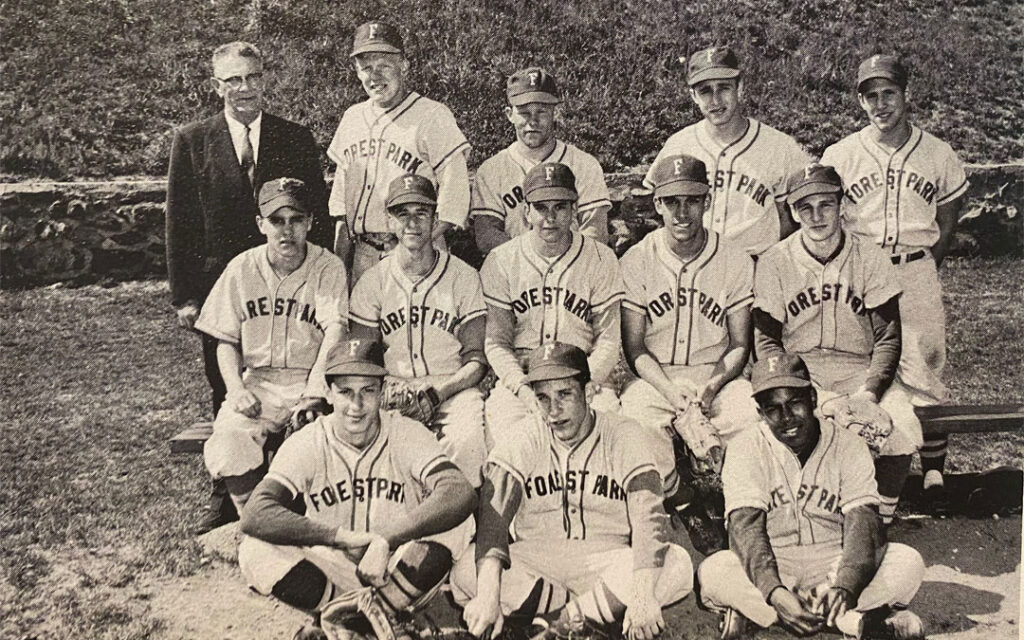
In the crowded streets and schoolyards of mid-20th century Northwest Baltimore, Bob Meyer stood tall. He was 5-feet-5. But almost nobody in that time and place seemed so imposing on a football field or baseball diamond or in a street fight.
In his old neighborhood, off Rogers Avenue behind the Arlington Cemetery of Chizuk Amuno, or anywhere around Forest Park High School, he was an earth force nicknamed “Monk” for his dexterity and “Dynamite” for his raw electric power.
When I called Ron Sallow a few nights ago, with the news that our old neighborhood pal had died at 80 after heart trouble, Ron responded impulsively.
“No,” he said. “No. No. He was too tough to die.”
How tough was he? One day, Bob walked into the old Read’s Drug Store at Gwynn Oak Junction. He spotted a few guys from Woodlawn in the back. They were known street toughs. Bob was known — for good reason — as a block of dynamite who’d beat hell out of the biggest bullies.
Now he walked up to the Woodlawn guys and demanded, “What’s my name?”
“Mr. Meyer,” they said, making it sound like an apology.
At this time, Bob was 14.
He was tough beyond the measuring. How else, at his size, could he have played middle linebacker and running back for Forest Park’s varsity football team? He was 135 pounds of burnished steel.
“Monk,” said his old coach, Milt Lumsden, “if you had five more inches, you’d have 60 scholarship offers to play college football.”
Football’s loss might have been baseball’s gain. The Boston Red Sox were scouting Bob when he was a 10th-grader on Forest Park’s baseball team. He made All-Metro that year. One game, he stole five bases.
Adolescence is a time of fantasy, and Bob’s athletic stardom brought accompanying benefits.
“At lunchtime in the cafeteria,” said Marilyn Nusenko, “the girls were always gathered around him, trying to get close to him. Believe me, he was adored.” She went to Forest Park back then, and her late husband, Stanley, lived on the same Crawford Avenue as Bob.
Late afternoons, after football practice, Bob would walk home along Liberty Heights Avenue. He’d lug his helmet and pads. When he’d reach Gwynn Oak Junction, there was invariably some schoolmate with a crush on him waiting there.
“Can I help you carry those?” they’d ask.
But it was the former Joyce Bank who won his heart. She called here the other night from their home in Davenport, Florida, to say Bob died. He’d been on oxygen for the past year. She and Bob were a few months shy of their 60th wedding anniversary. They had three kids, seven grandchildren and two great-grandchildren.
She remembered how she met Bob on a blind date.
“My girlfriend, Sharon Robinson, was dating Don Gallon,” who pitched for Forest Park and later went to AAA ball in the Orioles’ farm system. “Sharon said, ‘Do you want to go out with Bob Meyer? We’ll double.’ I couldn’t believe it. I had a crush on him since I first saw him play football. I said, ‘I’ll be a nervous wreck.’”
Instead, they hit it off. Joyce was still there when old dreams died and new ones had to be nurtured. She was with him through all of it.
He came from a family of terrific athletes. Two brothers, Alvin and Irv, preceded him at Forest Park and played football there. Alvin later made Little All-America at the old Baltimore Junior College.
And their father, Maurice, was a world-class sprinter who’d finished second to Jesse Owens at the 1936 Penn Relays. Maurice qualified for the Berlin Olympics, where a furious Hitler watched Owens win four medals.
Maurice stayed home. His mother saw what was coming. She told her son, “Germany is not the place for you.”
A quarter-century after that, still nurturing his baseball dreams, young Bob hurt his arm, throwing hard in cold weather. The arm was shot, the power was gone, and so were the baseball scouts who’d once watched him carefully.
When Bob and I last talked a couple of weeks ago, he remembered when the dream seemed close enough to touch.
“For a while,” he said softly, “it was fabulous, just lying in bed every night imagining playing big-league ball. I mean, I was so sure.” Then came the arm injury. At first, “I couldn’t figure out what was going on. You know, you’re a kid, and you don’t understand.”
After high school, he and Joyce married. Bob spent his career working for the U.S. Postal Service.
“For years,” he said, “even after I got out of high school, I’d think about playing in the big leagues. It takes a long time to work it out of your system. You go out to any ballpark, you see the old men sitting there, and they’re still living it.”
In our adolescence, a bunch of the neighborhood gang would grab the bus down to Memorial Stadium to watch the Orioles. Traffic inevitably backed up as University Parkway turned into 33rd Street, so Bob would hop off the bus and sprint the rest of the way. He couldn’t wait.
“The game doesn’t start for another hour,” we’d holler at him.
“I know,” he’d call back, “but I don’t want to miss batting practice.”
Or maybe he was just racing after his dream.
Bob’s not the first guy from the old neighborhood who’s slipped away. The departed are gaining numbers, and they’re waiting for Bob now. Lord, they’re gonna have some ballgames up there.
Michael Olesker’s latest book, “Boogie: Life on A Merry-Go-Round,” was recently published by Apprentice House. It’s the life story of Baltimore legend Leonard “Boogie” Weinglass, an original “Diner” guy who grew up to create the Merry-Go-Round clothing chain and contribute millions to charity.
As millions mourn the passing of Stephen Colbert from the airwaves, Michael Olesker looks back on the "institution" of late-night TV.

As he gets ready to leave for California, Rabbi Daniel Cotzin Burg looks back on his time in Baltimore and his 10 years writing for Jmore.
Michael Olesker pays tribute to WJZ’s retiring Marty Bass, a longtime fixture on local TV screens.