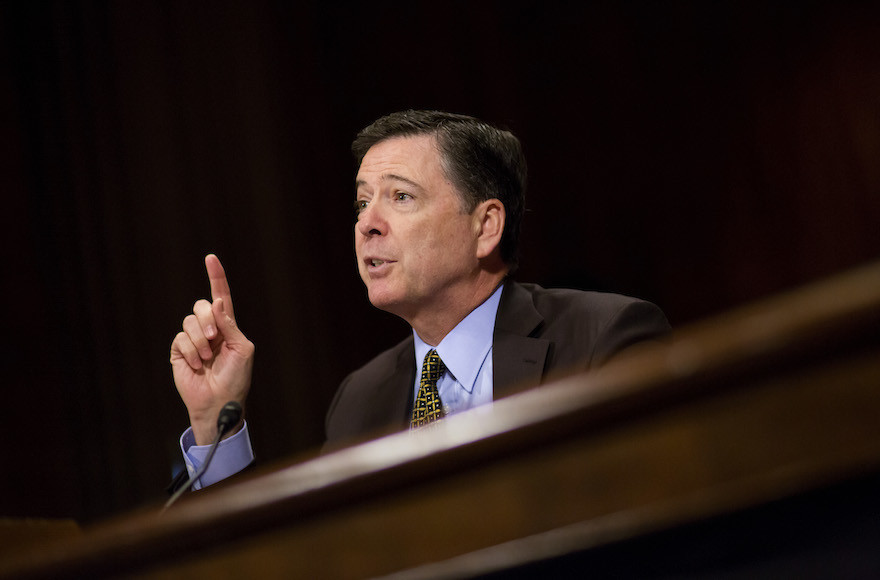
From the moment Washington went into convulsions this week over President Donald Trump’s firing of FBI Director James Comey, the comparisons came fast and furious to Richard Nixon’s “Saturday Night Massacre” of more than four decades ago.
But there’s an important distinction to be made, which this president must have known when he went public with his breath-taking action.
When Nixon fired Special Prosecutor Archibald Cox, and fell ever deeper into the swamp of Watergate, he specifically blamed his action on Cox trying to get too close to the White House itself. Cox wanted possession of Nixon’s famous Oval Office tapes and other presidential materials.
The excuse for that firing immediately became the closest thing we had, up to that point, to a smoking gun – a signal that Nixon was in full, frantic cover-up.
But in the current president’s cover letter explaining this week’s firing, he blames Comey not for investigating Trump or his closest aides but for mishandling the FBI’s investigation of Hillary Clinton.
In other words, folks, we shouldn’t imagine this firing has anything to do with the hypersensitive Trump getting a little nervous or with the tightening probe of any Trump-Russia connections.
No, no, not at all.
Instead, this same president who, for months, cheered on Comey and the FBI for pressuring Clinton … this same president whose press secretary, Sean Spicer, said only a week ago that Trump still had confidence in Comey … this same president suddenly decided to be magnanimous about poor Hillary Clinton and fire the man who might have cost her the election against Trump.
And just to make abundantly clear that the firing had nothing to do with any investigation of Trump himself, the current president said that Comey had told him “three times” that he himself was not a target of the FBI.
This raises a couple more points, to wit:
Do we believe Trump, who has consistently exhibited only an occasional ability to tell the truth?
And what was Comey doing, having conversations about an FBI investigation with a potential target of that very investigation?
By Wednesday afternoon, though, stories were surfacing that indicate Trump might have been prompted by feeling a lot more heat than we’d previously suspected.
Four congressional officials, including Sen. Richard Durbin (D-Ill.), informed the New York Times and Washington Post that just days before Comey was fired, he asked the Justice Department for a significant increase in resources for the bureau’s investigation into Russia’s influence in the presidential election.
Maybe that’s why the White House now says Trump was “losing confidence” in Comey and felt he had to go.
But there’s one more comparison to be made between Trump’s Tuesday afternoon tantrum and Nixon’s “Saturday Night Massacre.” Nixon told his attorney general, Elliot Richardson, to do the firing of Cox. Richardson refused, and was fired for it. So Nixon told Richardson’s deputy, William Ruckelshaus, to do it. He, too, refused and was fired for it.
These were men of principle, acting on behalf of justice. We’ll soon find out if we still have such people inhabiting the halls of power in Washington, D.C.
 A former Baltimore Sun columnist and WJZ-TV commentator, Michael Olesker is the author of six books, most recently “Front Stoops in the Fifties: Baltimore Legends Come of Age” (Johns Hopkins University Press).
Also see:
- Monday’s Testimonies by Yates and Clapper Raise More Questions
- James Comey Had Admirers Among Jewish Defense Officials
- How Will History Judge James Comey’s Decision?

The former Colt, who passed away on May 25 at age 93, achieved immortality during a cold December day in 1958, writes Michael Olesker.
A new biography on the creator of "Doonesbury" misses the mark, writes Michael Olesker.
As millions mourn the passing of Stephen Colbert from the airwaves, Michael Olesker looks back on the "institution" of late-night TV.