
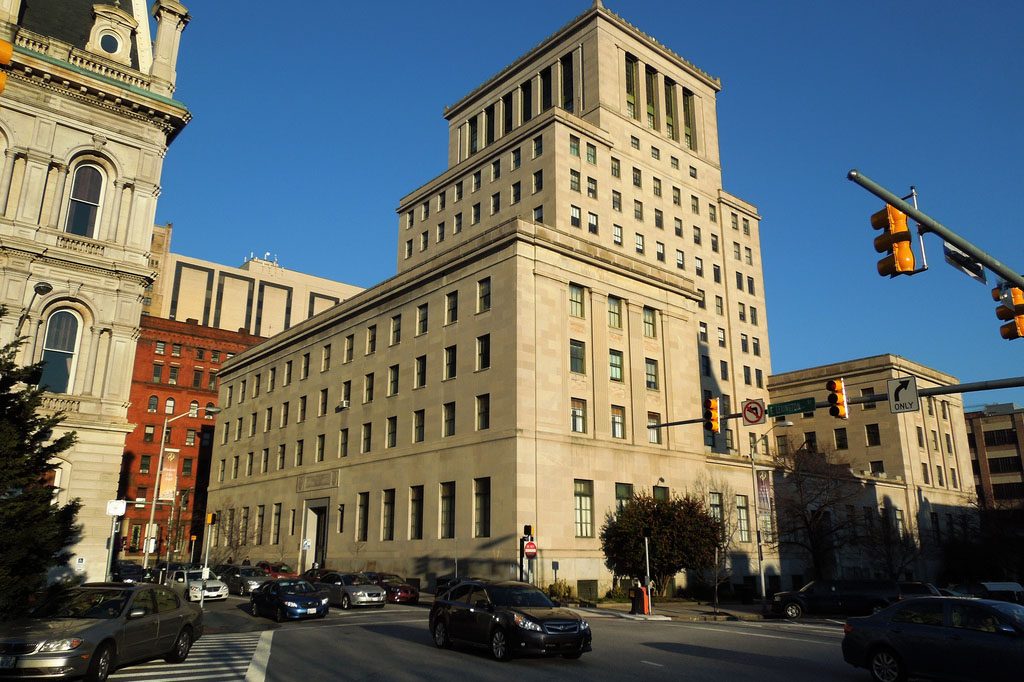
Elsa Wolman Katana’s earliest memory of her grandfather — a giant of 20th-century engineering and a lifelong Baltimorean rarely seen without his bow tie — goes back to the garden of his home at 3213 N. Charles St., “a gem of a little house” in the opinion of the Baltimore Architecture Foundation.
Elsa was about 3 back then, the year Elvis released “Heartbreak Hotel.” She remembers playing in the fallen leaves with her grandmother, while Grandpa and her dad sat nearby on the lawn, deep in “the conversation,” a lifetime father-and-son dialogue about everything under the sun (and below the ground) between two Johns Hopkins professors named Wolman.
The younger man was M. Gordon “Reds” Wolman, a professor of geography engaged in the earth sciences. And Grandpa was the venerated Abel Wolman (1892-1989), a City College graduate called “the father of modern plumbing” for his visionary work in water resources and public health.
Abel, who died 29 years ago last month at age 96, brought about the standardization of chlorinated drinking water (with chemist Linn H. Enslow), advised more than 50 foreign governments on public water policy and in 1975 was awarded a National Medal of Science.
At the time young Elsa was playing in the leaves behind the four-level house designed by Laurence Hall Fowler (architect of the War Memorial Plaza building), Abel was chair of the advisory council planning Israel’s 81-mile-long “national water carrier” project.
His lectures on water and how best to bring it to a thirsty world took Abel Wolman around the globe, including an address to the World Health Organization, which honored him with its “Health for All” medal.
But Baltimore — where he was born, educated, worked, played violin as his wife Anna accompanied him on piano, raised a family, gave freely to charity and died — was the speck of earth that Abel loved most.
“I was living in Israel when he died,” said Elsa, now 64. “Not long before that, he sent me a letter saying, ‘I hope you’ll come home one day.’”
By home, Abel did not simply mean the United States. He wanted Elsa to return to the place of his heart, the Queen City of the Patapsco River.
For generations, Baltimore’s tap water has been celebrated for its excellence. In my youth, I often heard my Polish grandparents (east-siders, like Abel in his youth) proudly say it was the best in the nation, though I did not learn who was responsible for it until I became a reporter.
The water about which Abel advised nine Crabtown mayors is so clean and sweet that my friend Willie Matricciani will often run some into a wine glass, sniff the bouquet, take a judicious sip and, like a smarty-pants sommelier, declare, “Ah, north end of the Loch Raven Reservoir …”
If ever you have occasion to pay your water bill in person, look up as you enter the building just north of City Hall at 200 N. Holliday St. There, between a pair of bas-relief carvings of the seal of Baltimore, are the words, ABEL WOLMAN MUNICIPAL BUILDING.
The man for whom Baltimore named the public works building in 1986 — “a practical man with far-reaching vision for the world, an optimist,” said Elsa — was proud to be Jewish but not religious. Which is fascinating in light of rabbinic wisdom held for millennium: “There is no water except for Torah.”
As a scientist, Abel knew the more recent adage that man does not live by bread alone was only half of the equation. We need something pure and safe to wash it down.
In 1993, Johns Hopkins University bought the gem that Abel Wolman commissioned in 1938 and named the house in his honor. And though the purchase made sense for the school where Abel established and chaired the Department of Sanitary Engineering, the 3200 block of N. Charles St. was never the same for Elsa.
“There was a huge magnolia tree in the back. It had blossoms that were as big as both your hands put together,” she said, the yard now a parking lot. “I cried and took pictures while they took it down.”
Rafael Alvarez can be reached via orlo.leini@gmail.com.
A lifelong Orioles fan, Jmore Publisher Scott Rifkin, M.D., shares a message to Orioles owner David Rubenstein.
Attorney and Barry Levinson confidante Donald Saiontz left his mark on the world, writes Michael Olesker.

When we create a world with a warm and loving connection, even when someone beloved is gone, that relationship is carried on, writes Pamela R. Weissman.

The Orioles this season have proven that money can't buy happiness, writes Michael Olesker.