

On street corners across Northwest Baltimore near Pimlico Race Course, you can hardly throw a rock without hitting a sign hammered into the ground reading, “Community Meeting About Pimlico. Tuesday, April 10, 7:30 p.m. Mt.Washington Pediatric Hospital.”

Nobody in the neighborhood needs an explanation – and, by “neighborhood,” we’re talking about the northwest side of Pimlico Race Course that stretches alongside Northern Parkway from Park Heights Avenue down to Falls Road.
Everybody’s wondering about Pimlico Race Course, whose future seems tied not only to the tortured demise of thoroughbred horse racing in Maryland but to the track’s uses if ownership decides to shut Old Hilltop down.
It’s been operating as a racetrack since 1870. So computing the odds, and doing some simple arithmetic, what’s the likelihood that Pimlico will still be around to celebrate its 150th birthday two years from now?
Maybe a 150-to-1 shot?
For years now, the track’s only money-making day has been the Preakness Stakes, when upwards of 100,000 spectators and network TV cameras arrive. The TV cameras are there to record racing history. Many of the spectators are there to party. The horse racing’s strictly an excuse to hang out and let a few wayward inhibitions loose.
But as it approaches its 150th birthday, the track is showing its age, and a year ago a report was issued declaring it needed about $300 million in upgrades.
Who’s to pay for it? If you were facing such a prospect, would you sink that kind of money in a track that only hosts live racing a relative handful of days each year – and the sport itself seems to be hanging on mainly because we try to be nice to our elders?
So the problem becomes this: If they shut the place down, what’s to replace it? And what does that mean to that big area just northwest of the track, whose residents rarely visit the place but perceive its value in another way – it’s a buffer, a safety zone, between the stable, middle-class homes around Mount Washington and that part of Park Heights Avenue extending below the track all the way to Park Circle?
That’s the area characterized, for nearly half a century now, by high crime, drug trafficking, decayed housing and intractable poverty – while a succession of mayors, including the current one, have all expressed promises to renovate the area.
How successful have they been?
The answer to that can be found in all those street corner signs hammered into the ground in recent weeks – and the crowd expected Tuesday evening to talk about the future of Pimlico Race Course, and what it means for more than a few surrounding communities.
A former Baltimore Sun columnist and WJZ-TV commentator, Michael Olesker is the author of six books. His most recent, “Front Stoops in the Fifties: Baltimore Legends Come of Age,” has just been re-issued in paperback by the Johns Hopkins University Press.
In Italy, the Jewish Brigade's flag has unfairly become a flashpoint in today’s battles over Zionism and anti-fascism, writes Dr. Ginaluca Fantoni.
At its annual meeting this year, the Baltimore Jewish Council will honor the late Harford County educator and longtime Holocaust education champion.
The former Colt, who passed away on May 25 at age 93, achieved immortality during a cold December day in 1958, writes Michael Olesker.
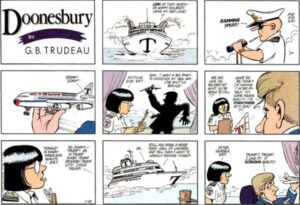
A new biography on the creator of "Doonesbury" misses the mark, writes Michael Olesker.