
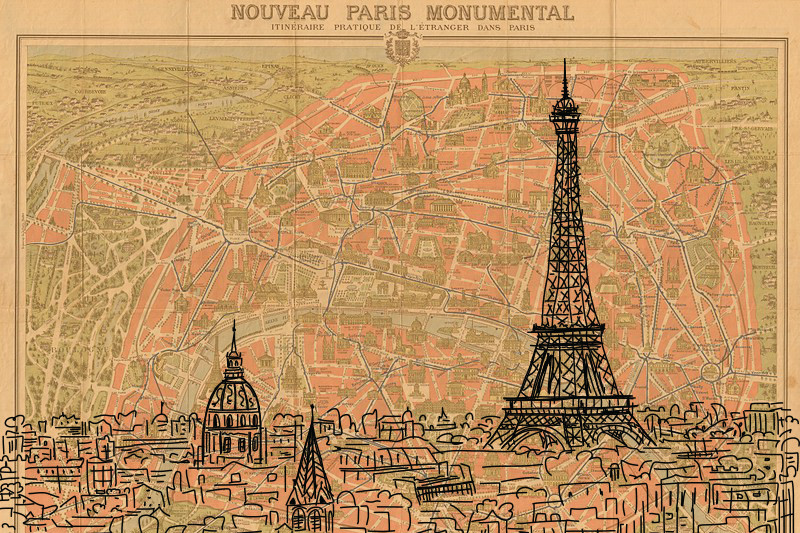
We were in Paris last week when a trans-Atlantic telephone conversation with a friend slipped us the latest bad news about bloodshed back home.
A Baltimore County police officer, Amy S. Caprio, was killed when a 16-year old kid named Dawnta Harris ran her over with a stolen Jeep Wrangler. Caprio was attempting to disrupt Harris and three pals “from the city” from some house-breaking activities out in Perry Hall.
That’s a key phrase — “from the city.” It’s a kind of racial shorthand, as everybody knows, but it also hints that the grotesque levels of city violence are not confined by any map lines separating city from county.
So we heard the news from home, and we looked around the radiant city of Paris, which charmed us for the obvious reasons – every street seems a work of art, every bridge and bistro and boulevard an expression of a love affair between its citizens and their environs – and we automatically made comparisons.
Paris has, at last count, 2.2 million people, and about 10.5 million people when you include its suburbs. The city of Baltimore has just over 600,000 people, and the metro area roughly 2.8 million. France’s population is 67 million. Maryland’s is about 6 million.
And yet, with one-fourth of Paris’s population, the city of Baltimore averages about 300 murders a year. With one-tenth of France’s population, Maryland averages about 500 murders a year.
Across the entire nation of France, they average about 125 homicides a year.
Obviously, neither a city nor a suburb is judged strictly by its violence. But it’s a measure. It measures not only a culture of anger and dissolution, but a level of generalized fear.
We spent 10 days in Paris — my wife and me, and another couple – and we walked the streets day and night, and not for a single instance did any of us feel the slightest shiver of anxiety.
In fact, much of the time, the streets were filled late into the night. One night, there was a bicycle race that started at 11 o’clock. There were roller skaters everywhere, and couples snuggling along the Seine. The sky itself seemed alit all night long.
Oh, and one other thing: not only were there lots of uniformed police quite visible at all hours, but French soldiers wielding high-powered rifles as well. The sight of them jarred us at first – military presence in live-and-let-live Paris?
When I asked a couple of shopkeepers about this, they beamed. Yes, yes, they said, of course we have them. This is Paris, after all. We’ve had terrorism here. We like the protection.
Well, there’s Paris’s random terrorism – and there’s the routine, everyday terrorism that you find around Baltimore. Am I suggesting we bring in the military full-time?
Nope, I’m just reporting it, and wondering how heartbreaking the violence has to get around here before we realize that whatever it is we’ve been doing – it just isn’t working.
 A former Baltimore Sun columnist and WJZ-TV commentator, Michael Olesker is the author of six books. His most recent, “Front Stoops in the Fifties: Baltimore Legends Come of Age,” published by the Johns Hopkins University Press, is now in paperback.
In Italy, the Jewish Brigade's flag has unfairly become a flashpoint in today’s battles over Zionism and anti-fascism, writes Dr. Ginaluca Fantoni.

At its annual meeting this year, the Baltimore Jewish Council will honor the late Harford County educator and longtime Holocaust education champion.

The former Colt, who passed away on May 25 at age 93, achieved immortality during a cold December day in 1958, writes Michael Olesker.

A new biography on the creator of "Doonesbury" misses the mark, writes Michael Olesker.