

When Julie Blumenfeld thinks about her strong Jewish identity, she often looks back to her childhood. Growing up in Savannah, Ga., raised by parents who were active in Jewish communal life, she fondly recalls how her early connection to Jewish tradition helped shape her life.
“I remember there was not a doubt in my mind that when I went away to college, I would get involved with Hillel and Jewish student organizations,” says Blumenfeld. “I think that being introduced to Judaism at a young age, it was natural that it became an integral part of who I am.”
Today, this mother of three, who is active in IMPACT, The Associated: Jewish Community Federation of Baltimore’s young adult division, is making sure she is introducing Judaism to her young children. She has enrolled her children in Jewish preschool, celebrates an early Shabbat dinner each Friday with them and incorporates tzedakah into her family routine.
Research shows that early childhood experiences (birth to five years old) play a significant role in a child’s development. Therefore, when we teach our youngest children about Shabbat, the Jewish holidays and Jewish values, it has the potential to inspire them and foster a long-term connection to their Jewish heritage.
“The younger your child begins to experience the world through a Jewish lens, the more likely they will identify Jewishly as an adult,” says Brenda Footer, director of PJ Library at the Macks Center for Jewish Education (CJE), an agency of The Associated.
Recognizing that early Jewish education is crucial to the development of a strong Jewish identity, The Associated, through its network of agencies, provides countless opportunities for positive connections.
Each year, The Associated funds PJ Library in Baltimore, with more than 3,000 Baltimore children receiving a free Jewish book each month through CJE. These award-winning books, designed for children six months to eight years old celebrate Jewish culture, tradition and values.
In addition, through several of its agencies, including CJE, the JCC and the Pearlstone Center, The Associated supports Jewish early childhood Jewish programming both in and out of the classroom.
Successful preschool programs are multi-sensory experiences that allow youngsters to touch, smell, taste, feel and hear what they are discovering, explains Judy Bickford, assistant director of the Meyerhoff Early Childhood Education Center at the Weinberg Park Heights JCC. And, Jewish holidays, rich in those opportunities, are among the best places to start.
“When they are tasting the honey or listening to the shofar for Rosh Hashanah, smelling the spices at a Havdalah service or seeing the Shabbat candles lit, we are planting seeds,” says Footer.
“We are providing preschoolers with happy memories and positive Jewish experiences that will stay with them as they grow,” adds Bickford.
Last year, the JCC introduced a new curriculum, Chageinu, to its early childhood education program that is centered around the holidays. Developed by a team of JCC professionals—Bickford, Staci Katz, the early childhood educator and Rabbi Jessy Dressin, senior director of Jewish learning and life— it uses age-appropriate materials, multi-sensory experiences and builds on the previous curriculum.
And this past summer, preschoolers attending the JCC’s Noah’s Ark experienced a hands-on program created by Pearlstone Center that integrated Jewish themes with nature.
For example, says Alana Unger, who created the curriculum, we planted flowers to bring love into the world to celebrate Tu B’Av (Jewish holiday of love).
Yet to be successful, Jewish education must go beyond the classroom.
“It is very important,” explains Footer, “for parents to bring these Jewish practices into the home if you want them to stick.” It can be a Friday night Shabbat dinner, complete with grape juice, challah and candles, and can even include a PJ Library tzedakah box for the children to add coins.
“When you educate young children about Judaism you are promoting the continuity of the Jewish people,” says Blumenfeld. “And I think it is so important to begin at an early age if you want them to feel connected as adults.”

The recently renovated campus at 5700 Park Heights Avenue will now serve as headquarters of the federation and several of its constituent agencies.
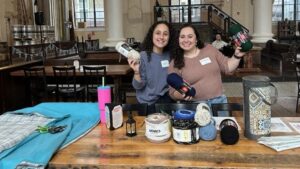
At Knit & Nosh, one of several VolunTeams run by the Macks Jewish Connection Network, young adults get together to knit scarves and hats for neighbors experiencing housing insecurity.
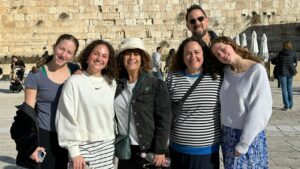
In honor of Women's History Month, The Associated talked with Pam Platt, Stephanie Baron and Leah Schottenstein Schulman about what drives their giving and the values that guide their leadership.
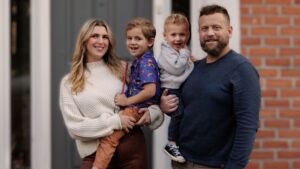
February is Jewish Disability Awareness, Acceptance and Inclusion Month (JDAIM). Supporting individuals with disabilities is a year-round priority for The Associated network.