
Maryland continues to develop innovative energy programs that are globally recognized, plus Maryland has been in the national top ten for energy efficiency eight years running.
In June of 2019, Governor Hogan signed the “Maryland Leads by Example” Executive Order, which directs the Maryland Department of General Services (DGS) and the Maryland Energy Administration (MEA) to develop and manage energy saving initiatives for state-owned buildings.
The goal of the “Maryland Leads by Example” initiative is to reduce energy consumption in state-owned buildings by 10 percent by 2029. An annual audit of state-owned buildings will be conducted and low-cost energy efficiency measures that reduce current and future operating costs will be developed.
The Maryland Energy Administration (MEA) offers a wide variety of grants and tax credits that help residents close the savings gap on everything from home heating to electric vehicle charging equipment. Read about some of their featured grants here and visit Energy.Maryland.gov to see the full list of programs for residents, businesses, nonprofits and local government agencies.
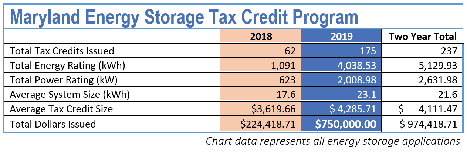
Maryland’s landmark Energy Storage Income Tax Credit Program jumped to 100 percent utilization in year two (Tax Year 2019). The Maryland Energy Administration (MEA) issued a total of 175 tax credits to 173 residential homeowners and two business entities. The 173 residential systems totaled 4,011.63 kilowatt hours (kWh) of energy storage which is equal to 16.7 hours, on average, of reserve power that can be used in a blackout.
Energy storage is like a battery backup, keeping electricity flowing in the event of a power outage. Energy storage systems can also be combined with a renewable energy technology like solar panels. When combined with a renewable energy source like solar, an energy storage system is like a bathtub, and the solar panels are like the faucet that runs when the sun shines filling the bathtub with energy.
Maryland made national headlines in 2017 when it became the first state to pass a bill allowing taxpayers to claim an income tax credit for purchased energy storage devices. Tax credit certificates are calculated differently for systems that are installed in homes and commercial properties. The tax credit is calculated as 30 percent of total installed cost of the energy storage system. Tax credits are capped at $5,000 for residential systems and $75,000 for commercial systems.
MEA is now accepting applications for the Maryland Energy Storage Income Tax Credit Program for tax year 2020. The deadline to apply is January 15, 2021 at 11:59 PM EST. For more information about the Maryland Energy Storage Income Tax Credit Program please visit Energy.Maryland.gov or contact us at energystorage.mea@maryland.gov or (410) 537-4000.

Why not honor your mom by making a donation to a nonprofit that supports women and children?

The 16-year-old sophomore succumbed to injuries sustained in a car crash last week in Cockeysville.

Schools in Montgomery County have recently experienced a wave of antisemitic incidents.

CCBC Honors scholars are discovering a level of academic rigor and opportunity typically associated with elite four-year institutions.