
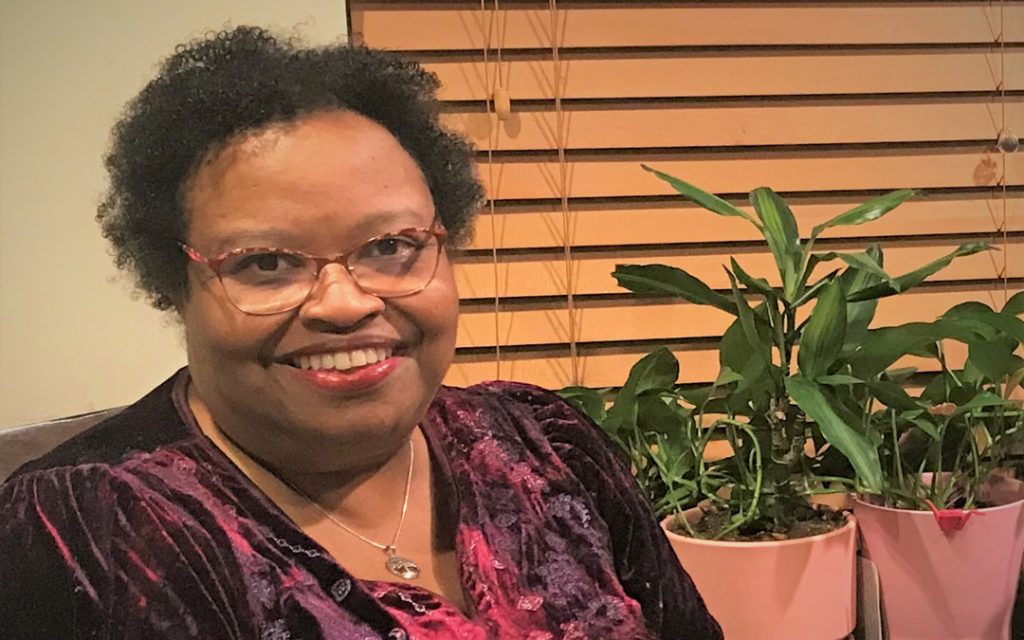
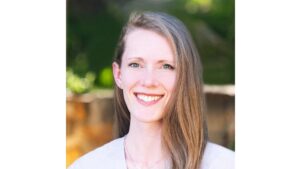
Dr. Harriette Wimms calls herself “an unintentional leader.”
“Baltimore has been my home for more than 30 years and I’ve seen lots of places where Baltimore hurts,” she says. “As a healer, I’ve tried to figure out how I can help. All the work I do is my covenant with God and my thank-you for my son and for another day.”
A psychologist and Mount Washington resident, Wimms is in the process of planning the National Jews of Color Shabbaton, a virtual weekend program to take place May 13-16. “I’ve gathered Jewish leaders from across the county,” she says. “Rabbi Jessy Dressin [executive director of Repair the World Baltimore] helped me write a grant for the Shabbaton, and the grant will support the entire program.”
A native of southern California, Wimms, who teaches psychology at Loyola University Maryland, is a “proud Jew-by-choice” raised in a Christian household in St. Mary’s County, Md.
She came to Baltimore in 1986 to attend Towson University. After earning a bachelor’s degree in English, Wimms obtained a master’s degree in developmental psychology from Johns Hopkins University and a doctorate in child clinical and community psychology from the University of Maryland, Baltimore County.
Wimms began her Jewish journey nearly a decade ago, after attending a service at Chizuk Amuno Congregation. “It was a 9/11 memorial service,” she said. “It was amazing!”
Unfortunately, she says her introduction to synagogue life was marred by an unfortunate incident. “My son [Harrison] picked up a siddur, and a woman came up to us and whispered, ‘That is a sacred book! You must be very careful,’” Wimms says.
It was clear to Wimms and her young son that he was admonished because of his race. Wimms mentioned the incident to a congregant, who later informed Chizuk Amuno’s Rabbi Deborah Wechsler.
“Rabbi Wechsler contacted me and said, ‘I want to apologize. Can I please meet with you?’” Wimms says. “That’s when I started my conversion [to Judaism].”
Wimms became a bat mitzvah at Chizuk Amuno in 2016. Two years later, she began studying at the Kohenet Hebrew Priestess Institute, a group that strives to “revive and re-embody Jewish spiritual leadership through embodied, earth-based feminist practice,” according to its website. The institute offers a three-year program, and Wimms hopes to be ordained as a Hebrew priestess later this year.
In 2018, Wimms introduced Kohenet teachings to Baltimore through a weekend Shabbaton that explored the divine feminine quality in Judaism. For the past two-and-a-half years, she has been a member of Hinenu: The Baltimore Justice Shtiebl, a Jewish community led by Rabbi Ariana Katz.
While no longer a member of Chizuk Amuno, Wimms has continued her relationship with the synagogue through her involvement in programming about Jews of color.
“Five months ago, some folks involved with the social justice committee at Chizuk Amuno reached out to say they were developing a program and wanted me to be involved with the planning,” she says. “In helping with that, I started wanting to focus some energy on Jews of color. We formed a partnership with Chizuk, the Jewish Museum of Maryland and the Reginald F. Lewis Museum [of Maryland African American History & Culture]. We’ve done four of a nine-part series so far.”
One highlight of the series was a conversation between Wimms and Chizuk Amuno’s Rabbi Joshua Z. Gruenberg in which she shared some of her experiences as a Jew of color. (All of the programs are online at jewishmuseummd.org.)
Meanwhile, Wimms has started a Jews of color chavurah at Hinenu. “We opened it up to Jews all over the community,” she says.
For the Jews of color Shabbaton in May, Ilana Kaufman, executive director of the Jews of Color Field Building Initiative in San Francisco, will be among the speakers. Kaufman came to Baltimore in January of 2020 for a program on race and the Jewish community presented by Bolton Street Synagogue and Repair the World Baltimore.
“That was really what catapulted my outreach [to Jews of color],” says Wimms. “Ilana said that if you aren’t seeing approximately 15-20 % people of color in your synagogue, you’ve got a problem in your congregation. I looked around and didn’t see that [percentage].”
Wimms says it feels “phenomenal” to see the development of the movement toward greater inclusion of Jews of color in the community.
“My vision and every project in the Jewish world has always been about love,” she says.
For information about the National Jewish People of Color Shabbaton and related programming, visit jocmishpacha.org.
A Norfolk native, Frankle worked at Sinai Hospital, Camp Airy and privately for five decades.
Esther Greenberg, Leora Match, Kathlleen St. Villier Hill and Ben Gershowitz will be recognized for the contributions to the community.
For more than five decades, Dr. Rosenstein was known by local families as a trusted and caring physician for their children.
Jewish Community Services' upcoming "Future-Ready Workplace" event will feature a keynote address from workplace expert and bestselling author Liz Fosslien.