
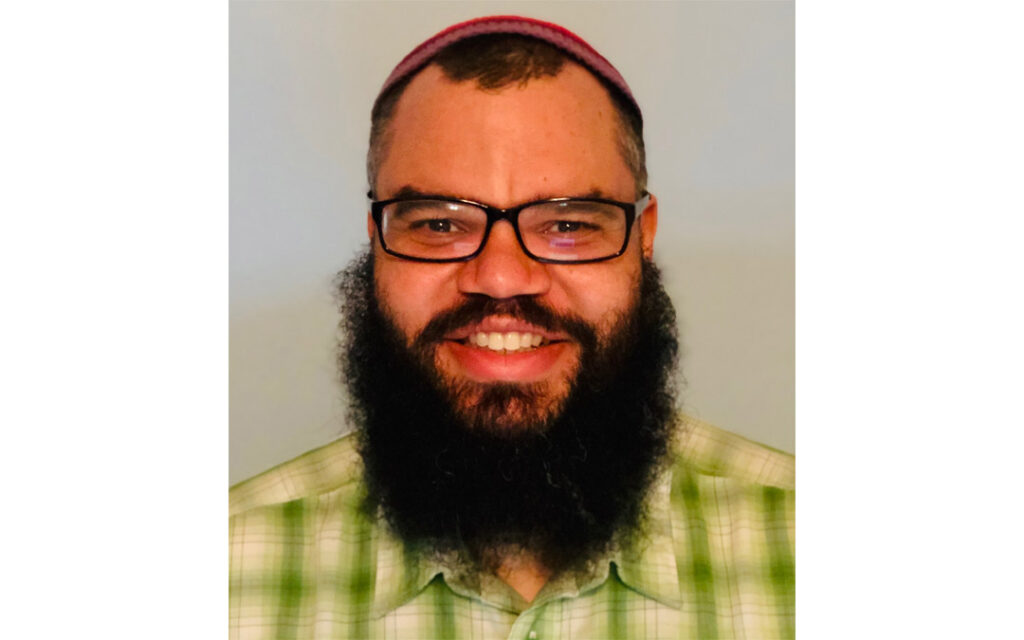
As co-founder and senior educator at the Calico Hill Collective, Yosef Webb-Cohen has made a career of helping individuals and organizations realize their social justice goals.
A diversity and inclusion coach, educator and master of social work candidate at the University of Maryland, Baltimore, Webb-Cohen sits on the board of Repair the World Baltimore. He is also an active participant in such local and national organizations as Jews United for Justice, Hinenu: The Baltimore Justice Shtiebl and the Jews of Color Initiative.
A Columbia resident, Webb-Cohen, 43, recently spoke with Jmore about contemporary white supremacy and the ways in which he believes anti-Semitism and racism are tools of the white supremacy movement.
Jmore: How do you define white supremacy?
Webb-Cohen: Historically, when people thought of white supremacy, they thought of Nazis or KKK members with their white hoods riding around on horses and burning crosses on the Rev. Dr. Martin Luther King Jr.’s front yard.
But I think in modern times, it’s not so much blatant white supremacy as it is more white supremacy culture. And when we talk about that, really what we’re talking about is the systems in place that make people of color less than white people. And that kind of goes hand in hand with the idea of white privilege.
What does white privilege entail?
There’s this idea that white privilege means white folks get more, and that’s not necessarily untrue. But it’s sometimes easier to think of it as, yes, things are hard but because of white privilege, it’s not extra hard for white people. One of the pushbacks to that idea of white privilege comes from poor white folks who say, “I’ve had a rough go of it. … I don’t have all the stuff that white privilege talks about.’ And my response to that is, yeah, that’s true. And for a person of color in your same situation, it’s extra hard just to have what you have.
An example?
I was having a conversation in class the other day. The students were talking about white supremacy and white privilege in the education system, and someone said, ‘I don’t understand. We’re getting master’s degrees. It shouldn’t be easy.’ And I said, ‘I agree. Getting a master’s degree shouldn’t be easy, but it shouldn’t be harder just because someone has a different skin color or sexual orientation or religion. These things shouldn’t make it any harder.’
When we talk about white privilege, I would say Western Europeans, Protestants, Christians, heterosexual and affluent people have the most privilege. Different groups can move into that [circle] and partake of some of that privilege. In the United States, for instance, Jewish folks who identify as white have what I call ‘conditional privilege’ or ‘conditional whiteness,’ so they are considered white until it’s inconvenient for the rest of white [people] to consider them white.
What do you mean by inconvenient?
White Jews, by and large, in this country consider themselves white and have all the privileges thereof right until something happens where the white supremacist narrative needs a scapegoat. Then, suddenly, it’s the Jews who are at fault. ‘The Jews are controlling the media.’ ‘The Jews are controlling the weather.’ Whatever trope you want to put in there, suddenly the Jews become a convenient scapegoat. And I would argue conditional whiteness kind of goes hand in hand with the model minority myth.
What’s the model minority myth?
The most typical model minority myth is the Asian grocer. They came [to the United States] the ‘right way,’ did all the paperwork, started a business as an active member of society. … That’s a model. But their narrative is conditional. They get some of the advantages of whiteness until it’s inconvenient. Most recently when COVID-19 hit, attacks against Asians went through the roof, as if this person who owns a grocery store who’s been here for four generations had something to do with COVID-19 in the United States.
People often point to the way Jews supported Blacks during the civil rights movement. Yet, there’s still racism in the Jewish community.
When we talk about racism in the Jewish community or anti-Semitism in the Black community, we’re really talking about two aspects of white supremacy culture. If white supremacy culture can keep Blacks and Jews at odds with each other, then they can’t focus on who’s really getting wealthier every day at our expense. … We need to focus on why racism and anti-Semitism exist. We need to recognize that they serve a greater purpose, which is to maintain white supremacy culture and to maintain the status quo, which keeps us all down.
If you want to end anti-Semitism, you have to end racism. If you want to end racism, you have to end anti-Semitism. You can’t end one without the other because they’re both tools of the same thing. And I think that’s a hard takeaway for some folks.
How do we come together?
Well, I always say let’s sit down and have a meal together because you learn a lot about people when you sit down and eat with them. Racism, anti-Semitism, whatever ‘isms’ you want to put behind it, as soon as you know someone who’s in that group [the isms fade away]. We always hear about white supremacists who say, ‘I hate Black people, except Tony. He’s cool because I know him.’ Well, what would happen if you knew more Black folks? Or what about the person who says, ‘I can’t trust the Jews except for Yosef. He’s cool, because I know him.’ Well, what would happen if you just got to know more people in my community?
If you get to know people, you realize there’s vastly more similarities than differences between us. We’re all trying to breathe fresh air, drink clean water, get some food, find a place to sleep that’s warm. We all want to have people who love us and do things we want to do with our lives.
Once you’re sitting down together, what do you talk about?
I used to teach a cultural competency class at University of Maryland, College Park. Basically, I would take groups who historically didn’t communicate with each other like Christians and non-Christians, white folks and non-white folks, straight people and those who do not identify as straight, and put them in a dialogue together. Then I’d say ‘Let’s get some shared language. Let’s talk about why we think what we think? Where did that come from? Does it help or hinder us in the world?’
We have to engage with our neighbors. We have to educate people and we have to start interrogating those beliefs and myths that we’ve learned and find out where do they come from, why do we believe them, who do they serve?
At least some of the people who rioted at the U.S. Capitol on Jan. 6 were white supremacists.
If the Black Lives Matter movement had stormed the Capitol, they’d have been shot and killed on the steps. They wouldn’t have made it into the building and there wouldn’t have been [only] one person shot by the police. They would have fired until they had no bullets left.
The fact that [the rioters] could go home [after the riot], that’s amazing! That’s what I would argue is white privilege.
Is there any hope?
Absolutely. I don’t know how long it will take, but there’s always hope. I don’t know if it will be in our lifetime. I hope so. I have an 18-month-old who’s a mixed-race Jewish kid, so I certainly hope so.

"A Beautiful Noise" chronicles the singer-songwriter's rise to musical icon.
Duke Zimmerman and Lori Gale will talk at Towson University about their new book "People Get Ready" and the role played by Globe Posters in the civil rights movement.
The new exhibition revisits and updates a previous show about ritual hair covering in the observant community.
One of the most competitive local races for public office this political season is for Baltimore County Executive. Jmore recently spoke with four of the candidates about their views on how they hope to enhance life in the county.