
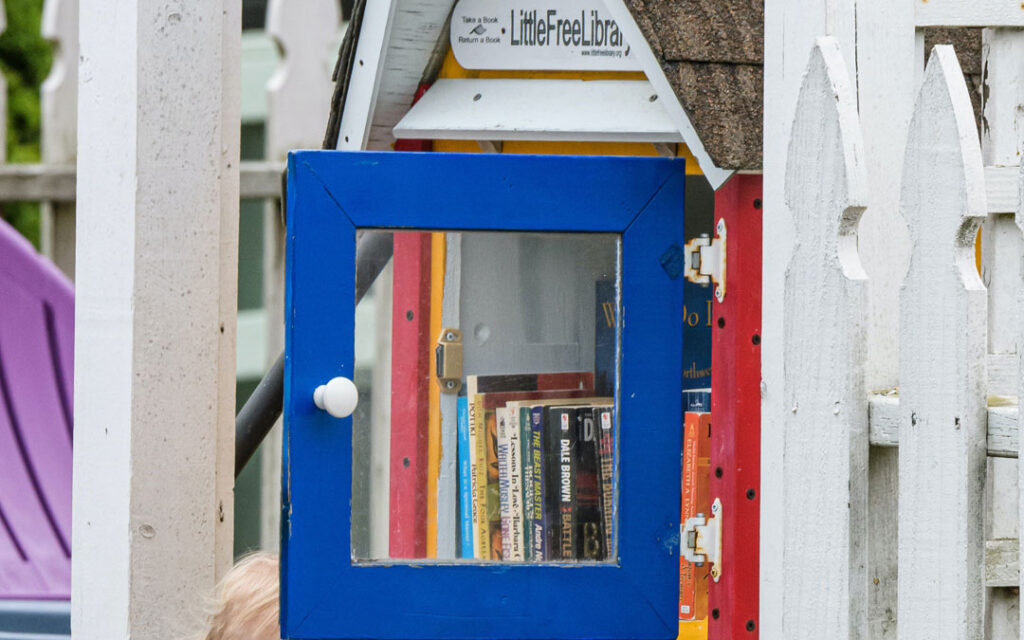
My cozy suburban home is situated within a mile’s walk of four Little Free Libraries. No matter which direction I set off for a Hobbit-like adventure, I eventually come across a literary oasis.
Each of these stops on my daily lollygag has its own personality. There’s the one in front of the church that is usually overflowing with (ironically?) anachronistic Danielle Steels and Judith Krantzs. Stacked between the hardcovers are a few Christmas coloring books and a pamphlet titled something like, “How to Find God in Unexpected Places.” (I mean it’s not that unexpected, I’m outside a church.)
Next is the double-decker, plant-adorned number on the edge of a cul-de-sac. This one must be run by a grade school teacher or a standard issue grandma. It’s often filled with Dollar Store toys – sticker books, craft supplies. This is where you would search for a volume in “The Hunger Games” trilogy or the “Twilight”-verse. I like to balance the YA fiction by leaving crazy, rich grownup trash like Kevin Kwans or Candace Bushnells here.
The furthest Little Free Library also happens to be the most highfalutin. It boasts a steady rotation of short stories by Jeffrey Eugenides, Chuck Klosterman and Augusten Burroughs. Recently, I nabbed a copy of Rob Sheffield’s “Love is a Mix Tape” and spent a few days mourning the demise of the ‘90s version of “the feels”: the mix tape. The good ol’ pre-pandemic years. This is the box I visit when I’m ready to give up a weathered Nick Hornby or any Michael Chabon that is not “The Amazing Adventures of Kavalier & Clay” (never parting with that one).
The Little Free Library around the corner from my house is the closest and my favorite. It’s in a high foot-traffic area, so it gets plenty of turnover (I BYO hand sanitizer, always wear gloves and give everything a good wipe-down as soon as I get home — I also like to let the goodies rest out on the sunporch for a day or so). Here, I’ve scored blank watercolor journals (!), gold letter stickers (!!) and even Stephen King’s “The Institute,” which I would have willingly paid for in an alternate reality. It might sound morbid, but King is a given for these times. After all, he’s the guy who already wrote this story (“The Stand.” Read it). This is where I unload my pile of Daniel Silvas and Jo Nesbos (loooove a fresh Nesbo).
I’ve been home alone for however long it’s been, so the act of giving a book/taking a book has become my way of making a connection with someone out there somewhere. After many, many, many months of taking part in this literary swap meet, these libraries now serve as my main source of company and communication. I like to imagine who’s reading my selections. I peek inside as I walk by to see which of my offerings have moved on and which remain, forlorn and dejected. I also pass on some of my favorite discoveries to my mom during our monthly curbside meetups. After reading the book, she’ll then leave it on the free stack in her building’s common room. We are staying connected through these books and I’m staying sane(ish).
My extended paternal family — heavy readers, all — started a Zoom book club. First up: “Killers of the Flower Moon,” by David Grann. I am NOT a big nonfiction fan (I’d much rather escape into La La Land), but it doesn’t matter what we’re reading. What matters is that suddenly we’re spending an hour a month together, seeing each other’s faces, talking about common interests. We’re spread out across Maryland, New York, New Jersey, Massachusetts, Canada and Australia, so this is not something we would have had much opportunity to do in the Before Times.
One last ode to how books have saved my life this year: My closest family and friends have an irreverent holiday tradition that involves the reading of a particularly off-color poem (I won’t name names). Much hilarity ensues. Social distancing might have rendered this activity undoable — especially since the book in question has been out of print probably since it was released (which is as long as we’ve been reading it). Yet, I was able to unearth three “gently used” copies on thriftbooks.com for a mere $4 each. I hand-delivered each (contact-free) and we got together over Zoom for the annual reading — I can’t think of a better holiday gift than that.
Books got me this far. Throughout the pandemic, they’ve been something to share, trade, gift, save and discuss. While real friends remain out of reach for any number of reasons, I’m keeping company with Wild West outlaws, Maine monsters and (other) dysfunctional characters.
That, to me, is just as valuable as a roll of toilet paper and a bottle of hand sanitizer.

Amanda Krotki is a Baltimore-based freelance writer and Jmore’s former digital and social media manager.

Commemorations of the Holocaust must transcend the past to include concerns about the present and future, writes Menachem Z. Rosensaft.

Someone needed to tell Donald Trump that his appearance at a UFC fight over the weekend was not a good look, writes Michael Olesker.
Journalists bear a responsibility to go beyond the headlines and social media posts to understand the past and present, writes New York University student Lucia Alonso.