
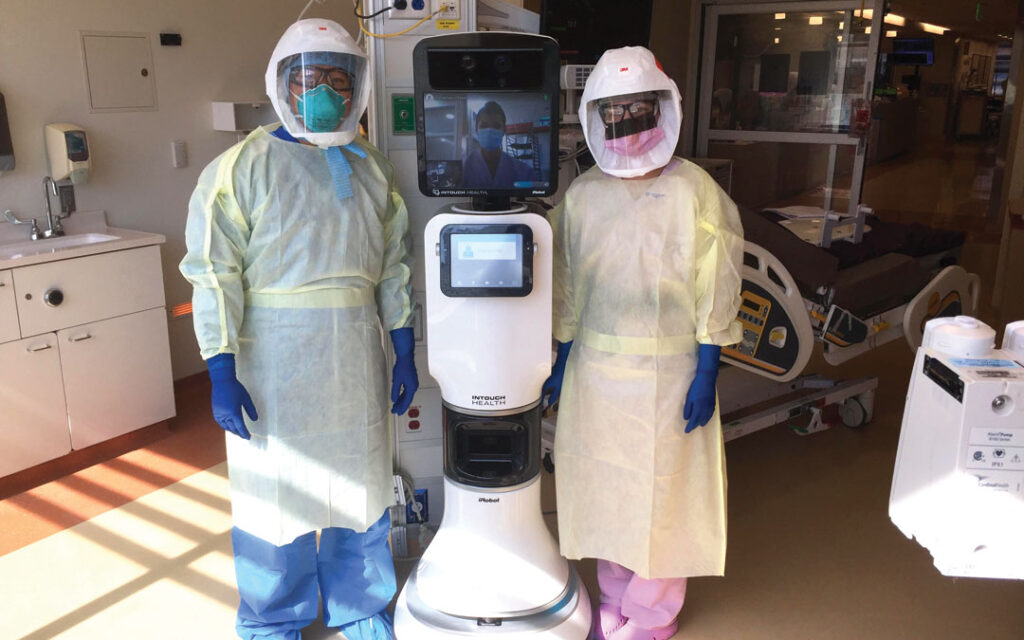
Every morning, Dr. H. Neal Reynolds, an intensivist at the University of Maryland R Adams Cowley Shock Trauma Center, makes rounds with his colleagues in the intensive care unit, located just one floor below a designated COVID-19 unit.
But Dr. Reynolds, 73, hasn’t set foot in the ICU — which he co-directs — since March when the pandemic first hit.
“I have not physically been to work for seven or eight months, but haven’t missed a single day of clinical duty,” he says. “I make rounds by using a robot with a screen on top that allows me to see the patient, and the patient to see me. I control the robot in real-time, which means I can do what I normally do with the robot but I do it from home.”
The robots, known within the University of Maryland Medical System as “Fast Freddy,” allow critical care physicians considered high-risk, like Dr. Reynolds, to participate in team rounds where important medical decisions are made without risking a COVID-19 exposure. Dr. Reynolds manipulates the robot from his home, driving it in and out of patients’ rooms, consulting with colleagues, monitoring vital signs and looking at ventilator settings.
“Patient acceptance of the robots has been stunningly high,” Dr. Reynolds says. “Because everyone is doing telehealth, I’m able to Zoom into the room and talk to people without any gap. I always introduce myself, the patient acknowledges I’m Dr. Reynolds and we get right on with our business. Patients seem very comfortable because it’s all taking place in real-time.”
In March, Dr. Reynolds approached hospital leadership with the idea to invest in a handful of these robots for COVID-19 floors or ICUs designated as COVID-19 overflow, like the floor run by Dr. Reynolds.
“When we knew the pandemic was coming, but none of us knew what to think, we had to make our best guesses on what to do,” says Dr. Reynolds, who first started using these robots in 2004 in a different hospital system. “I went to all the places destined to be COVID ICUs and step-down ICUs and asked if they would be interested in these robots. Everyone said yes, so I went to university leadership who said yes to the idea in about two minutes. It was that kind of decisiveness at the leadership level that allowed us to get this going so quickly.”
The University of Maryland Medical System has six robots in total, one on Dr. Reynolds’ floor and the rest on dedicated bio-containment COVID-19 units.
Dr. Jonathan H. Chow, a critical care anesthesiologist at Maryland, treats patients in one of the COVID-19 units and uses the robots regularly.
“We’ve found the most utility using the robots to round on patients from outside the airlocked units,” says Dr. Chow. “We can physically look at patients through the cameras and see how they are doing in real-time. We Zoom in on vitals, monitors and different medications or infusions we are administering, all on a real-time basis. But the robot doesn’t replace any clinician. Whenever a patient needs a procedure done, we suit up and go back to do those procedures.”
Dr. Chow and the entire ICU medical team — which consists of about 10 providers, including doctors, nurses, nurse practitioners, respiratory therapists and other therapists — have to wear full gowns, gloves, goggles, N95 masks and powered air purifying respirators, which are used to safeguard workers against contaminated air in order to go into the locked, bio-containment unit.
“The robots have helped decrease the amount of time by a couple of hours I’m physically in the room with COVID-19 patients,” says Dr. Chow. “Every minute you spend in an enclosed room with someone infected by COVID-19, your risk of getting the virus increases, even though we are wearing PPE. If the robot helps decrease the amount of time by an hour, that is helpful in terms of decreasing overall exposure and overall risk because we are spending less time face to face.”
With cases of COVID-19 increasing nationwide, Dr. Chow says hospitals are starting to see more patients requiring intensive care leading to a shortage of ICU beds.
“This past year has really been very difficult on every person in the world and placed enormous strains on health care systems,” says Dr. Chow, 34, who recently got his first dose of the coronavirus vaccine. “These robots are one small way to make our jobs a little easier when we take care of these patients and provide a little more reassurance that our exposures to the virus are minimized.”
Dr. Chow’s patients are those with the most severe COVID-19 cases, which takes an emotional toll on him and his colleagues.
“The saddest part of all of this is patients are so sick and are dying by themselves,” he says. “There is no family member who can go back there with them, and we are having these end-of-life discussions with the patient’s husband or wife, mother or father, sister or brother over Zoom, when normally we would have them face to face, around a table where we can comfort them and hand them a box of tissues. It’s hard for the family members, hard for patients and hard for the front-line medical staff.”
Adds Dr. Reynolds: “I’ve been a critical care physician since 1985 and I have never had a time in my career where I didn’t go bedside. We have never had anything like this.”
A Baltimore native, Sweren was a collector of artists' books whose own works were displayed in national galleries.
The BCO, founded in 1984, will perform the works of Frank Zappa, Beethoven, Mason Bates and Karena Ingram.

For more than 130 years, Sol Levinson & Bros. has been woven into the fabric of Baltimore’s Jewish community.

Led by local Israel-American cellist Amit Peled, the Mount Vernon Virtuosi aims to inspire people beyond musical enjoyment.