
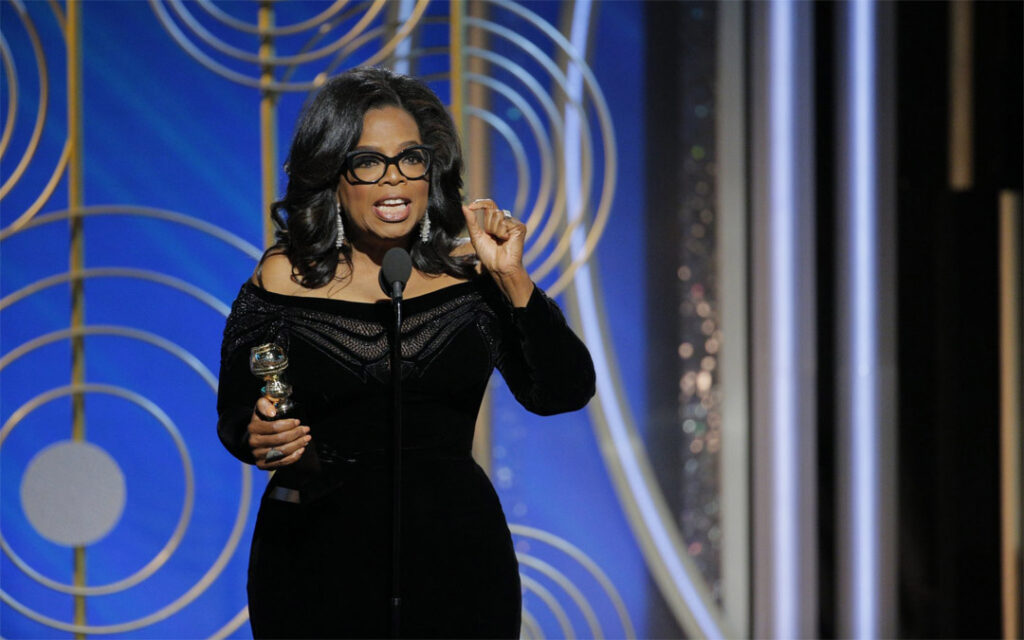
It’s more than a week now since Oprah Winfrey sat down in front of TV cameras with the Windsors of Great Britain, Meghan and Prince Harry, and Oprah’s still getting raves for the interview.
Big deal, so she got them to spill the squalid beans about the royal family in front of several hundred million viewers all around the whole world.
Around Baltimore, we knew the young Ms. Winfrey at the precise moment she discovered her inner Oprah. And all it involved was a local show called “People Are Talking.”
And a meat thermometer.
Remember “People Are Talking?” The show aired five mornings a week on WJZ-TV, starring Oprah and Richard Sher. It first aired Aug. 1, 1977, and lasted six years with Oprah before she headed off for Chicago.
But in that time, she made the paramount discovery that comes only to those who become true stars in front of the ever-probing eye of TV cameras: Be yourself. Trust yourself.
“People Are Talking” was still finding its way when Oprah made this discovery. She and Sher were doing a mix of celebrity interviews, pop culture, “Dialing for Dollars” and cooking segments.
The weird part was, Oprah was handed the cooking segments, and she didn’t know the first thing about cooking.
“I eat out every meal,” she announced on the show one day. “I don’t cook. I can’t bake a roast.” While the audience digested that little non sequitur, she blithely went on, “When I put things in my refrigerator, they go there to die. I have to call the fire department to come in and take them out.”
(I’m recalling some of this from memory, and much of it from a book I wrote about my own years on WJZ’s Eyewitness News called “Tonight at Six: A Daily Show Masquerading as Local TV News,” published by Apprentice House.)
On the air one morning, a female chef from a local restaurant stood at the “People Are Talking” cooking area preparing a turkey. Oprah stood next to her. Then came a changing of the world. Oprah picked something off the kitchen counter, gazed into the camera and asked a question.
“What’s this?”
“This?” the chef asked. “It’s a meat thermometer.”
The studio audience, mainly women, chuckled. Who among them didn’t know what a meat thermometer was?
“You never saw one?” the chef asked, her voice caught between sheer incredulity and a desire not to make Oprah look dumb.
Behind the scenes, panic brewed. In the WJZ control room, an associate producer (and future reporter), Sandra Pinckney, muttered, “Lord, where has this child been?”
The show’s producer, Sherry Burns, frantically scribbled words on a pad and raced from the control room, down a hallway and into the studio, trying to signal Oprah to move on.
No chance. Oprah had locked into this meat thermometer and wouldn’t let it go.
“Isn’t this the best thing you ever heard of?” she asked the studio audience. “Every kitchen should have one.”
It was the moment Oprah discovered TV honesty. You didn’t have to be an expert on everything. TV reporters are marketed as instant experts on whatever they cover on any given day. It’s the nature of the job: homicides today, city politics tomorrow, courtroom drama the next day.
Oprah was ready to kiss this off this faux expertise and simply be herself. She wasn’t afraid to say what she didn’t know. She understood she was a proxy interviewer for every viewer, and she figured if she didn’t know something, neither did the viewers. So don’t be too self-conscious to ask any question at all.
A few days after the meat thermometer incident, Oprah told producer Sherry Burns that the show now felt as natural to her as breathing.
And she’s been breathing pretty royal air ever since.

A former Baltimore Sun columnist and WJZ-TV commentator, Michael Olesker is the author of six books. His most recent, “Front Stoops in the Fifties: Baltimore Legends Come of Age,” was reissued in paperback by the Johns Hopkins University Press.
Allow me a few paragraphs of time travel, and let’s go back to Johnny Carson’s monologue the night after Neil Armstrong became the first man to set foot on the moon. I’m paraphrasing here, but I think the joke still works 57 years after Carson first delivered it. “The good Read more

As he gets ready to leave for California, Rabbi Daniel Cotzin Burg looks back on his time in Baltimore and his 10 years writing for Jmore.

Michael Olesker pays tribute to WJZ’s retiring Marty Bass, a longtime fixture on local TV screens.