
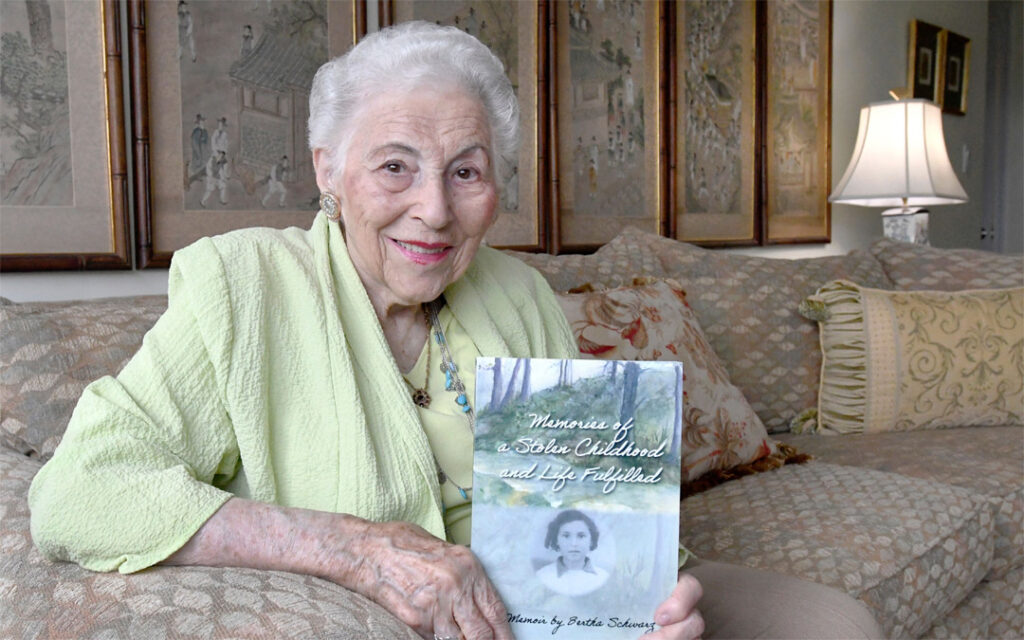
Bertha Schwarz was only seven when World War II broke out. For the next five years, she lived in constant fear and on the run, from her native Belgian city of Antwerp to France to Switzerland and eventually to Palestine.
Over the past decade, Schwarz, 88, who now lives in Towson and belongs to Beth Am Synagogue, has shared her story with schools and congregations throughout Maryland, on behalf of the Baltimore Jewish Council’s Holocaust Speakers Bureau.
With the release of her book “Memories of a Stolen Childhood and Life Fulfilled” (Wordsmithy), Schwarz hopes to ensure that her story will never be forgotten, a fitting aspiration on Holocaust Remembrance Day, which this year falls on Apr. 7-8.
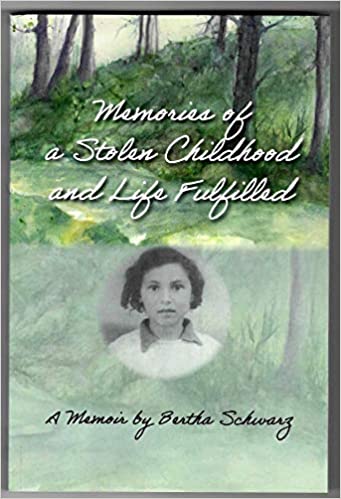
“I wrote the book after my brother-in-law wrote his memoir, and felt I should do the same for my family’s story,” says Schwarz. “I was the oldest of my sisters and they didn’t remember a lot from the war. After my mother passed away, I was the only one left in my family who remembered that time period.
“I wanted to write the book for my family, for my children and grandchildren. But I also felt it was an important book for the Jewish people, as a document of what we went through.”
To write the book, Schwarz and her two younger sisters, Malka and Bella, returned to Belgium, France, Israel and Switzerland, spending weeks retracing their history and the places they hid during the war.
The journey took Schwarz three years to plan because she spent time researching and contacting individuals who still lived in Europe and could help her learn more about what happened to her family.
She and her sisters returned to Belgium where they went to school; the labor camp where their father, Asher Teitelbaum, was sent to; the town where their grandparents were in hiding; and the border where smugglers helped them escape from southern France to Switzerland.
“We learned a lot on that trip we never knew,” says Schwarz. “We met the daughter of the smugglers who got us over the border. She picked us up and took us to the border so we could see. We found out those smugglers were arrested and put into camps where they died. The school in the French town is named after them, and there is a ceremony honoring them.”
Schwarz and her sisters also learned about their grandparents’ fate after visiting Yad Vashem, Israel’s national Holocaust museum and memorial.
“We never knew where my grandparents were hiding,” Schwarz says. “We looked up my grandparents and saw an unfamiliar name with a phone number and address in France. I called the number and asked if he knew my grandparents. He said yes and we had dinner with him when we went on our trip. He told us to go to the center square, where we saw a memorial with my grandparents’ names on it. This was one of the many pieces of information we found out through our road trip.”
Schwarz and her family escaped Belgium by train when she was seven, surviving a German bombardment. They arrived in the free zone of France and lived in hiding for years.
While in hiding, her father was arrested and sent to a labor camp.
“We found out where my father was arrested, and I went with my mom to see him once,” says Schwarz. “It was during that visit my father told us the police were arresting the men first and then planning to arrest the women and children. My mom visited him one more time and my dad told her about a rabbi that was allowed to visit Jews in the internment camp, and that we needed to leave as soon as possible or we would all be arrested. My mom had to decide what to do with us at that point and chose to send my middle sister and me to that rabbi. She got us a one-way ticket and we left. At that time, I was nine and my sister was six.”
That was the last time Schwarz saw her father, who was killed in Auschwitz along with her grandparents. Schwarz and her middle sister traveled to Marseilles with members of French resistance and were arrested, but eventually were saved by Rabbi Zalman Schneerson and and spent the next couple of years at his Jewish school for girls outside of Marseilles. Her sister Bella came a month later.
“The places we lived were rundown with broken windows,” she says. “My mom lived with my aunt near our school and appeared one day. We had lice, our heads were shaved and our clothes were in bad shape. My mom cried and I told her not to because our hair would grow back. She left after four hours, and I was concerned I would never see her again. She had no documents when she came to see us, and I knew from experience it was a matter of chance if we ever saw her again.”
It was after that visit that Schwarz’s mother, Dora Teitelbaum, was informed about the smugglers. In 1943, Schwarz, her mother and sisters crossed the border from France to Switzerland.
“A van took 16 of us to the border and we were told to throw our suitcases over the fence and crawl under it,” Schwarz says. “It was very scary. We are lucky we got accepted into Switzerland because I saw thousands of people who crossed the border get rejected and sent back to the camps in France. That is not very well-known, but it is documented.”
When the war ended, Schwarz, her mother and sisters reunited with family members in Palestine. Her mother eventually remarried, and Schwarz attended an agriculture school. Later, she enlisted in the Israeli military at the age of 18.
It was in the army that Schwarz met her future husband, Michael, and learned how to use computers. Through her work in the army, she made a career training companies how to operate computers.
Schwarz and her husband moved to the United States after 1956’s Suez Crisis, had three children and resettled in Boston. She moved to Baltimore in the 1970s when her daughter, Mira Appleby, relocated to this area.
Schwarz says she hopes her memoir serves as an historical document for her six grandchildren and the rest of the world.
“The reactions to the book have been great so far,” she says. “I’ve received many emails from those who have read it and am surprised that both Jewish and non-Jewish individuals are responding to the story. I knew I wanted to have both the genealogy of my family in it and the historical elements so my family could know who we are and where we came from.”
Click here to find “Memories of a Stolen Childhood and Life Fulfilled.”
A Baltimore native, Sweren was a collector of artists' books whose own works were displayed in national galleries.
The BCO, founded in 1984, will perform the works of Frank Zappa, Beethoven, Mason Bates and Karena Ingram.

For more than 130 years, Sol Levinson & Bros. has been woven into the fabric of Baltimore’s Jewish community.

Led by local Israel-American cellist Amit Peled, the Mount Vernon Virtuosi aims to inspire people beyond musical enjoyment.