
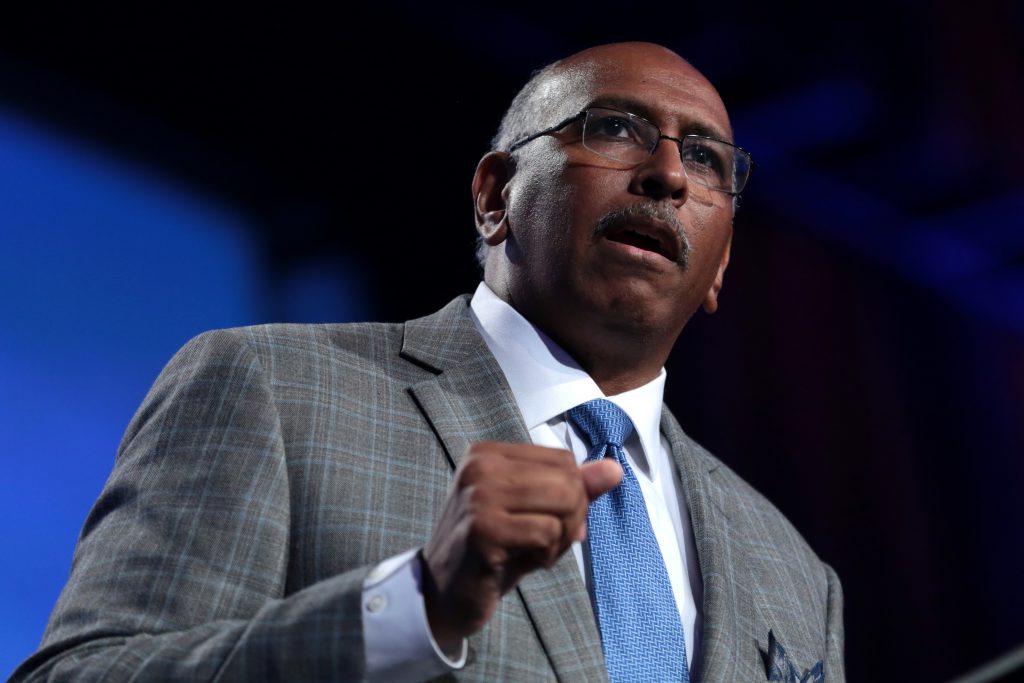
Michael Steele says he’s seriously considering running for governor of Maryland, naturally as a Republican, prompting at least one question: Who’s going to have less enthusiasm for him, Democrats or Republicans?
It’s an unfair question, but a valid one.
Unfair, because Steele’s got plenty of legitimate credentials to run, and plenty to suggest he’d handle the job if he got himself elected.
He was Maryland’s lieutenant governor for four years. He was chairman of the Republican National Committee. He’s been a regular on MSNBC’s news analysis shows over the better part of the last decade.
He’s also been a voice of sanity among Republicans, a rather brave and outspoken figure refusing to march lock-step behind Donald Trump on the GOP road to national disgrace.
And that’s why the question comes up: voters from which party will have less enthusiasm for him if he runs for governor?
Democrats won’t be lining up for him — unless you believe that Democrats who happen to be Black will cross party lines just because Steele is Black. Political history has some pretty compelling examples showing no one should believe that old racial cliché. It’s white people who have most staunchly stuck by candidates of the same skin color.
But what about Republicans voters and Steele?
Steele floats his trial balloon at the same time Republican leaders in states around the country are trying to turn back the clock, making it tougher for people of color to vote.
Steele, of course, is a person of color. In a different time, before his party had gone completely off the tracks, Steele’s color was a distinct advantage. He was former Gov. Robert Ehrlich’s running mate.
Ehrlich was a right-wing Republican who learned hard-ball politics at the knee of Rep. Newt Gingrich, and he ran against Democrat Kathleen Kennedy Townsend, a liberal who learned her politics at the knee, literally, of her father, Robert F. Kennedy.
Steele gave Ehrlich cover. He softened Ehrlich’s dogmatic right-wing image, at least for a while. Ehrlich was not only combative in office, but so completely ineffective that when he ran for re-election, he was the only governor in all of America who got rejected.
Since then, as Ehrlich has largely faded from public view, Steele has flourished. But he’s flourished as a figure many Republican voters probably don’t like. He’s consistently bashed Trump, and he’s bashed those Republicans who haven’t had the courage to do the same.
But there’s one more question about political parsing. In states around the country, Republicans have introduced legislation making it more difficult for minorities to vote. Voter suppression, it’s all the rage.
Is that gesture strictly a matter of math — that they see the changing demographics of a country where minorities are becoming a greater percentage of the whole country?
Or is the calculation more mean-spirited than that? Is it a declaration of overt racism by these leaders — and a reflection of racism that permeates Republican voters?
Because if the stain of racism really does permeate the ranks of Republican voters, then they’re not going to vote for Michael Steele even if he is their party’s nominee.
A former Baltimore Sun columnist and WJZ-TV commentator, Michael Olesker is the author of six books. His most recent, “Front Stoops in the Fifties: Baltimore Legends Come of Age,” was reissued in paperback by the Johns Hopkins University Press.

The BCO, founded in 1984, will perform the works of Frank Zappa, Beethoven, Mason Bates and Karena Ingram.

As he gets ready to leave for California, Rabbi Daniel Cotzin Burg looks back on his time in Baltimore and his 10 years writing for Jmore.


A former college campus activist, Veksler will speak at Chizuk Amuno on June 8 at the Ruth and Jay Lenrow Visiting Scholar-in-Residence for Combating Antisemitism.