
Here’s a riddle: What colorful things pop up everywhere when the rain pours in the spring? The answer isn’t flowers but umbrellas.
And the rainy season in Charm City is a reminder that Baltimore was for decades the national capital of umbrella and rainwear manufacturing, mostly thanks to entrepreneurial Jewish immigrants and their offspring.
Although the story is likely apocryphal, the first umbrella ever spotted in the American Colonies was reportedly in Baltimore in 1772, an exotic import from India by way of England.
But it was in 1828 that a non-Jewish woodcarver named Francis T. Beehler from the German town of Heidelberg opened the first umbrella factory in the young republic right here in Baltimore.
At the turn of the 20th century, with the influx of Eastern European Jews, umbrella-making became — like the manufacture of ready-made garments — a heavily Jewish business, centered in the immigrant district of East Baltimore.
Two companies in particular, Gans Brothers (founded in 1888) and Polan Katz & Co. (founded in 1906), dominated the industry. Gans was famous for the punning slogan, “Born in Baltimore, Raised Everywhere.” Other companies, like Crown Brand (founded by Harry and Simon Ades) and Siegel, Rothschild & Co., specialized in ladies parasols, in addition to umbrellas (known colloquially as “bumbershoots”) and canes.
By the late 1920s, an increasing percentage of the 5 million umbrellas annually manufactured here was no longer just black, since the chemists at Polan Katz & Co. had figured out how to dye umbrella fabric so the colors would not run in the rain.
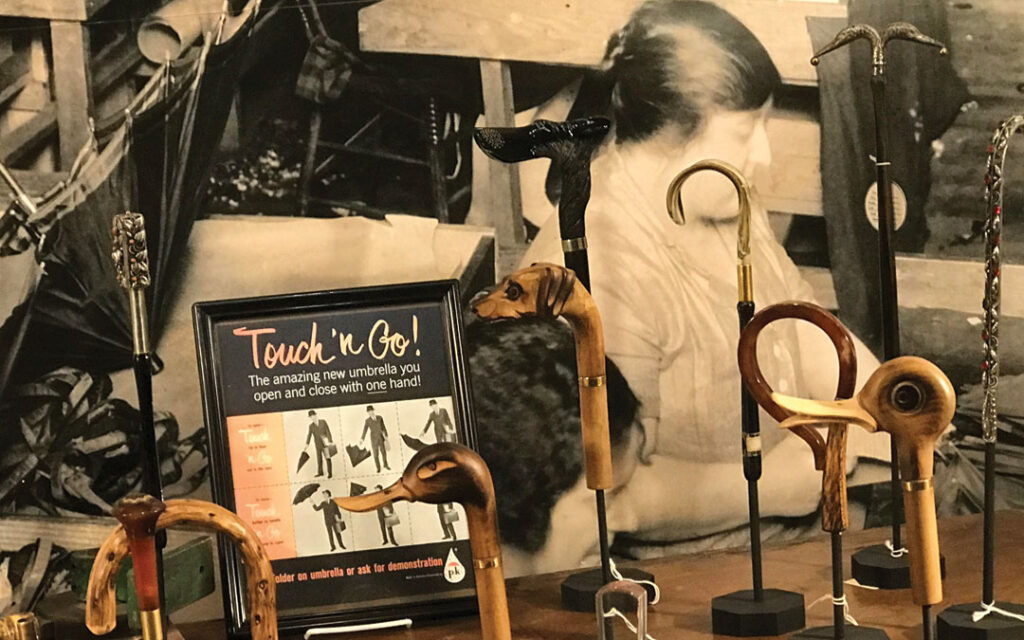
On permanent display at the Baltimore Museum of Industry is a collection of unusual umbrellas, including one in the visual style of a Tiffany lampshade, along with umbrella handles made of Bakelite, ivory, sterling silver and other materials, with carved wooden handles in the whimsical shapes of ducks, dogs and other animals.
Baltimore’s most famous raincoat company, of course, was London Fog. The brand’s line of waterproof, Dacron cotton blended gabardines — launched nationally in 1954 at Saks Fifth Avenue — sold so well that at one point, 92 percent of Americans who were surveyed recognized the corporation’s name. The brand was on a level with Coca-Cola and McDonald’s.
Indeed, in a 2012 episode of “Mad Men” set in the 1960s, advertising executive Don Draper tells the top brass at Dow Chemical that London Fog, a client of the agency, sells 81 percent of the raincoats in the nation. Draper’s partner, Roger Sterling, then pipes up, “Name another raincoat?” knowing that no one can.
But London Fog, which was founded in 1923 by Israel “Izzy” Myers as the Londontown garment company, was far from the only rainwear manufacturer, even in Baltimore.
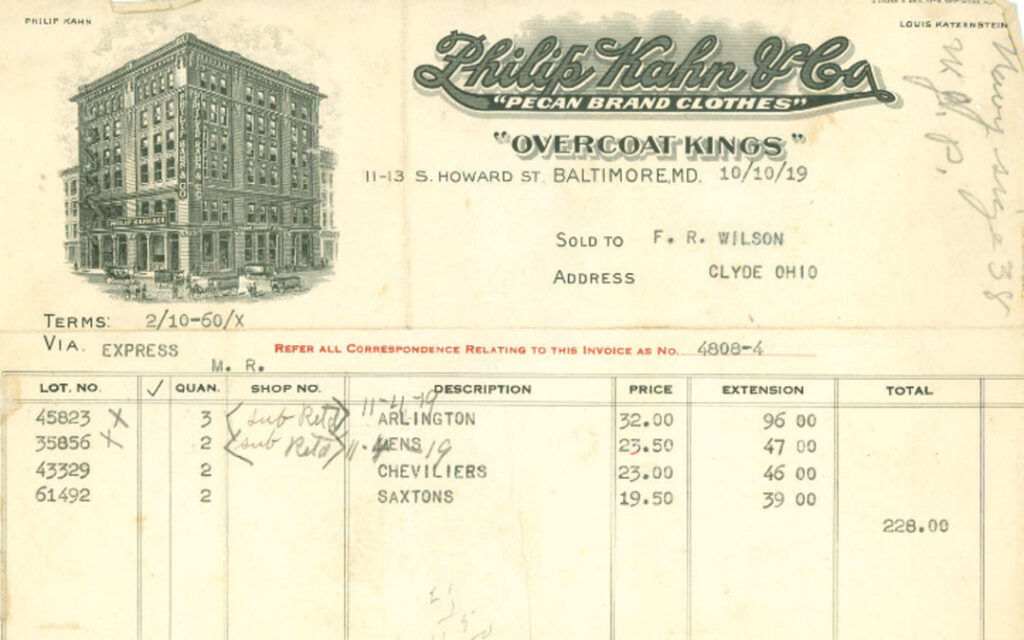
Philip Kahn & Co., founded in 1901, had close to 1,000 employees. The company’s Pecan Brand was known for its version of the popular raincoat the Balmacaan, which consisted of a high lapel and raglan sleeves (made from single, continuous pieces of fabric).
Gleneagles Inc., founded in 1912 as Lamm Brothers, was ultimately acquired by the famous Chicago firm of Hart, Schaffner & Marx.
Henry Sonneborn & Co. — which boasted the largest clothing factory in the world with a daily output of 3,000 suits — sold raincoats under the StylePLUS clothing brand, which the company advertised in mainstream and Jewish newspapers.
And Nathan Hess, a German-Jewish immigrant shoemaker, was a major manufacturer of shoes and boots. His son and grandsons ultimately founded a well-known chain of dozens of local footwear stores that lasted until the end of 1999. Retailers up and down the Atlantic Coast who were warned a storm was brewing would wire Hess Shoes, Nathan & Adler and other wholesalers to place rush orders for cartons of rubber boots.
The decline of the umbrella and rainwear industry in Baltimore occurred gradually, beginning with a flood of cheap clothing imports from Asia beginning in the 1970s. London Fog, which merged in 1976 with St. Louis-based Interco, the maker of Florsheim Shoes, took an audacious gamble by going retail, opening 140 stores across the country.
But they upset their traditional retail partners, big department stores, in the process. When the company moved its headquarters from Maryland to Connecticut in 1994, it lost many of its top executives.
By the beginning of the 21st century, the umbrella and rainwear companies founded by Jews a century or more earlier had all been swept away by the tide of foreign competition, or bought out by larger corporations.
But there was a time when Baltimore reigned … when it rained.
Ted Merwin, Ph.D., has worked in the Jewish nonprofit world for two decades. He resides in Pikesville with his wife and three daughters.

Finding himself in the midst of a pandemic-induced period of unemployment, Ted Merwin turns to the networking version of "Jewish geography."
For Ted Merwin, futuristic Jewish food is in stark tension with Jewish nostalgia, and he wonders what impact new meat substitutes will have on the traditional Jewish deli.