
Baltimore County Executive John “Johnny O” Olszewski Jr. likes to tell a story about Terry Sapp, the public health emergency coordinator who months ago helped create the county’s first vaccination site at the Maryland State Fairgrounds.
To accomplish this daunting task in a relatively short amount of time, Sapp drew upon his logistical skills from working as a stagehand for the heavy metal band Twisted Sister for more than a decade.
“I’ll never forget leaving that vaccination center feeling hopeful, thanks to Terry and our staffers and others,” Olszewski said. “I felt, for the very first time, we can beat this thing together.”
Or, put another way, we’re not gonna take it anymore, as the old Twisted Sister anthem goes.
During the greatest public health crisis of our lifetime, how did the Baltimore metropolitan region fare? And what is the future of the city of Baltimore and Baltimore County in the post-pandemic age?
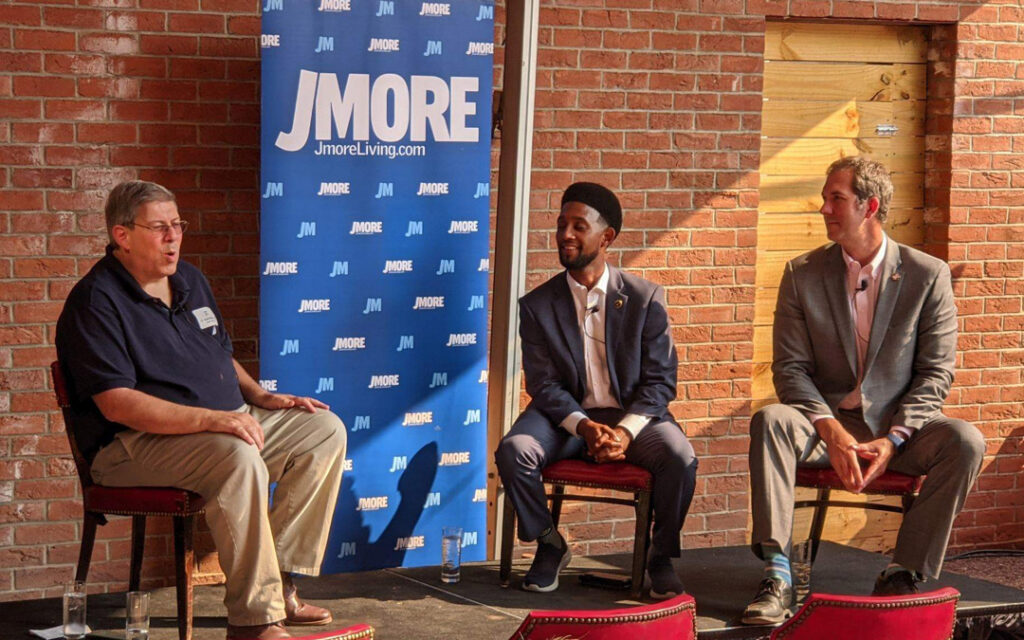
To answer those questions and more, Olszewski and Mayor Brandon M. Scott spoke about “Baltimore Resilience” at a Jmore gathering held June 20 at La Cuchara restaurant in Hampden-Woodberry’s historic Meadow Mill.
Moderating the discussion — which was held in person and aired on Facebook Live – was Dr. Scott Rifkin, publisher of Jmore. The event was presented by Jmore, JBiz, La Cuchara and Meals on Wheels of Central Maryland.
In his introduction, Rifkin described Scott and Olszewski as “young, good-looking guys … who really care about the city and county. They’ve brought absolute integrity to what they do, and the Baltimore area needs that.
“These guys have been through a war over the past year-and-a-half, and it’s not over yet.”
When asked by Rifkin about preparing the city’s infrastructure for a potentially challenging fall due to a COVID-19 resurgence or variant outbreak, the mayor said, “It’s an hour-by-hour situation, so we have to be able to make adjustments so [medical facilities] are not flooded like they were before. Right now, they’re as ready as they can get.”
Scott said the city is moving away from distribution centers and now using data to pinpoint communities in need of vaccinations. “We’re going where we need to go, and we’re doing everything we can,” he said. “We’re using local rappers and artists to talk about COVID to deliver the message. We tell folks, ‘Everyone who died last month was unvaccinated. Do you want to be next?’ We’re trying to reach people where they are.”
Olszewski said the county is taking a similar approach.
“We’re trying to get more surgical in going out to our communities to meet them where they are,” he said. “Our health officers are out there and saving lives. That’s our vaccination strategy, going from house to house. If young people know they could lose [their personal freedoms in public] again, they would get vaccinated.”
Olszewski said many businesses, restaurants, bars and health care facilities have been greatly impacted by the pandemic and will have to address staffing needs.
“People are reevaluating what’s important to them and their priorities. They want a life balance,” he said. “We have to help businesses reimagine what their business can be. We’re in uncharted territory. Employers have to be able to pivot because everything will be reevaluated after we come out of this thing.”
Scott said the pandemic opened many people’s eyes about the social and economic inequities in the American workplace. For instance, he noted that employees working in the city’s waste management department were required to work in person every day during the pandemic.
“A lot of young people quit,” he said. “So in the midst of this situation, we have to invest in people in more equitable ways and help them provide for their children. But who wants to go back to not seeing their children except at night when they’re in bed? We have to think more about flex time.
“The world is never going to be the same, so we have to think about what’s ahead.”
Scott said he was constantly inspired and moved by the sense of determination and resiliency among Baltimoreans during the pandemic. He recalled seeing a group of East Baltimore activists pushing a shopping cart from door to door in their neighborhood to help feed elderly residents.
Also, he recalled standing in a long line to purchase crab cakes from his favorite supplier of that seafood delicacy, Koco’s Pub on Harford Road.
“Even I had to wait in line,” he said with a laugh. “But people really have come out to support small businesses. … When you want to see the true spirit of Baltimore, see us in a crisis situation. We take care of ourselves like no one else.”
During the pandemic, Olszewski said the county has provided between $25-30 million focused on helping small businesses, including loan guarantees
“We were very intentional about it,” he said. “We thought we’d lose 40% of bars and restaurants [due to the pandemic], but I can count [the number of defunct businesses] on my hand. … As we recover, we have to be intentional in ways to invest in those wishing to establish new businesses.”
Both Olszewski and Scott praised the Biden administration for providing federal dollars to help their areas bounce back and thrive. “I’m ecstatic because [President Biden] understands how focusing that money on cities is so important,” said Scott.
In particular, Olszewski praised the Coronavirus Aid, Relief and Economic Security (CARES) Act in benefitting nonprofits and businesses.
“Now, we can step back and think about the recovery,” he said. “We were resilient, but that’s not enough. We’re going to take our $160 million and be very deliberate about how we spend it in the county.”
One benefit stemming from the pandemic has been a strengthening in regional cooperation between area governments, said Scott and Olszewski.
“We are interconnected, and with any opportunity we have to partner and collaborate. People want that,” said Olszewski, offering examples such as neighborhood snowplowing and public transportation.
Other issues that need to be addressed jointly by the city and county, said Scott, are police reform, gun trafficking, community violence reduction, and enhanced relations between neighborhoods and law enforcement agencies.
“We have to tackle problems in a multi-faceted approach and build a system that allows people a chance to change their lives,” he said. “We have to build these systems and invest in people. We’ve made a lot of progress, but we have a long way to go.”
One existing problem cited by Scott is police officers responding to situations in which a mental health episode takes place.
“In Baltimore, we’re known for having the best health and mental health institutions,” he said. “So if anybody should be able to help someone with a mental health issue, besides a police officer, it’s us. We’re wasting thousands of hours having people do something they’re not skilled to do. We have to alleviate that burden.”
Olszewski said education and government transparency are crucial to building up the public trust in elected officials and law enforcement.
“We’re all in this together, and if we’re open and transparent, we’re the better for it,” he said.
When asked by Rifkin how he plans to get more city residents vaccinated, Scott said, “We know folks will do outlandish things for their, quote-unquote, freedom. But first and foremost, we all need to listen to our public health people and their recommendations.”
Olszewski echoed that sentiment. “We need to be rooted in the health and the science,” he said. “That’s why we all now compare notes, and I think that’s strengthened the region and beyond. That helps build a consensus and push the state where we think they need to be leading. We have to keep our people safe, and the larger the scale of the response, the more effective we’ll be.”
Watch a replay here:
Brought to you by

Plus, read four stories of resilience from Jmore’s July/August 2021 issue highlighting how members of the Jewish community have remained “Baltimore Strong” during the pandemic.

Jmore's fourth annual celebration of entrepreneurs brought together an esteemed panel of Charm City innovators.

During Jmore's May 4 virtual event, Maryland Rep. Jamie Raskin discussed his experience serving as the Lead House Manager during the second impeachment trial of former President Donald Trump and more.
Jmore's inaugural Your Finances/Your Future event brought together a panel of the area's leading experts on various aspects of finance.
Among the speakers at the second annual Jmore Innovation in Health Care event were Dr. Bruce E. Jarrell of the University of Maryland, Baltimore; Dr. Todd E. Peters of Sheppard Pratt; and Dr. Andrea R. Levine of the University of Maryland School of Medicine and the University of Maryland Medical Read more