
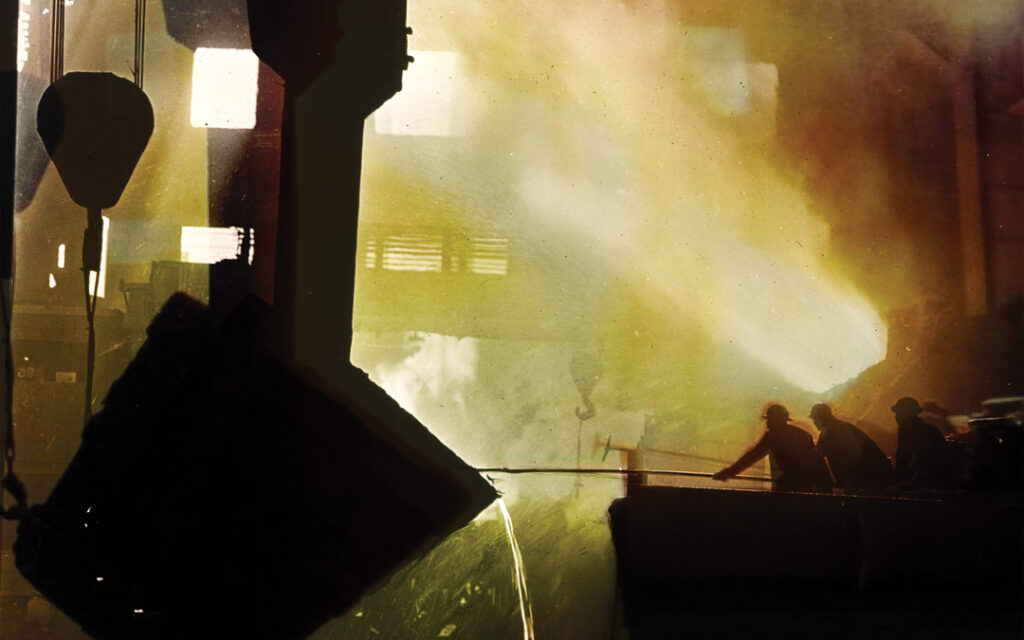
The Baltimore Museum of Industry explores the legacy of Sparrows Point.
It’s virtually impossible to contemplate Baltimore’s history without talking about Bethlehem Steel. But how many Baltimoreans really know the story of the steel mill’s rise and fall?
A new exhibition by the Baltimore Museum of Industry sheds light on the mill’s 125-year history at Sparrows Point, the generations of men and women who worked there and their significant contributions to American industrialism.
“Fire and Shadow: The Rise and Fall of Bethlehem Steel” opens Sept. 21 at the museum at 1415 Key Highway. The exhibition is part of a larger initiative called the “Bethlehem Steel Legacy Project” underwritten by Tradepoint Atlantic, the company redeveloping the Sparrows Point site. The project also includes a photography exhibition by J.M. Giordano, an open-air installation called “Women of Steel” installed during the pandemic and a six-part podcast series hosted by WYPR’s Aaron Henkin.
Founded in 1887 as a subsidiary of the Pennsylvania Steel Co. and acquired by Pennsylvania-based Bethlehem Steel in 1916, the enormous industrial complex known as Bethlehem Steel (for its parent company) and Sparrows Point (for its location) was built on a peninsula near Dundalk.
By the mid-20th century, Sparrows Point — which manufactured both steel and ships — was the world’s largest steel mill and employed more than 30,000 Baltimoreans.
But by the late 20th century, Sparrows Point was on the decline. A casualty of the dying American steel industry, the company went bankrupt in 2001. For the next nine years, Sparrows Point was sold and resold until it was finally shuttered in 2012.
The closing of the mill devastated workers and their community. The “Bethlehem Steel Legacy Project” is a tribute to those individuals.
“We designed the project as a community outreach-focused initiative because it was really important to hear from members of the community who frankly have felt sort of unheard through the years as Bethlehem Steel went through its death throes,” says BMI executive director Anita Kassof. “Between bankruptcy and acquisitions and more acquisitions that stripped the retirees of their pension benefits and health care, they just felt they had been hurt by the system.”
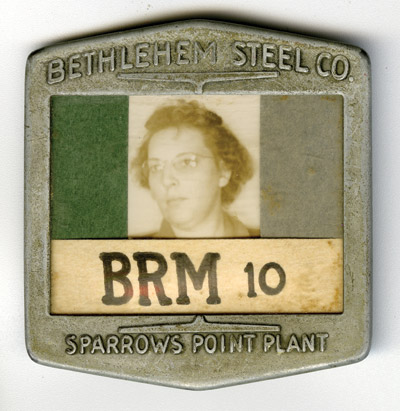
A 60-foot exhibition located at the center of the BMI’s Decker Gallery, “Fire and Shadow” takes up much of a relatively small space. But as exhibition designer Danielle Nekimken explains, “The footprint of the exhibit extends beyond the walls with an augmented reality portion that brings some very large items into the gallery virtually, and audio tour stops that let visitors hear from steelworkers and residents themselves.”
Nekimken says images by such well-known Baltimore photographers as Giordano, Amy Davis and the late A. Aubrey Bodine — along with personal photos from the generations that worked at Beth Steel — reveal the “inner workings of the massive plant and the community built around it.”
Artifacts featured in the exhibition include signs, safety equipment and tools from inside the plant, as well as personal items from workers and residents of Sparrows Point.
Historian Deborah R. Weiner conducted many of the oral histories included in the exhibition. To collect them, she says she “invited myself” to community meetings in Sparrows Point where she shared information about the project with attendees, most of whom had some connection to Beth Steel.
Weiner says she discovered “people really want their stories to be told. They’re proud of the history. The mill made a big contribution to World War I and World War II.” In addition, steel from the mill built the Golden Gate, George Washington and Chesapeake Bay bridges.
“There were stories about what it was like to work in the mill,” she says, “stories about the camaraderie they had, stories about terrible accidents that happened, stories about how terrible they felt when the mill was shut down, how shocking it was and what a devastating event it was for the community.”
As former steelworker John Worth, whose oral history is featured in the exhibition, said in the exhibition, “It was a good life. It was saddening to see that disappear. Work gives people self-respect. Work gives people identity. You feel like that’s part of who you are. I mean, what are people going to do? That’s sad to see, and that’s what I saw at Bethlehem Steel, really, was the goodness of honest work. There’s nothing wrong with honest work.”
For information about “Fire and Shadow: The Rise and Fall of Bethlehem Steel” visit thebmi.org.
Marc Ribot’s Ceramic Dog will bring its blend of rock and avant-garde to Creative Alliance.

The Baltimore Symphony Orchestra looks forward to an interesting season and a promising future.

A streamlined Baltimore Festival of Jewish Literature will be held throughout November.
Here are just a few of the cultural gatherings happening in the area this fall.