
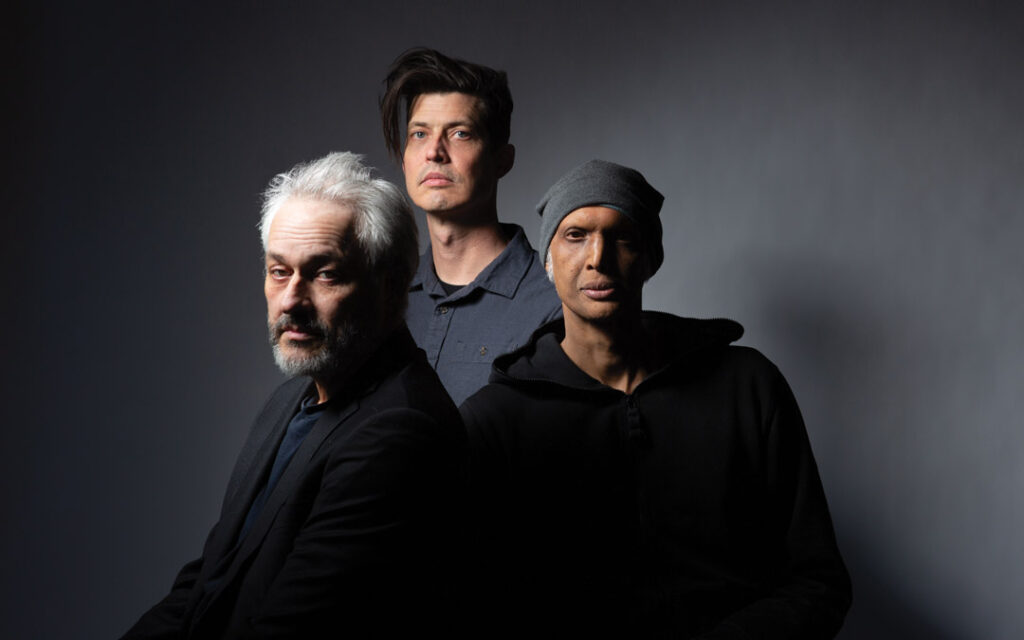
Marc Ribot’s Ceramic Dog will bring its blend of rock and avant-garde to Creative Alliance.
Yes, his name may sound somewhat French, and he’s been hailed for his virtuosic playing of son montuno, the music of the eastern mountains of Cuba.
But when all is said and done, acclaimed guitarist Marc Ribot owns up to being simply a nice Jewish guy from the Garden State with eclectic tastes in music.
“I don’t genre-hop but when I hear something I like, I want to know where it comes from,” he recently told Jmore from Trieste, Italy, while on a European tour. “I’m trying to get past the concept of genres. I’m looking for a kind of intensity.”
Over the course of his 40-year-plus career, Ribot (pronounced Ree-bow) has played and recorded with a dizzying array of musical luminaries — Elton John, Chuck Berry, Wilson Pickett, Elvis Costello, Tom Waits, John Mellencamp and Norah Jones, to name a few. Among his frequent collaborators is producer T Bone Burnett, with whom he worked on “Raising Sand,” the Grammy Award-winning CD by Robert Plant and Alison Krauss.
But Ribot’s own personal musical proclivities tend to mine the offbeat, alternative and irreverent, as evidenced by the title of his 1999 album, “Yo! I Killed Your God.”
Marc Ribot’s Ceramic Dog will perform Friday, Oct. 8, at 8 p.m. at Creative Alliance, 3134 Eastern Ave. in Highlandtown. The Ceramic Dog trio, which has been recording together since 2008, includes bassist/multi-instrumentalist Shahzad Ismaily and drummer Ches Smith.
Their latest (and fourth) outing is “Hope” (Northern Spy Records), which was recorded at Ismaily’s Figure 8 Recording studio in Brooklyn, New York. Despite the album’s sanguine title, the songs on “Hope” — most of which were composed at the height of the pandemic by Ribot, who also sings on the record — explore the flimsiness and futility of life.
“I wasn’t trying to bum people out,” he said. “We had a great time writing and recording the record. But the lyrics are what they are. This is what we were feeling. I’m very happy with the record.”
New York Magazine wrote of “Hope,” “Guitarist Marc Ribot’s wildest project doesn’t mess around. The guitar legend, with bassist Shahzad Ismaily and drummer Ches Smith, merges funk backbeats with the taut chaos of Sonic Youth and flashes of Woodstock Santana.”
AllMusic called “Hope” an “absolute scorcher. … This band can do nearly anything.”
Born to a well-to-do family in Newark and raised in nearby South Orange, Ribot began studying guitar at the age of 11 and played in high school rock bands. “I wanted to play like Keith Richards,” he said.
Now 67, Ribot described his parents as “generally supportive” of his musical aspirations. “But at 16 or 17, they sat me down and said, ‘It’s nice you play but it’s not sensible as a career,’” he said. “They weren’t happy when I dropped out my first year of college. But I never asked them for any money.”
In 1978, Ribot moved to New York City and made a name for himself in the downtown experimental music scene. He also became an in-demand session player.
“I’ve just been lucky and worked with a lot of great musicians,” he said. “I don’t usually get nervous around the famous ones. I did at first get nervous around Robert Plant. I thought, ‘It’s Robert [expletive] Plant.’ But he was a very nice guy. … You understand we’re all working toward the same goal, of making something amazing.”
Ribot has recorded more than 25 solo albums and is known for a body of work that touches on myriad musical styles, from rock, Afro-Cuban, blues and Haitian folk to funk, free jazz, avant-garde and soul.
Spin magazine listed Ribot as 47th on its list of the 100 greatest guitarists of all time, calling him “a restless downtown spirit whose music always sounds just as fidgety.”
Ribot — who lists George Benson, Eugene Chadbourne, Hubert Sumlin and Sister Rosetta Tharpe as among his favorite guitarists — shrugged off all accolades. “It’s nice to hear, but technically I’m not that great,” he said. “On the block of Brooklyn I live on, I’m not even the fastest guitar player around. I’ve done what I can with my limitations.”
Ribot said he believes being Jewish informs his music on a conscious and unconscious level.
“I eventually realized that how I approach cover tunes and music history is very talmudic,” he said. “I give myself a lot of freedom to interpret. Free association is part of the tradition. At the same time, I have very little interest in klezmer music. I’m pretty far outside the [Jewish music] mainstream.”
For the upcoming Creative Alliance show, Ribot said he and his Ceramic Dog bandmates plan to simply rock the house.
“That’s what we do. We’re a rock band and we play loud electric music,” he said. “It’s a ritual experience that should charge your brain. That’s what we hope to do in Baltimore. We’ll be playing from ‘Hope’ and other stuff, as well as some improv.”
As for his next musical direction, Ribot admitted he doesn’t have a clue yet.
“Right now,” he said, “all I want to do is take a long vacation and figure that out.” —Alan Feiler
For information about Marc Ribot’s Ceramic Dog at Creative Alliance, visit creativealliance.org/events/2021/marc-ribots-ceramic-dog.

A new exhibition at the Baltimore Museum of Industry sheds light on Bethlehem Steel's 125-year history at Sparrows Point, the generations of men and women who worked there and their significant contributions to American industrialism.
The Baltimore Symphony Orchestra looks forward to an interesting season and a promising future.

A streamlined Baltimore Festival of Jewish Literature will be held throughout November.
Here are just a few of the cultural gatherings happening in the area this fall.