
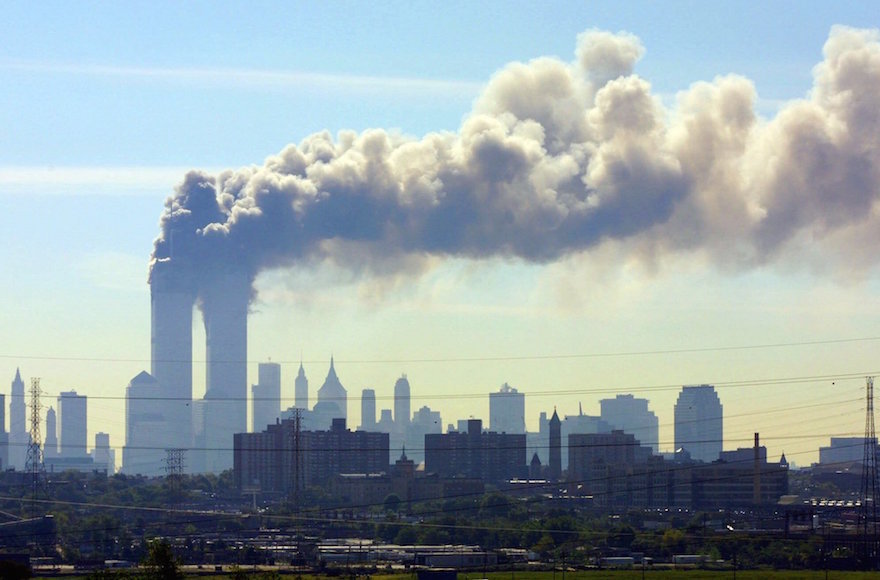
Is there anyone alive these past 20 years who doesn’t remember where they were, and how they reacted, when they first heard the news of the terrorist attacks of Sept. 11, 2001?
Just as earlier generations took to their graves memories of Dec. 7, 1941, and Pearl Harbor, and Baby Boomers will always recall Nov. 22, 1963, and the killing of John F. Kennedy, we remain haunted by the awful moments that arrived 20 years ago this week.
Where were you?
If you worked in downtown Baltimore, chances are you heard the news and went to your car. In the immediate aftermath of the attacks, there was traffic gridlock all over the city’s central area. Little more than an hour later, though, there were almost no cars on the street, and almost no pedestrians on sidewalks.
Downtown was a ghost town. The radio was reporting bomb threats in Baltimore. No one knew if we might be the next terrorist target.
If you were Martin O’Malley, then mayor of Baltimore, you were headed up the New Jersey Turnpike, about an hour from the Holland Tunnel entering New York. He wanted to help his brother Patrick’s campaign for a City Council seat there.
Then came a phone call telling him America was under siege, and he needed to come back home. O’Malley speeded back to Baltimore and rushed into city police headquarters for a press conference, wearing a shirt and jeans.
He had to get past an officer at the front door, William Harris, who wore riot gear and carried a submachine gun. On an intercom, a voice could be heard, saying, “All personnel — police and civilians — must display identification in the building.” Suddenly, police veterans had to identify themselves to each other. No one was beyond suspicion.
In a small first-floor conference room, a dozen reporters and photographers were gathered as O’Malley walked in. He stood next to then-Police Commissioner Ed Norris, who was urging calm.
“Have there been any bomb threats?” one reporter asked.
Norris shrugged. Bomb threats were routine business on the best of days, he said. This was meant to be reassuring. There was no indication Baltimore was a target, Norris said.
O’Malley echoed Norris. Stay calm, he said. There was a studied reasonableness to his tone. This is Baltimore, he was saying, and not New York; it’s Baltimore, and not the Pentagon.
It hadn’t occurred to anyone yet: If O’Malley had left for New York an hour earlier that morning, he might have been standing nearby as the planes hit the Twin Towers.
Almost everywhere, the morning had a certain Pearl Harbor feel to it, as if the earth had spun off its axis and we’d all suddenly entered some new era from which there would be no return.
When I left police headquarters and walked to Baltimore Street and Guilford Avenue, my car was the only one on the street. A policewoman, Renee Holmes, stood there to direct traffic, but there was no traffic to direct.
A couple of guys from the city’s Department of Public Works passed nearby. One of them pointed a block east on Baltimore Street, toward The Block’s strip joints and porn shops. The street was empty.
“Look at that,” one of them said. “When The Block is empty, you know it must be serious.”
It was still possible to tell jokes at that hour. We didn’t yet know the numbers of the dead. We didn’t know the full extent of the heartache, nor the 20 years that would follow of endless war and political convulsion, and the haunting that would cling forever to a whole generation.
A former Baltimore Sun columnist and WJZ-TV commentator, Michael Olesker is the author of six books. His most recent, “Front Stoops in the Fifties: Baltimore Legends Come of Age,” was reissued in paperback by the Johns Hopkins University Press.
As millions mourn the passing of Stephen Colbert from the airwaves, Michael Olesker looks back on the "institution" of late-night TV.

As he gets ready to leave for California, Rabbi Daniel Cotzin Burg looks back on his time in Baltimore and his 10 years writing for Jmore.
Michael Olesker pays tribute to WJZ’s retiring Marty Bass, a longtime fixture on local TV screens.