
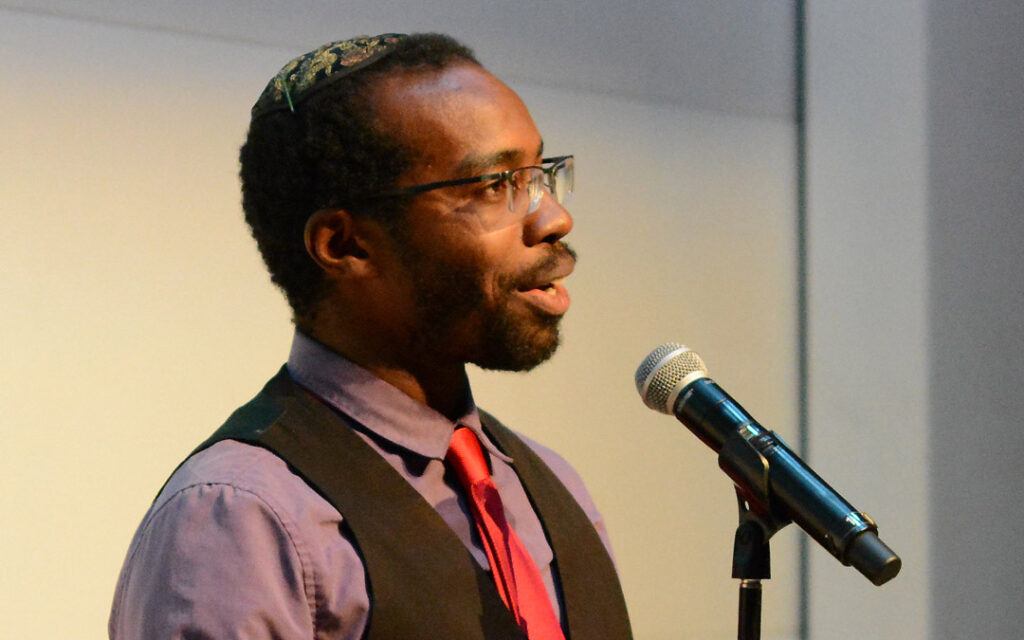
Though he’s not yet 40, Rabbi Shais Rishon — who writes under the pen name of MaNishtana — has already accomplished more than most people do in a lifetime.
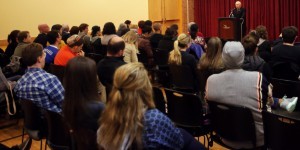
On Sunday morning, Sept. 12, Rabbi Rishon was the featured speaker at the annual Shoshana S. Cardin Leadership Symposium hosted by Na’aleh, an agency of The Associated: Jewish Federation of Baltimore.
He spoke about proximity — physical and emotional — to other individuals and to God during the Jewish month of Elul. Attendees can participate at an in-person watch party or via Zoom.
Rabbi Rishon is a New York-based educator, playwright, public speaker and author of three books about Jewish and African-American identity. His first novel, the semi-autobiographical “Ariel Samson: Freelance Rabbi” (Multikosheral Press), was a finalist for the 2018 National Jewish Book Award’s Goldberg Award.
Currently, he is working on “A Traditional Torah Commentary for the 21st Century.”
A Black Orthodox Jew whose African-American Jewish lineage on his maternal side dates to the 1780s, Rabbi Rishon is a native Brooklynite who grew up in the Chabad-Lubavitch movement.
He recently spoke with Jmore about his work, beliefs and the experience of being a Jew of Color in America.
Jmore: It’s now estimated at least 20% of Jews are of color. But many white Jews are very surprised when hearing that. What’s been your experience?
Rabbi Rishon: It’s very interesting and cognitively dissonant. Every year when we celebrate Purim, we’re talking about the Jewish communities that existed from India to Ethiopia. It says it right there in the text. Those communities and people in those communities don’t disappear when you finish reading about them.
We believe that Jews were scattered to the four corners of the Earth. That means the actual four corners of the Earth.
There is the ‘How are you Jewish?’ question. And in a lot of these situations, because I’m highly sarcastic, I’ll respond, ‘Fine, thanks. How are you Jewish?’ Or you get, ‘You don’t look Jewish.’ [His response is] ‘Oh, you don’t look like a jackass.’ So it’s that kind of back and forth.
I’ve sort of learned to answer the question that is being asked, not the question that you know they’re asking.
It feels sometimes like you’re walking through your own house and a set of gates just gets thrown up, just pops up in the middle of the floor. It’s, like, ‘No, this is my house, too.’
Some in the Jewish community take issue with the Black Lives Matter movement, saying it’s anti-Semitic and anti-Israel. What’s your take?
Seeing the reactions [of some Jews] to Black Lives Matter was very disheartening. You can’t get behind a movement that thinks [Black people] shouldn’t randomly get shot by police.
And the whole debacle of, ‘Oh, Black Lives Matter came out with a platform, and they’re anti-Semitic and anti-Zionist in it.’ When Black Lives Matter started, [white Jews] weren’t there at the table. You didn’t join. The first people that joined were Palestinian activists. That’s where that came from. And the Jews that joined afterwards were Jews that were anti-Zionist. So you can’t not show up to the table, then complain there’s not a space for you at the table.
Then, people say Black Lives Matter came up with a manifesto. No, it didn’t. Black Lives Matter did not because Black Lives Matter is not an organization. It is a movement. It is a hashtag. It is an ideology. There is the Movement for Black Lives, which is an umbrella organization of Black Lives Matter-affiliated organizations and groups. They came out with him a manifesto and bulletin.
Part of that manifesto and bulletin said as a demand, it wanted America to withdraw from all foreign conflicts that it was involved in. For example, our wars in Israel and the Middle East. So one part of the manifesto wasn’t inherently anti-Semitic. It was saying it didn’t want America fighting in any of the wars. Israel was an example. But this was maybe two sentences out of at least a 40-page document.
So to say that you can’t stand by an organization where 98% of what it’s saying has nothing to do with [anti-Semitism and anti-Zionism] and 2% does is very irritating.
What will you speak about at the Cardin Symposium?
It’s kind of tied into the concept that right now we’re in the month of Elul and there’s this idea that the king [God] is in the field, meaning that God is closer. So, you might say, ‘Let me do all these mitzvot while he’s watching.’ But if you continue doing terrible things, that might be more detrimental. [So God might say], ‘Oh, so you’re just going to continue doing the terrible things, even though I’m standing here. What? Really?’
Do you think the Jewish community is making progress in dealing with racism?
No. [Some people think] liberal Judaism or non-Orthodox Judaism is more accepting when it comes to things like race, but it’s pretty much like Northern and Southern racism.
In the South, a white person might ask a Black person, ‘What are you doing here?’ And in the North, a white person might ask a Black person, ‘So what’s your story?’ It’s the same thing. One happens to be more blatant and one gives you, like, some sugar iced tea with it.
How can we make this better?
You have to be in an actual relationship with people, not just a superficial one. People will tell you their story when they want to tell you their story, over the course of time. That’s not going to happen the first time you meet them at a kiddish.
I remember this story about a rabbi somewhere in the South, I think. And [the rabbi said], ‘Oh, we have a new Hispanic family. I don’t know how to welcome them. What should I do?’ he asked.
You could start with, Shabbat Shalom.
On its "Five Minute Histories" series, the preservation group recently looked at the historic "Shul in the Park," now and then.
Stewart, a business attorney, believes trust and affordability are the county's biggest obstacles.
The County Councilman from the 2nd District feels that transit-oriented developments can help meet pressing priorities.
The gathering on June 4 will be part of activities and programming around the world marking "Holocaust Survivor Day."