
This article is part of Jmore’s October 2021 Innovations in Health Care issue.
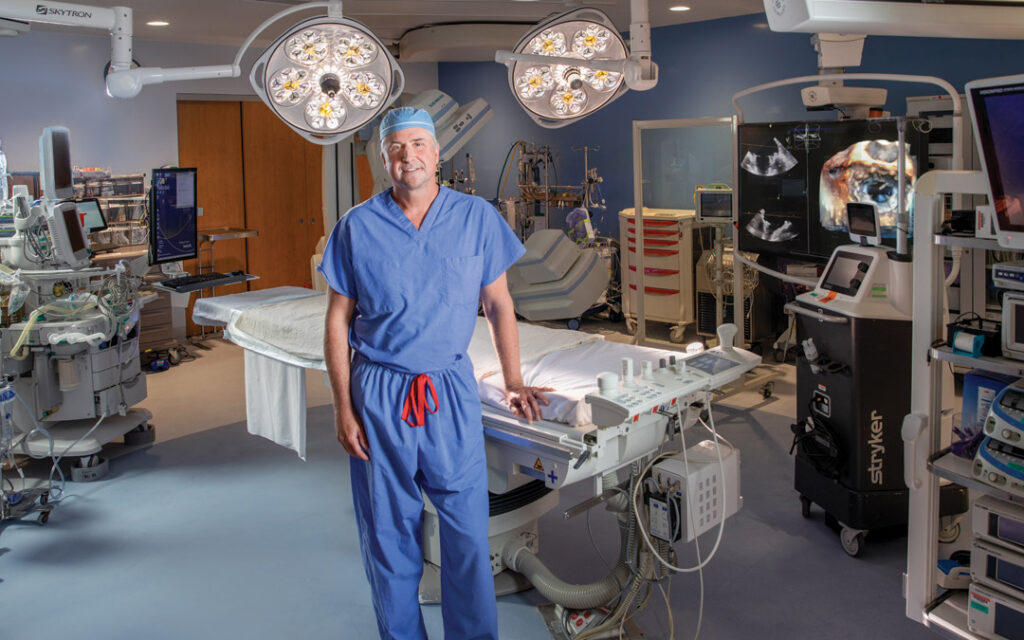
For individuals who suffer from atrial fibrillation (commonly referred to as AFib), a procedure known as Hybrid AF Convergent Therapy — performed at MedStar Health Union Memorial Hospital in Baltimore and MedStar Washington Hospital Center in Washington, D.C. — offers the opportunity to return to a more normal life.
The risk of AFib, an irregular heartbeat that you may not even be aware of until it is discovered during a physical examination, increases as we age.
Those who have symptoms may experience palpitations, weakness, reduced ability to exercise, fatigue, lightheadedness, dizziness, shortness of breath and chest pain. These symptoms can be both frightening and debilitating and can worsen over time. More worrisome, however, is that AFib can significantly increase one’s risk of stroke.
MedStar Health was the first health system in the Baltimore-Washington area to offer Hybrid AF Convergent Therapy, with MedStar Washington Hospital Center performing the first such procedure in this region in 2011. This treatment is especially suited for patients who have had long-standing, persistent atrial fibrillation (LSPAF) for more than a year.
In the past, patients with LSPAF have been difficult to treat, and about half suffer from progressively worsening symptoms.
“AFib is an increasingly serious public health problem because millions of Americans have it. The numbers keep growing as our population ages, and treatments have not always been great,” says Dr. Zayd Eldadah, director of cardiac electrophysiology at MedStar Heart and Vascular Institute.
With recent approval from the U.S. Food and Drug Administration, Hybrid AF Convergent Therapy has moved to the forefront of treatment options.
Dr. Brian Bethea, vice chief of cardiac surgery at MedStar Union Memorial Hospital, says the two-part procedure joins the specialties of cardiac surgery and electrophysiology.
During the first procedure, the cardiac surgeon makes a 2 centimeter upper abdominal incision; the surgeon is aided by a camera that visualizes the back wall of the heart. Radio frequency ablation — heat — is then used to stop the erratic signals that cause AFib.
In a second procedure called endocardial ablation, which is performed either immediately following the first surgery or on another day, an electrophysiologist inserts a catheter through the large vein in the thigh to deliver therapeutic energy to areas of the heart to block the abnormal electrical activity.
“For patients with chronic and worsening AFib, this is their best chance at becoming AFib-free,” says Dr. Bethea.
For information, visit medstarhealth.org/afib.
A former Baltimore resident, Carol Sorgen is a freelance writer based in Portland, Oregon.

Schwab currently serves as president of Cumberland's historic B'er Chayim Congregation.
A former U. S. Marine, Pat Young has served as a Baltimore County Council member representing District 1 since 2022.
Mansoor Shams is known for carrying around a sign proclaiming, “I’m a Muslim and a U.S. Marine. Ask anything.” Now the Baltimore County Department of Recreation and Parks community engagement and outreach officer is running for Baltimore County Executive.
Baltimore native Susan Landsman recently celebrated her rite of passage surrounded by family, friends, fellow residents and staff.