
This article was provided by the Institute for Islamic, Christian, and Jewish Studies (ICJS).
By John Rivera
Interreligious dialogue has made tremendous strides over the last half century. What was once considered extraordinary is now commonplace in many circles: we read and study one another’s scriptures, learn our respective histories, and engage one another on a deep, personal level.
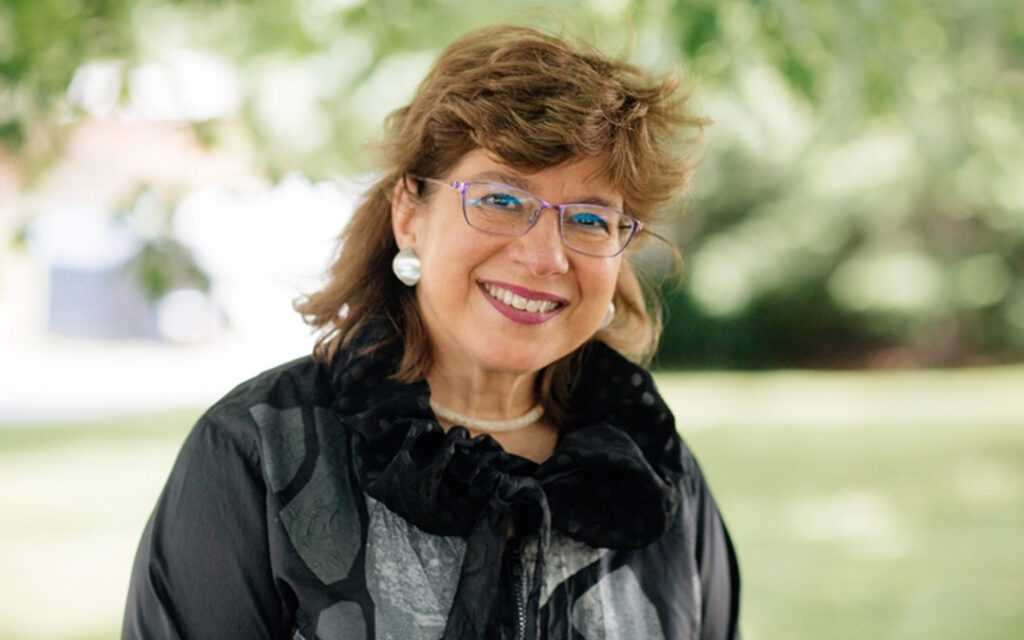
But Susannah Heschel, Ph. D., an award-winning and leading authority on interreligious issues, poses a provocative question: Has our dialogue grown stale and repetitive?
Dr. Heschel will speak on “Recapturing the Prophetic Tradition: A Challenge for Interreligious Dialogue” for the ICJS Manekin-Clark Lecture. The free lecture is Monday, Dec. 6 from 7:00–8:30 PM at Goucher College’s Kraushaar Auditorium. The event will also be live streamed on YouTube.
The Manekin-Clark Lecture is sponsored by the Baltimore-based Institute for Islamic, Christian, and Jewish Studies (ICJS), an educational nonprofit that offers events, courses, fellowship cohorts, lectures, and scholarship projects to disarm religious bias and bigotry to build an interreligious society.
Dr. Heschel acknowledges that there has been much past and current interreligious scholarship that is excellent and some that is breaking new ground. “The problem is that sometimes the field can get a little stale. I want to hear what’s new, what’s the 21st century agenda, and not simply a repetition of the 20th century,” she says.
One element she finds lacking in much interreligious dialogue is emotion. This is important, because anti-religious prejudice such as antisemitism or Islamophobia isn’t rooted simply in knowledge or ideas, so countering these biases can’t be simply an intellectual exercise. “It’s not just a matter of giving someone a book to read. Because when we speak about malevolence, we’re speaking about an emotion. And emotions can only be changed through other emotions,” she says. “So what’s important about the dialogue that takes place today is that they should be—they aren’t always—but they should be emotionally compelling.”
She recalls seeing the impact of emotion and personal connection when her father, Rabbi Abraham Joshua Heschel, a leading Jewish theologian and philosopher of the 20th century, invited guests from other religions into their home. “I remember from my childhood priests and nuns who came to our home for Shabbat dinner or for Passover seder. It was the first time they had been to a Jewish home from a religious holiday. And they were transformed,” she says.
Another crucial question for future interreligious dialogue is “who are our partners?” Are we too likely to engage with like-minded people, especially in an increasingly polarized religious and political world?
“I think one of the biggest problems today is the lack of dialogue within religious communities, between conservatives and liberals, for example,” she says. “For example, it was much easier for the chief rabbi of the United Kingdom, Jonathan Sacks, to sit down with the Dalai Lama than to sit down with Jewish feminists or Reform rabbis.”
Moving forward, Dr. Heschel believes we can draw inspiration for rejuvenating future interreligious dialogue by looking to our past. She draws on the legacy of her father, whose work and writings on the prophetic tradition offer a model to sharpen future dialogue and inspire us to move beyond the comfort of our own traditions, viewpoints, and assumptions.
“I think one of the crucial questions for us is recapturing the prophetic tradition and what it means,” she says. “And it’s not simply a slogan about social justice or tikkun olam, but is also very much about self criticism.”
Assuming a prophetic stance calls people to speak truths that might offend or make some uncomfortable.
“The prophet is not in an office next to the ruler. The prophet is a very lonely figure and a figure in exile. And has to be, because it is only in that position that one can be critical and have an independent voice,” she says. “And how many people actually care about that these days? That worries me.”
To register for the ICJS Manekin-Clark Lecture with Dr. Susannah Heschel, visit icjs.org/manekin-clark-lecture-2021.
John Rivera is the Director of Communications and Marketing at ICJS.

Colorectal cancer rates are climbing among young people and Ashkenazi Jews.

Commemorations of the Holocaust must transcend the past to include concerns about the present and future, writes Menachem Z. Rosensaft.

Someone needed to tell Donald Trump that his appearance at a UFC fight over the weekend was not a good look, writes Michael Olesker.