

Judge Joseph Henry Herbst Kaplan, a retired judge for the Circuit Court for Baltimore City who was arguably best known for his role during Maryland’s savings and loan crisis of the 1980s, died Jan. 5 at MedStar Union Memorial Hospital.
A Baltimore resident who was born in Brooklyn, New York, Kaplan turned 85 three days before his passing.
“Judge Kaplan dedicated his life and career to public service for the people of Baltimore and the entire state of Maryland,” read his family’s obituary placed on the website of Sol Levinson & Bros. funeral home.
A graduate of the Johns Hopkins University, Kaplan received his law degree from the University of Chicago Law School in 1960. He was admitted to the Maryland Bar the following year while serving as a law clerk to Chief Judge Frederick W. Brune of the Maryland Court of Appeals.
Kaplan became a partner at Venable, Baetjer & Howard, and served in the firm’s litigation department from 1969 to 1977. He was named a judge in 1977.
Kaplan served as an administrative and chief judge of Baltimore’s Circuit Court, where he presided for more than 30 years. He was designated a “living legal legend” by the Bar Association of Baltimore City.
Beides his role in resolving the savings and loan crisis, Judge Kaplan was instrumental in saving the George A. Lucas Art Collection. Kaplan negotiated a settlement that allowed the collection, which includes 18,000 paintings, bronzes and porcelains, to become part of the collection of the Baltimore Museum of Art.
In addition, Kaplan brokered a settlement that allowed the Camden Yards development to proceed, and he advocated for the approval of adoptions without regard for a parent’s sexual orientation.
Also, Kaplan made national headlines in 1995 when he barred the exhumation of the body of John Wilkes Booth, President Abraham Lincoln’s assassin, who is buried at Greem Mount Cemetery in Baltimore.
Kaplan rejected various claims that the grave was occupied by a random individual and that Booth escaped justice in 1865 and lived n the Midwest until 1903. He cited “the unreliability of petitioners’ less-than-convincing escape/cover-up theory.” The Maryland Court of Special Appeals upheld Kaplan’s ruling.
Kaplan retired from the bench in October of 2006.
He served on the board of trustees for the Baltimore Bar Foundation and the Baltimore City Historical Society. He was also involved in the Big Brothers and Big Sisters of Central Maryland.
In a 2014 profile on Kaplan titled “The Best Judge You Never Heard Of” for the Duke Law School scholarly journal Judicature, U.S. District Court Judge Paul W. Grimm wrote, “I watched Judge Kaplan carefully during the years I appeared before him. The first thing I noted was that no matter how complex the matter, or how quickly it had been set in, he always was prepared. He had read the filings, and studied the law. Not once did I hear him announce, at the start of a well briefed motions hearing, the words that signal that the judge has not read the papers: ‘Well now, counsel, what’s this matter all about?.’ Usually, he knew the issues and the law better than the lawyers did.
“The second thing I noticed was how he treated everyone who came before him,” Grimm wrote. “He was courteous to every lawyer, party and witnesses who appeared before him. I never saw him lose his temper or display anger. And, I noticed that the dignity that he displayed influenced how the other lawyers, myself included, behaved towards each other and the court. …
“Judge Kaplan also displayed enormous common sense,” he wrote. “Many judges are brilliant on the law, but seem out of touch with the real world. Judge Kaplan was a scholar of the law, but also pragmatic and end-result oriented.”
On the Sol Levinson website memorial page, E. David Silverberg, a Towson lawyer, wrote, “Joe’s life and his commitment to the Baltimore legal community specifically and to the citizens of Baltimore in general are his legacy. There was no finer Judge.”
Wrote local attorney Elliot N. Lewis: “Judge Kaplan was a great judge, but more importantly he was a great person. May his memory be a blessing to his family, and may he Rest In Peace.”
Kaplan is survived by his wife of 59 years, Joy Kaplan (nee Keller); his children, Elizabeth M. (late Dr. Bryan Paul) Fitzgerald, Katharine Herbst Kaplan (Dr. Lance Bryan Bush), and Dr. Frederick Thomas D. Kaplan (Linda Halvorsen Kaplan); his grandchildren, Sarah Fitzgerald Sacco (Ryan Thomas Sacco), Hailey Fitzgerald Hughes (Matthew Daniel Hughes), Cassandra Lee Kaplan, Thomas D. Kaplan, Chloe Isabella Kaplan, Kaitlyn Rose Kaplan, Ella Grace Osdoba, Devon Rashid Bush, and Sebastian Hunter Bush.
Kaplan was predeceased by his parents, Dorothy Herbst Kaplan and Irving E. Kaplan; and sister, Ellen Kaplan Kohn.
Memorial services for Kaplan will be held in the spring. Contributions in his memory may be sent to the Baltimore Courthouse and Museum Foundation, c/o Robert Gaumont, Esquire (Treasurer), Gordon Feinblatt, LLC, 1001 Fleet Street, Suite 700, Baltimore, Maryland 21202.

Weekend Backpacks is partnering with Heritage | MileOne Autogroup for the largest corporate volunteer engagement and donation initiative in the organization's history.
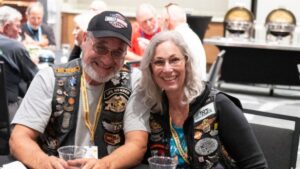
Pikesville residents David and Wendy Hefter recently joined Jewish motorcyclists from around the world to raise money for victims of the Oct. 7th terrorist attacks in Israel.
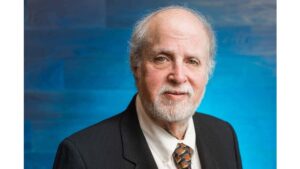
Attorney and Barry Levinson confidante Donald Saiontz left his mark on the world, writes Michael Olesker.

A new educational initiative helps Israel’s ethnic and religious minority communities understand their own stories and appreciate what democracy looks like in a diverse society.