
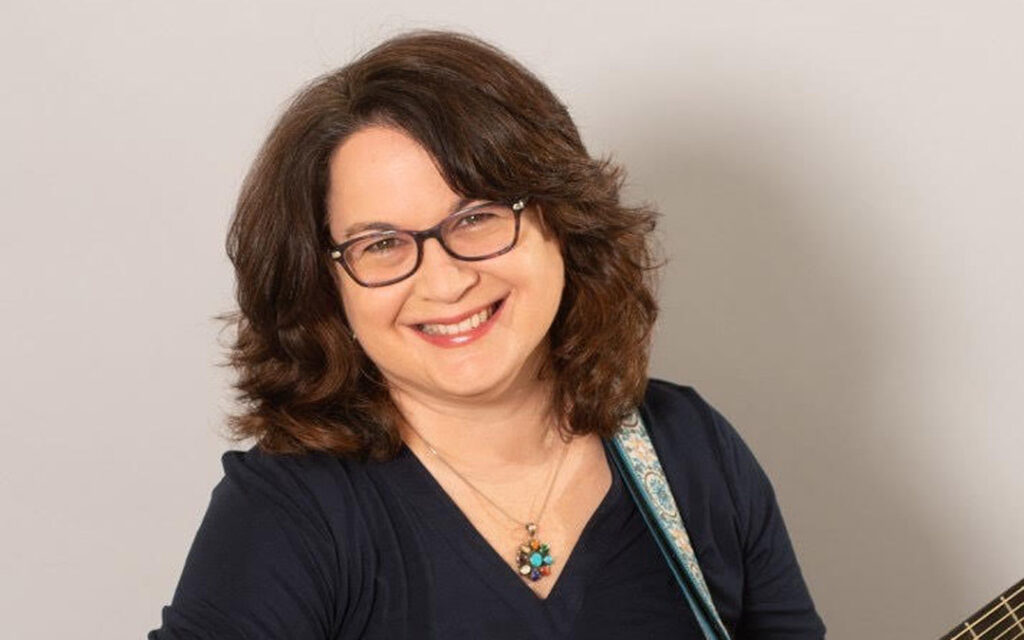
Music has the power to awaken and shake people up emotionally, psychologically and spiritually, says Cantor Caitlin McLaughlin.
“Music is something that can be a regular part of life,” she says. “It can be involved in social justice activities. We can kick ourselves up with some music to dedicate and focus our minds.
“For me, music has been about a sense of something transcendent and divine that is different from our mundane experience of the world. It’s a way to tap into an energy that some people call God.”
A Philadelphia area native, Cantor McLaughlin recently joined the clergy staff at Oseh Shalom, a Reconstructionist congregation in Laurel founded in 1966. She succeeds Cantor Charles “Charlie” Bernhardt, who came to the congregation in 1983 and now serves as its cantor emeritus.
“I am delighted to join the Oseh Shalom community as its new cantor,” she says. “I’m so deeply grateful for the warm welcome I’ve received already. I knew right away from my visit in November that Oseh Shalom is a community that loves making music, praying deeply and doing justice, and a place where my family and I would feel at home.”
Cantor McLaughlin says her predecessor sings occasionally at synagogue services, and she lauds him for his “amazing legacy” at Oseh Shalom.
“He’s my friend already,” she says. “He’s got a lot of insider tips to share and gave me a tour of the building, the sound system and the secrets of the ‘Cantor’s Closet.’”
She also sings the praises of the synagogue’s spiritual leaders, Rabbis Daria and Josh Jacobs-Velde, for their spirit of Jewish renewal and being “open to flexible and innovative ways to structure the services. We’ve already experimented, and I love that they’re open to that. It’s a huge asset that we can share creative ideas.”
Cantor McLaughlin earned a bachelor’s degree in psychology and minoring in vocal studies at Temple University in Philadelphia. She also has a master’s degree in music from the University of California, Irvine. She has led choral groups in schools and congregations in California, New England and Minnesota.
Prior to coming to Oseh Shalom, she served as a cantorial soloist at Temple Emanuel in the Montgomery County town of Kensington, Rockville’s The Jewish Studio, Bethesda Jewish Congregation and Adas Israel in Washington, D.C.
A Silver Spring resident, Cantor McLaughlin says she was born into a “blended” family with a non-Jewish father. Her mother got remarried to a Jewish man, and she says she was raised in an “observant Conservative” household.
While in graduate school in Southern California, she became involved in a Reconstructionist synagogue there and took a leading role in congregational life there. She also served as a cantorial soloist at the Roth Center for Jewish Life in Hanover, New Hampshire, but eventually decided to pursue psychology as a career. Music, she says, took a “backseat” and she became a “weekend musician.”
But after relocating to the D.C. area in 2006, Cantor McLaughlin and her husband, Tim, became involved in social causes and put down roots at Kensington’s Temple Emanuel.
She says she wound up falling in love with the congregation and played in its Mizmor L’Shabbat “house band,” gradually becoming the temple’s cantorial soloist.
In the wake of her two children, Lydia and Ben, pursing their life dreams, Cantor McLaughlin says she decided to “spread [her] wings” and immersed herself in the cantorate.
She says that liturgical music is a way of transcending everyday life to express and explore one’s Jewish identity.
“When I think of praying, that concept is where I experience a connection to God and divinity,” Cantor McLaughlin says.
She says she tries to transmit that feeling to others, and she’s a big fan of communal singing as “the heart” of the worship experience. She says she always tries to lead songs and prayers in a “singable key,” and incorporates folk and pop musical style into services.
In particular, Cantor McLaughlin says she wants to connect with the younger generations at Oseh Shalom. The congregation has a program called Team Connect, which is attempting to mix youth service leaders with already-established song leaders at the synagogue.
During services, Cantor McLaughlin usually relies simply on her voice and guitar, but she occasionally employs her “survival piano” skills.
“It’s just enough to lead a choir rehearsal,” she says, “but it’s a must-have and incorporates more of what the congregation likes to listen to.
“Singing and communicating with other people is a sacred activity, regardless of how perfect it is. It is a holy experience,” Cantor McLaughlin says. “I feel so fortunate to do that as a cantorial soloist.”
Nicholas Elliott is a Jmore editorial staff intern.
The BCO, founded in 1984, will perform the works of Frank Zappa, Beethoven, Mason Bates and Karena Ingram.

For more than 130 years, Sol Levinson & Bros. has been woven into the fabric of Baltimore’s Jewish community.
Led by local Israel-American cellist Amit Peled, the Mount Vernon Virtuosi aims to inspire people beyond musical enjoyment.

A former college campus activist, Veksler will speak at Chizuk Amuno on June 8 at the Ruth and Jay Lenrow Visiting Scholar-in-Residence for Combating Antisemitism.