

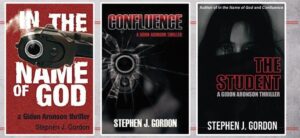
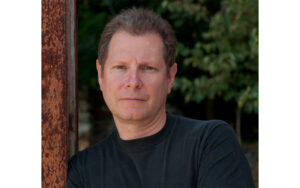
Pikesville-based author Stephen J. Gordon recently published a third installment of his Gidon Aronson thriller series.
In “The Student” (Apprentice House), the protagonist — an American who served in the Israel Defense Forces — promises a Mossad officer to check in on Noa, the officer’s niece who attends a college in Baltimore. What begins as a simple monitoring favor develops into a far more serious situation involving foreign intelligence and murder, leading Aronson to take on a personal undercover operation.
Jmore recently spoke with Gordon, a Baltimore native and retired history teacher at Krieger Schechter Day School, about this latest installment in his series.
Jmore: What inspired the Gidon Aronson series?
Gordon: I wanted to present Israel in a positive light without getting political or talking about the country’s politics. During the Second Intifada, my wife and I visited the north of Israel, and at the time Israel was getting really bad international press. I had been writing for years, since junior high school, and I thought, ‘What can I do to contribute to Israel’s image?’
I decided to create a mystery thriller series, because that’s the kind of stuff I like, and have it be about an American who moved to Israel. Then, I built the character up from there.
By design, the books are split between Israel and the U.S. The main character is an American who made aliyah to serve in the IDF. He developed PTSD, came back to the States and had to rebuild his life in that situation. I designed the books so that the mysteries he would get involved with would take him back to Israel. One of Gidon’s best friends in the book is a Palestinian security guy, and they get along really well. I have some scenes in the book about Israeli soldiers helping out Palestinians. It’s not all what you see in the mass media, and I wanted to present things like that.
What can readers expect with ‘The Student’?
The impetus for the hero’s involvement is something quite current: the ongoing anti-Israel sentiment on many college campuses by some student organizations. Also, we see a less sure-of-himself protagonist who doesn’t always make the right choices. It’s a layer of Gidon we haven’t seen before, and become hopefully part of his growth. Of the three books in the series, I like this one the best. I think it has more meat to it. I’ve also grown as a writer, and I think the writing’s more mature.
What do you like most about Gidon?
He’s very human. He’s really good at what he does, but his life is falling apart because of his PTSD, and he’s unsure of other parts of his life. He’s got very tough parts about him, and he takes things around him seriously, but he also has a sense of humor about himself.
What part of the book was the most fun to write?
I like several of the Israel scenes, and I like the climax to this book. The last third of the book just really takes off, in my opinion. Writing the dialogue between the characters is also something I enjoy because they play off each other through the conversations. It’s really rewarding when the scene works well because the dialogue comes from the characters and they can have a good time with each other. When they can kid each other, that really is fun for me.
What challenges do you face as a writer?
As the writer of a series, you have the challenge of, is the reader going to be following the series in order or as a stand-alone? I created each book to work both as part of a series and as a stand-alone. That way I can develop the character from the previous books in a way that’s still fresh and not repetitive.
What’s some of the feedback that you’ve gotten about the series and character?
From readers in general, the feedback has been very positive. Gidon has various personal relationships, so some of the feedback is, ‘He should continue his relationship with so-and-so” or “I don’t like so-and-so.” It’s nice when people react as if the characters are real. That’s a real compliment.
How do you research your stories?
Some of the stories are projections based on what I’ve read about intelligence operations. And part of it is talking to people. For example, on a trip to Israel with KSDS, I visited the Lone Soldier Center in Jerusalem. We had a speaker talking to the eighth graders who was an oleh [immigrant] in Special Operations. I actually said to him, ‘My wife and I are coming back in the summer. Can I take you to coffee then?’ We ended up speaking for several hours and he told me about various operations that he was allowed to talk about. I got the verisimilitude that I wanted for operations, and from there I would extrapolate and build scenes. Also, when you have family and friends in Israel, there’s stories all over the place about the military. They’re my sources for details.
Are your stories inspired by any real-life people or experiences?
There are some personal experiences that make it into the book. The character is part-me in a way. My wife says that the character is who I wish I were. I say he has my sense of humor. As a writer, you create characters who are conglomerates of people you know. And then their elements are just fabricated. But the characters have to have elements that are rooted in something realistic. They have to have logical, realistic reactions to things.
What are your favorite books to read?
I generally like mystery thrillers. Daniel Silva is a favorite author. Robert B. Parker, who created the Spenser detective series out of Boston. Lee Child, Robert Dugoni and Michael Connelly are also favorites. On the non-fiction side, I like books that put Biblical events in historical context.
What do you love about thrillers?
Thrillers are present-day, so they are rooted in a certain amount of reality. And I like the mystery of it. Also, thrillers usually have deadlines of some sort, which adds structure. The main character has to resolve the issue because there’s some pressing event that’s going to happen that they need to unravel. For me, it’s very exciting, it’s what I’m drawn to.
What do you hope readers get from your books?
I want to get people to see Israel in a positive way. I also want them to have a love of this character because of who he is. I tried to create a multi-dimensional character who has a very specific moral compass that drives him. It’s creating a likeable character that you can identify with. When you write a book like this, you’re really creating a world. And I really do think people will enjoy it.
What do you see for the future of the series?
In the next book, I would like to see more character reveal of Gidon’s friends. I want to get into his Palestinian security friend’s background. I also haven’t fleshed out Gidon’s own family background yet. I still want to go back and forth to Israel, but I don’t want to be doing the same formula. There’s a certain structure to the books, and I want to mix it up a little bit. That will be a big challenge, to step out of that formula to some degree. I don’t want to be derivative of myself.
As long as I’m happy with what I produce, as long as people keep asking me, ‘When’s the next one coming out?’ we’ll keep going.
“The Student” is available for purchase at The Ivy Bookshop, 5928 Falls Road in Mount Washington, or on Amazon. For information about the author, visit stephenjgordonbooks.com.
Hanni R. Werner is a Baltimore-based freelance writer.
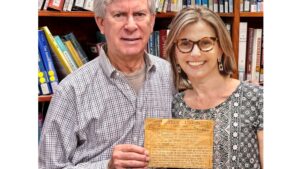
Duke Zimmerman and Lori Gale will talk at Towson University about their new book "People Get Ready" and the role played by Globe Posters in the civil rights movement.
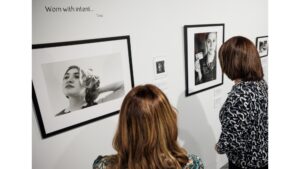
The new exhibition revisits and updates a previous show about ritual hair covering in the observant community.

One of the most competitive local races for public office this political season is for Baltimore County Executive. Jmore recently spoke with four of the candidates about their views on how they hope to enhance life in the county.
The Pikesville resident's latest offering "There's a Dragon in the Tree House and He Won't Come out!" was co-written with her grandsons.