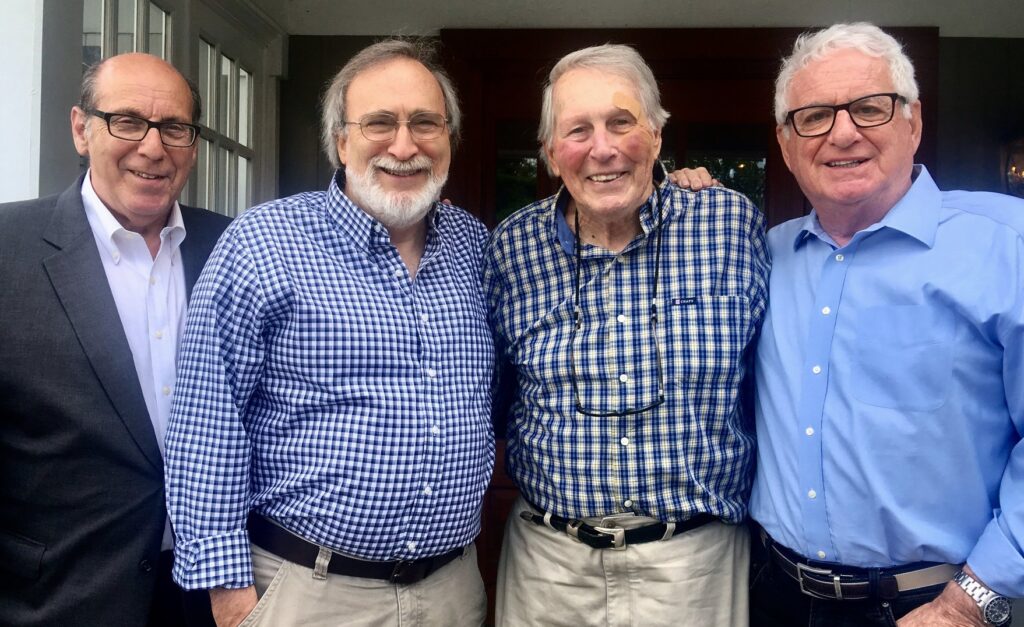
Brooks Robinson arrived here in the summer of 1955 when Dwight Eisenhower was in the White House, Nancy D’Alesandro was a teenager down in Little Italy and Robinson was an 18-year-old getting his first workout at a ballpark over on 33rd Street.
If you need another measure of time, here’s one: Brooksie turns 85 this week.
He’s grayer now and a little slower going to his left. But it’s still No. 5 all right, whose birthday reminds a few generations around here of time’s unstoppable flight.

After all these years, he’s still the iconic Oriole, still our picture of a generous soul and still the measure of the sweetest moments in the entire history of Baltimore baseball.
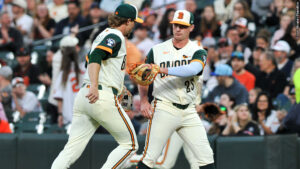
When the newest Oriole, a kid named Rylan Bannon, dived far behind third base last Thursday, May 12, in his first major league game, and threw out a St. Louis Cardinal, wasn’t the comparison instinctive?
It looked like Robinson in mid-domination of the 1970 World Series.
And don’t the old-timers around here — anytime a grounder slips through the left side of the Orioles’ infield — find ourselves muttering reflexively in the Bawlamer grammar, “Brooksie woulda ate that up”?
And isn’t it part of our municipal folklore that some of us still remember the teenage Robinson who went 2-for-4 in his very first appearance in an O’s uniform?
(And isn’t it typical of Brooks that whenever that first game comes up, he modestly replies, “Yup, but I went for oh-for-18 right after that?”)
He turns 85 on Wednesday, May 18. But in the mind’s eye of a few generations who watched him across 22 seasons at Memorial Stadium, he remains our measure of greatness, not only as a ballplayer but as a man.
As the old Associated Press sports editor Gordon Beard said years ago, back when they tried naming a candy bar after Reggie Jackson, “Around here, nobody’s named a candy bar for Brooks. We name our children after him.”
Remember several years ago when they unveiled that statue of Brooks in downtown Baltimore? (It’s the one outside Oriole Park, not inside. I mean, who else gets two municipal statues, much less one?)
As Brooks addressed the big crowd that day, he said, “To you friends out there, you have always been so good to me…”
And then he stopped, to keep himself — and the rest of us — from blubbering and wiped away a few tears, and in a voice cracking with emotion said, “I have never considered you my fans. I have always considered you my friends.”
When the rookie Cal Ripken Jr. started playing third base for the Orioles, he said he felt “like I was standing on hallowed ground.”
Partly, it’s because Cal knows Robinson the baseball player. Partly, it’s because Cal knows the man.
A couple of years ago, Boog Powell recalled his first day of spring training as a nervous 19-year old rookie back in 1961. Boog’s dad drove him to camp. As they pulled up to the ballpark, who’s there to greet them but Brooks Robinson, who introduced himself.
“Don’t worry, Mr. Powell,” he told Boog’s dad with a wink. “I’ll take care of him.”
In the best of times, Brooks Robinson took care of Orioles baseball. Even in the worst of times, he sheltered our memories. For all time, he’s the guy we still name our children after.

Michael Olesker’s newest book, “Boogie: Life on A Merry-Go-Round,” will be published this spring. It’s the life story of Baltimore legend Leonard “Boogie” Weinglass, an original “Diner” guy who grew up to create the Merry-Go-Round clothing chain and contribute millions to charity.
Allow me a few paragraphs of time travel, and let’s go back to Johnny Carson’s monologue the night after Neil Armstrong became the first man to set foot on the moon. I’m paraphrasing here, but I think the joke still works 57 years after Carson first delivered it. “The good Read more

The BCO, founded in 1984, will perform the works of Frank Zappa, Beethoven, Mason Bates and Karena Ingram.

As he gets ready to leave for California, Rabbi Daniel Cotzin Burg looks back on his time in Baltimore and his 10 years writing for Jmore.