
By Jackie Hajdenberg
At Washington Hebrew Congregation in the nation’s capital, a weekend of educational programming is on the agenda for Juneteenth, which will be observed this Sunday and Monday, June 19-20.
Guests at the D.C. temple’s Kabbalat Shabbat service on Friday night will enjoy a dinner provided by a Caribbean catering company featuring such menu items as jerk chicken, green beans and fried plantains. After Shabbat services on Saturday morning, the synagogue will send a group to the Moral March on Washington. On Sunday, there will be a screening of the film, “Who We Are: A Chronicle of Racism in America.”
In Greensboro, North Carolina, Temple Emanuel will tell the story of one of its white congregants who was involved in the Woolworth lunch counter sit-ins during the civil rights movement. In Georgia, the Atlanta Jews of Color Council and Kol Panim will co-host a musical Shabbat at the Distillery of Modern Art.
And here in Baltimore, Repair the World Baltimore, the Baltimore Jewish Council and Jewish Volunteer Connection will present a virtual discussion on Tuesday, June 21, from 6-8 p.m. exploring the themes of Black fatherhood, the ethnic identity of American descendants of slavery and reparations as teshuvah (repentance), in honor of Juneteenth and Father’s Day. (For information, visit werepair.org/baltimore.) Also, at its annual meeting on June 20 at Baltimore Hebrew Congregation, the BJC will recognize the Juneteenth holiday during the program.
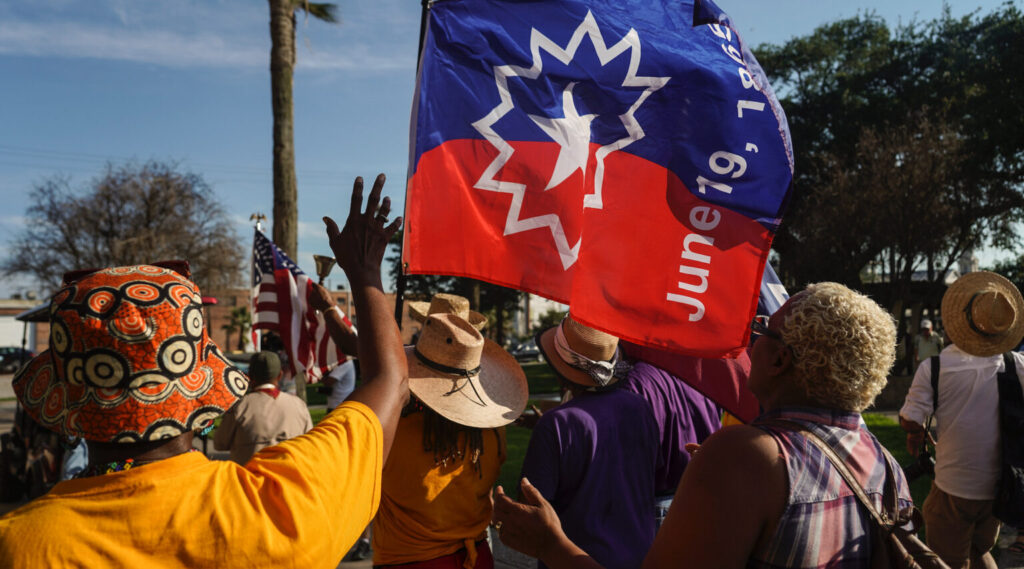
These communities join the many others celebrating Juneteenth in Jewish spaces for the second year of its recognition as a federal holiday. The holiday commemorates the day in 1865 when enslaved Black people in Texas learned of their emancipation, two years after the Emancipation Proclamation.
For many Jewish institutions, Juneteenth is not just an opportunity for solidarity with the Black community, but a moment to grapple with racism in their own spaces. Many of these communities’ celebrations and commemorations will be led by their own members who are both Black and Jewish.
“I certainly hope that this event will be the start of a conversation, not just the end,” said Josh Maxey, head of the Jews of color group at Washington Hebrew.
Two years ago, Washington Hebrew launched a roundtable program to address racial inequity. But Maxey knew that Jews of color needed a place for fellowship, so the affinity group was founded last August.
“It’s really a chance for other Jews of color to come together to celebrate each other and to be themselves and not feel like we have to hide aspects of our identity,” Maxey said. “Sometimes, it’s difficult to walk into Jewish spaces and be the only person that looks like you.”
Amid a national reckoning over racism in the United States in the wake of the 2020 murder of George Floyd, Jewish communities are turning the focus on themselves. And many are finding the ways their actions fail to match their rhetoric of inclusion.
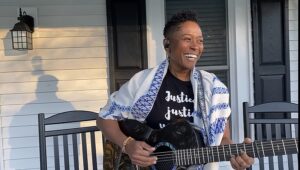
At the Reconstructing Judaism convention in March, attendees of an anti-racist workshop co-led by Rabbi Sandra Lawson, director of racial diversity, equity and inclusion for the Reconstructing Judaism movement, learned about how harmful it is to ask a person of color when they converted, or, during Shabbat services if they know what they’re doing.
Nate Looney, director of community safety and belonging at the Jewish Federations of North America, said this is something he deals with when deciding whether to go to synagogue.
“As much as being observant is important to me, my peace of mind is better guarded if I stay home and observe Shabbat at home, versus going to this new random synagogue and being faced with all the questions that I’m going to get,” Looney said.
“My heart goes out to Jews of color that are struggling with their Judaism and going into these spaces to seek refuge and then are met with this exoticism or curiosity,” he added.
In April, Lawson launched the beta version of a tool for synagogues to assess their racial justice and equity work.
Synagogues have also had to reckon with their attitudes toward security, especially in the wake of antisemitic violence that included the hostage situation at Congregation Beth Israel in Colleyville, Texas, in January. While white Jews might welcome police and armed guards at their synagogues, Jews of color do not feel that same sense of security in their presence, given the disproportionate amount of police violence directed at Black and brown people in the United States.
Looney, a farmer by trade, is now leading an examination of armed security for the Jewish Federations’ equity, diversity and inclusion efforts.
“It’s really important to ensure that individual communities are engaging in these conversations about safety and security, that they’re seeking out the Jews of color in their community to engage them in those conversations as well,” Looney said.
Many of the Jewish Juneteenth programs across the country will touch on these year-round issues for Black Americans. But they’ll also focus on how Black Jews have always been part of the Jewish community by centering Black Jewish voices.
At the Marlene Meyerson JCC Manhattan, ritual leaders Rabbi Isaama Goldstein-Stoll and Marques Hollie — the “Jewsician” — will lead a rooftop music session, followed by a vegetarian potluck dinner. In Elmira, New York, Congregation Kol Ami will host guest speaker Mookey Van Orden, a Jewish day school alum, teacher, theater director and activist, who will give a presentation on how to be a Jewish anti-racist.
“Black Jews aren’t an oddity or something that’s just cropped up since the murder of George Floyd,” Looney said. “We’ve always been a part of the community and have been either hidden or ignored.”
“There’s often a conversation when it comes to talking about the Black community around saying ‘the Jewish community’ and ‘the Black community,’” he added. “I think it’s important for us to shift that conversation some to recognizing that it’s not two separate things, and that there can be overlap.”
Recently, that overlap became tragically evident after a shooting in a Buffalo, New York, grocery store left 13 people dead, 11 of whom were Black. The shooter had been influenced by the antisemitic and racist Great Replacement conspiracy theory, which among other things suggests Jews are behind a plot to “replace” white people with a tide of immigrants and Black and brown people.
In some ways, the parallels between Jewish history and Black history are clear. The central story of the Jewish people — the exodus from Egyptian bondage — echoed with enslaved African-Americans and their descendants, to the extent that Juneteenth seders have become part of Black Jews’ commemoration of the day.
In 2018, Jews for Racial & Economic Justice began hosting an annual Juneteenth seder, creating a haggadah and seder plate that blends the symbols from Passover with traditional foods from the American South such as beets, okra and sweet potatoes.
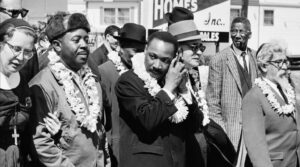
The civil rights movement was the high water mark for an alliance of Jews and Blacks who saw common cause. Rabbi Abraham Joshua Heschel famously marched from Selma to Montgomery with Martin Luther King Jr.; two Jewish activists, Andrew Goodman and Michael Schwerner, and the Black civil rights worker James Chaney were murdered by members of the Ku Klux Klan when they were registering Mississippi’s Black citizens to vote as part of 1964’s Freedom Summer.
In the Jewish world today, though, the challenge is not just interfaith or interracial work to end racism elsewhere, but also dealing with racism in Jewish community spaces, Black Jewish leaders say. Hosting a Juneteenth seder is an opportunity to recognize these issues using a familiar Jewish lens.
“We’re retelling the story of coming into freedom,” Looney said. “And oftentimes within the United States, the messaging to Black Americans is that you should forget about slavery. But as Jews of color, it’s part of our tradition to remember being a part of slavery and being out of slavery. So what does it mean to hold on to something that was 5,000 years ago, but forget about something that was 300 years ago?”
Josh Maxey from Washington Hebrew said his synagogue’s Juneteenth programming serves two purposes: “It’s not only bringing the Jews of color together, but also just educating the community about what Juneteenth is and why it’s important.
“We have to be comfortable with being uncomfortable in those conversations,” he said. “And that’s really the only way that things will change.”
Jackie Hajdenberg wrote this article for the JTA global Jewish news source. Jmore staff contributed to this report.
Jmore is giving away two pairs of tickets to the Orioles' Jewish Heritage Night on May 26. Enter now for your chance to win.
An appeal to New York's Jewish Museum for help cites President Trump’s record of demolition as a real estate developer and history of preservation failures.

Dara Bunjon talks with Joe Lertch and Mark Robinson, co-founders of The Wine Matrix and co-authors of "The Art of Spice & Wine Pairing."

With just five ingredients (plus apples), this apple cake from Elite Jakob is as easy as it is delicious.