

This month, America marks Independence Day, a national holiday celebrating our founding as a republic and declaring our freedom from British rule.
But in 1776, only some American residents were free. First among those without freedom were tens of thousands of enslaved Africans, ripped from their communities and forced into cargo holds and then brutal service on American plantations. For many Black folks, July 4th is complicated, inviting feelings of pride but also resentment, sadness or anger.
This is one reason last month’s Juneteenth celebration was so important, enough for President Biden and Congress to declare June 19th the first new federal holiday in nearly 40 years. Governor Hogan and Maryland quickly adopted the holiday, and a number of other states have done so.
But some have resisted making Juneteenth official. In Tennessee, where the state recognizes observances for Robert E. Lee Day, Confederate Decoration Day and Nathan Bedford Forrest Day (Forrest was the first grand wizard of the Ku Klux Klan and a prominent Confederate general), the legislature failed this year to advance funding for Juneteenth. One state senator said, “I just think we’re putting the cart before the horse making a holiday that people don’t know about.”
The reason for creating holidays is at least in part so more people can learn about them, especially when they highlight historic injustices. Juneteenth marks the end of American chattel slavery, but hardly the end of its impact. In order to better appreciate July 4th, we must be willing to better understand the importance of June 19th. To fully celebrate American freedom, we must also be curious and concerned about the ways that freedom has been so unevenly distributed throughout our history.
The rabbinic sages were sensitive to an investigatory approach to justice. The Babylonian Talmud (Gittin 55a) outlines a debate between the Houses of Hillel and Shammai with regard to a stolen beam:
The Sages taught (Tosefta, Bava Kamma 10:5): If one robbed [another of] a beam and built it into a building, the House of Shammai says: [He must] destroy the entire building and return the beam to its owners. And the House of Hillel says: [The injured party receives] only the value of the beam, due to an ordinance instituted for the sake of the penitent.
The Houses of Shammai and Hillel disagree fundamentally about the best way to right the wrong when one party erects an edifice undergirded by sin. Shammai says the entire building must be unmade. Hillel says restitution must be paid.
As Rabbi Sharon Brous points out: “Neither argues that you can pretend, year after year, generation after generation, that the beam wasn’t stolen. Neither suggests that time rights the wrong. Both understand that the theft, unaddressed, threatens the legitimacy of the whole enterprise.”
This is Jewish tradition’s version of restorative justice, the notion that retribution doesn’t provide sufficient opportunity for learning, engagement or growth. When Hillel’s students say the thief pays for the value of the beam “for the sake of the penitent,” this doesn’t in any way justify the act of theft, nor minimize the impact of such a violation. But it does provide opportunities for growth, even repair between two parties.
As Rabbi Brous writes, “Our country was built on a stolen beam. More accurately, several million stolen beams. Only they weren’t beams. They were human beings.”
The adoption of Juneteenth as a federal holiday isn’t only about Juneteenth; it’s also about Independence Day. Perhaps one day, more of us will be prepared to take more seriously the possibility of reparations for the harm done to millions of African Americans. Until then, keep in mind Dr. Martin Luther King’s 1960 words at Spelman College: “If you can’t fly, run; if you can’t run, walk; if you can’t walk, crawl; but by all means keep moving.”
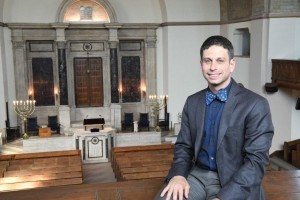
Rabbi Daniel Cotzin Burg is spiritual leader of Beth Am Synagogue in Reservoir Hill, where he lives with his wife, Rabbi Miriam Cotzin Burg, and their children, Eliyah and Shamir. This column and others also can be found on The Urban Rabbi. Each month in Jmore, Rabbi Burg explores a different facet of The New Jewish Neighborhood, a place where Jewish community is reclaimed and Jewish values reimagined in Baltimore.

Jmore Publisher Scott Rifkin, M.D., reacts to President Donald Trump's latest poll numbers and the real force behind the growing decline of the Trump movement.

Last weekend's Flower Mart once again demonstrated that there's nothing to fear about downtown Baltimore, writes Michael Olesker.

A junior at Roland Park Country School, Katie Grossman writes about a recent experience that spurred her to take action to fight antisemitism.

At a time when many Jews fear appearing Jewish in public, seeing Judaism depicted correctly onscreen is reassuring, writes Jewish content creator Rabbi Yael Buechler.