

You could call Adam Gussow a genuine renaissance man. He played the blues harp busking on the streets of Europe and Harlem for a dozen years, has written several well-received books and earned a doctorate in English literature from Princeton.
He is also the last of a vanishing breed: an itinerant bluesman.
Best known as the harmonica-wailing half of the groundbreaking duo Satan and Adam (with the late Sterling Magee), Gussow is now a member of Sir Rod & the Blues Doctors, which performed at The Clubhouse of Catonsville last night, July 13. Besides the harp/percussion ace, the soul-blues trio includes guitarist Alan Gross and singer Roderick “Sir Rod” Patterson, nephew of Magee.
A New York City native who grew up in nearby Rockland County, Gussow, 64, first came to the attention of international audiences after appearing with Magee in the 1988 rockumentary “Rattle and Hum,” chronicling the U.S. tour of the band U2. The award-winning Satan and Adam went on to make five albums and performed around the world.
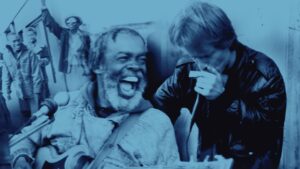
In addition, Gussow has written several books about the blues and race, as well as a memoir (“Mister Satan’s Apprentice”) about his life with Magee. He is currently a professor of English and Southern Studies at the University of Mississippi in Oxford and hosts popular YouTube video tutorials about playing the harmonica.
In 2018, the acclaimed documentary “Satan & Adam” premiered at the Tribeca Film Festival, and streamed on Netflix for two years. The Los Angeles Times called the film –which features cameos by U2’s The Edge and Rev. Al Sharpton — “a moving testament to the boundary-shattering language of music.”
Jmore recently caught up with Gussow before his local appearance to talk about his career, his latest band and their new album “Come Together,” and the magic and mystique of the blues harmonica.
Jmore: What should folks expect when they come to a Sir Rod & the Blues Doctors show?
AG: They should expect a mix of blues, R&B, funk and soul, with a high-energy and positive vibe. Although we’re only a trio, Rod is a true front man. He sings, dances a little and pulls the crowd in.
How would you characterize the music?
We certainly have elements of Chicago blues and Delta blues mixed in. Alan and I have been playing that stuff for a while.
But we also mix in a fair number of Satan and Adam songs, songs that Sterling ‘Mr. Satan’ Magee and I played back in the 1990s, and those songs, although they’re soulful as hell, don’t always follow a blues format.
There’s my original instrumental, ‘Thunky Fing Rides Again.’ Rod and I teamed up on the title song for our first album, ‘Come Together,’ and that almost sounds like the breakaway section at the end of ‘Free Bird’ — just four chords and a groove, over and over.
So how did the band come together?
Long story! Rod saw the documentary on Netflix. He emailed me, ‘I’m Mr. Satan’s nephew. I sing and dance, and I can sing my uncle’s songs. We should get together and do something.’
I was dubious at first, to be honest. How could this possibly work? But we got together and it worked better than any of us could have imagined. It turns out that four years before I first met Sterling, he was living with Rod and Rod’s mom — Sterling’s older sister — for two years. So Rod and I had this uncanny, almost family-like connection, through Sterling Magee. And that immediately showed up in the ease of our musicmaking.
How does the music and style of Sterling Magee influence the band?
Well, I make music from my deep knowledge and feeling of being with Mr. Satan on the bandstand. Some of the harp parts that I play on our songs — like ‘Seventh Avenue’ — are exactly the same harp parts that I played with Mr. Satan.
Rod spent a lot of time woodshedding with old Satan and Adam CDs, and he sounds a little like Sterling — but he also doesn’t sound like Sterling, he sounds like Sir Rod.
The driving groove that I conjure not just on harp but on drums is quite a bit like the old S&A groove. But of course Sterling was a genius of a percussionist, and I’m just keeping the beat.
Do you sing in the band as well as play the harp and percussion?
I sing a handful of songs, but since Rod is our front man, he naturally sings the bulk of our songs.
Alan and I generally warm up the stage before Rod comes on, and occasionally he steps off mid-set to change clothes. That’s when I sing, and Alan sings.
How did your tour wind up in the Baltimore suburb of Catonsville?
A fan of our music told me, ‘You should play this venue!’ She connected me with the folks [the Baltimore County Arts Guild] who book it.
Were you surprised with the reception and reviews of the ‘Satan & Adam’ documentary?
I was delighted that the filmmaker [V. Scott Balcerek] finally completed it after working on the danged thing for 23 years! Anything beyond that is gravy.
But yes, the fact that it premiered at the Tribeca Film Festival was great, especially since it gave me a chance to jam with Sterling one last time. I traveled to 11 film festivals to help promote the film.
I should note that I had nothing to do with making the film. I’m just one of its subjects. I sat for a few interviews and allowed the filmmaker to follow me — and us — around. I don’t have any financial or creative stake in it, except that it tells the story of how Sterling and I forged a brotherhood in the blues, and I’m delighted that that story is out there.
What do you wish it had included or left out?
Well, the first five minutes of the film are hyper-compressed. Essentially, they say, ‘One day Gussow had his heart broken by a girlfriend and the next day he was wandering around Harlem with a harmonica in his hand and he ran into Mr. Satan, and this amazing journey began.’
What the film leaves out is the two-and-a-half years between the day the girlfriend moved out and the day I first jammed with Mr. Satan. They leave out that whole journey, which includes my irreplaceable blues harmonica teacher, Nat Riddles (he’s never mentioned in the film); my time as a busker in New York City, Paris and elsewhere in Europe (never mentioned); my time as a bit of a phenom playing harmonica in the Harlem jazz clubs during the nine months before meeting Mr. Satan.
That’s a lot to leave out, and it does give most people the impression that I simply … started playing the harp after my heart was broken. Nothing could be further from the truth. I was well trained! I paid quite a few dues, then I ran into Sterling, and the next chapter began.
What do you hope the legacy of Satan & Adam will be?
That Martin Luther King Jr.’s conception of beloved community, a redemptive interracialism that brings people together, lives on in contemporary America. That’s one reason why the documentary makes so many people cry. Dozens of people have told me this. Because racial friction, racial violence, seem so much the norm in America, many people are profoundly moved to realize that some folks — me and Sterling, for example — have actually found another way to live.
Do you get tired of people asking you about U2 and appearing in ‘Rattle and Hum’?
No, I’m fine with that. The song that we were performing during that 39-second clip, ‘Freedom for My People,’ is Sterling’s composition and it’s an extraordinary song that should be better known.
Do you feel that your Jewish background informs your world or musical perspectives?
Being half-Jewish [through his late father, artist/environmentalist Alan Gussow] certainly informs my world perspective. I’ve never personally experienced antisemitism. Most people don’t even realize that I’m half-Jewish.
But I have a vivid sense of my ethnic inheritance; I had the archetypal Jewish grandmother, in stylistic terms, and during my whole childhood she refused to buy a German car. ‘I hate the Germans!’ she would cry, because of the Holocaust. So that helped give me a sense of the tragedy endured by the Jewish people.
I’m also keenly aware from teaching a course on Mississippi’s Freedom Summer — the [1964] summer that [Michael] Schwerner, [James] Chaney and [Andrew] Goodman were murdered in Philadelphia, Mississippi — that half of the Freedom Summer volunteers were Jewish. Black-Jewish interracialism drove the civil rights movement.
Do you think that Jews are predisposed to the blues genre?
I know that [legendary Jewish jazz musician] Mezz Mezzrow thought so! But now, I don’t think so.
You’ve been playing the harp a long time. What makes the harmonica such an evocative instrument?
It’s a free-reed instrument, one of the very few, which means you play it by drawing in as well as blowing out air. The vibrato on the low draw notes is particularly powerful, and those are the notes that we blues harp players bend as well, lowering the pitches.
The combination of inhale notes, vibrato and bends are what makes the harmonica uniquely expressive.
Your last book ‘Whose Blues?’ examined the thorny subject of cultural appropriation in music. Are you working on any more books?
Not right now. I needed a break!
For information about the Sir Rod & the Blues Doctors show, visit sirrodandthebluesdoctors.com/. For information about the Baltimore County Arts Guild, visit bcartsguild.org/.
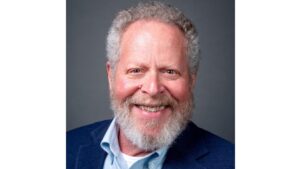
Schwab currently serves as president of Cumberland's historic B'er Chayim Congregation.
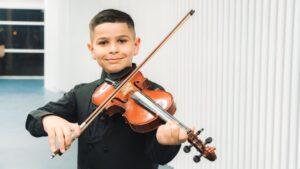
The Jerusalem Orchestra East & West, which arranged the program for young musicians, blends Western orchestral music with Middle Eastern traditions.

Pikesville resident and entrepreneur Luna Rosendorff discusses what she's seeing these days in the world of contemporary interior design.
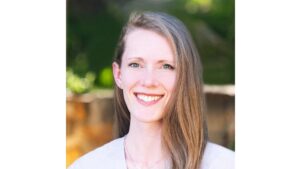
Jewish Community Services' upcoming "Future-Ready Workplace" event will feature a keynote address from workplace expert and bestselling author Liz Fosslien.