
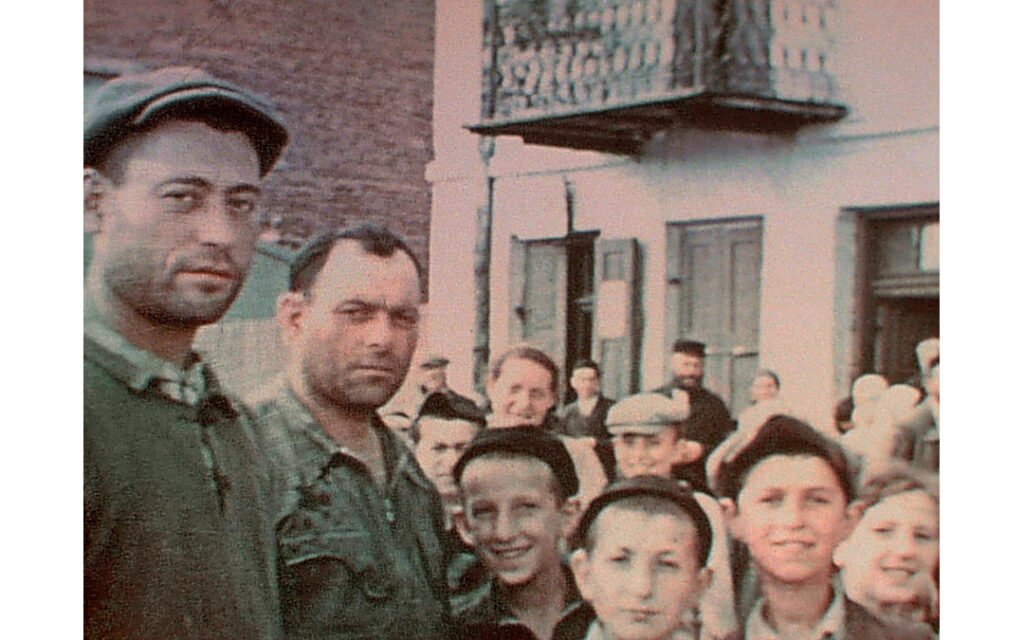
It was a fleeting moment captured on celluloid of a vanished world. But now, like the photographer Roman Vishniac’s celebrated images of shtetl life, it will remain a testament to the vibrancy of Jewish culture in pre-World War II Europe.
“Three Minutes: A Lengthening,” by Dutch filmmaker, historian and culture critic Bianca Stigter, will be presented at a pair of special screenings on Sunday afternoon, Sept. 11, at The Charles Theatre by the Baltimore Jewish Council and local Holocaust survivors. The documentary will open at The Charles, at 1711 N. Charles Street, on Friday, Sept. 2.
The film, which appeared at the Toronto International and Sundance Film festivals, received a wide theatrical release on Aug. 26.
Narrated by English actress Helena Bonham Carter and co-produced by Stigter’s husband, Academy Award-winning British director Steve McQueen, the 69-minute film was inspired by Glenn Kurtz’s acclaimed book, “Three Minutes In Poland: Discovering A Lost World In A 1938 Family Film” (Farrar, Straus and Giroux). The 2014 book reveals the story of three minutes of footage shot in the Polish town of Nasielsk by the author’s late grandfather, David Kurtz, in August of 1938.
In 2009, Glenn Kurtz discovered the unmarked home movie in a closet of his parents’ home in Palm Beach Gardens, Florida. The amateur film, 14 mintues long, chronicled the Polish-born David Kurtz’s vacation trip from New York to Europe, including to his grandfather’s birthplace in the Jewish quarter of Nasielsk.
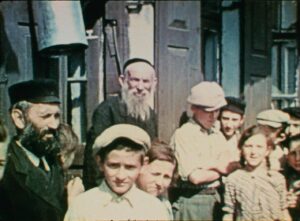
The faded footage — shot a year before the Nazi invasion of Poland and the start of the war — is the only moving images of the Jewish community of Nasielsk before the Holocaust. At the time, Nasielsk, located 30 miles northwest of Warsaw, was home to approximately 3,000 Jews, with only about 100 surviving the war. David Kurtz’s film, shot on 16mm Kodachrome color film, documents ordinary life in a small Jewish community in Poland.
“I myself became obsessed with identifying the people who appeared in this film,” Glenn Kurtz told the JTA global Jewish news source. “There’s hundreds of people, and lots of children, and I had this moment of shock when I realized, this is probably the only footage of these people — certainly the only color moving imagery — that exists. And I was now, in a way, responsible for their memory.”
Ultimately, Glenn Kurtz located seven living survivors from Nasielsk, including Maurice Chandler, who appears in the footage as a puckish 13-year-old boy among a crowd of peers. Chandler, who is now in his 90s, was recognized and identified by his granddaughter, Marcy Rosen, who saw the footage after it was posted online by the U.S. Holocaust Memorial Museum.
“That smile. I must’ve been happy or something,” Chandler, a Warsaw Ghetto survivor who is now a Detroit resident, said of his younger self in the documentary. “If somebody’d told me what a couple of years later I was gonna have to do, I wouldn’t believe it probably.”
Said Stigter: “For me, it’s a historic document. But for him, it’s his past, his childhood, so he has a completely different relationship to the material than most viewers.”
The Washington Post called “Three Minutes: A Lengthening” a “work of ruminative grace and power,” and the film review website RogerEbert.com called it “a great film about filmmaking and a quietly devastating memorial for lives long gone.”
Emily Goodman, the BJC’s director of Holocaust and Countering Antisemitism Programs, said the Associated agency decided to promote the film to “help bring more Holocaust programming and awareness to the Baltimore community. In these times of troubling rising antisemitism and Holocaust denial and distortion in our country, we are relying more and more on the willingness of others to engage and learn about this important history, and the BJC is happy to help provide resources and opportunities for this learning.
“This film will bring life to one of the many Jewish communities that was destroyed during the Holocaust and the memory and faces of its Jewish inhabitants,” she said. “It’s important that our community continue to remember and share the stories of these otherwise forgotten places of Jewish ancestry to ensure their place in history is never forgotten. The film also includes a score of highly-esteemed producers, directors, and narrator with recognizable names that will attract the audience members as well. We also invited local survivors and their families to provide an opportunity for them to be together in a space again after two years of distance due to the ongoing pandemic.”
Stigter, who is not herself Jewish, told JTA that the film “works as a kind of tool against erasure. Because there is so little known about what we see in the film, everything that you discover feels like a kind of small fix … for that erasure.”
The Sept. 11 screenings of “Three Minutes: A Lengthening” will be at 1 and 4 p.m. at The Charles Theatre. To purchase tickets, visit thecharles.com. For information, email egoodman@baltjc.org.

Emma Snyder, owner of The Ivy Bookshop, offers recommendations for must-read titles for adults and children.
Schwab currently serves as president of Cumberland's historic B'er Chayim Congregation.
A former U. S. Marine, Pat Young has served as a Baltimore County Council member representing District 1 since 2022.
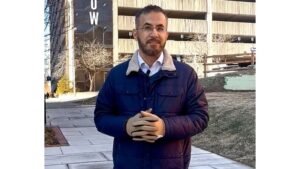
Mansoor Shams is known for carrying around a sign proclaiming, “I’m a Muslim and a U.S. Marine. Ask anything.” Now the Baltimore County Department of Recreation and Parks community engagement and outreach officer is running for Baltimore County Executive.