

I was playing baseball that spring afternoon on the big, grassy lot on Marmon Avenue, just off Belle Avenue near Rogers, when the man in the battered station wagon pulled up and offered me my first chance at really big money.
We’re now marking the Labor Day Weekend, so thoughts of one’s first job, and first money, come naturally to mind, no?
The man in the station wagon said his name was Mr. Berlin. He asked if I wanted to serve newspapers. Or in the parlance of the day, would I like to be a paperboy?
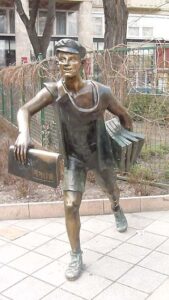
I didn’t want to. I was 13 years old, and I wanted to go back to my friends playing baseball. I still wanted to grow up and be Mickey Mantle, not Joseph Pulitzer. But I had a problem besides lack of actual ballplaying talent.
I knew that if my father somehow heard I’d turned down a chance to make money, he would let loose a holler that could be heard from our little kitchen on Crawford Avenue all the way over to Gwynn Oak Park.
“What are you, some kind of a Rockefeller?” he’d admonish. And then my mother would start in, with a cry like Ethel Merman in high dudgeon.
So I told Mr. Berlin, “Yeah, sure.” And I began to imagine the big money I’d be making, working seven days a week for the old News Post, which became The News American a few years later.
Every afternoon I’d head over to the big Seton Apartments complex, across Liberty Heights from the Sheridan Armory. At the bottom of a big hill on Parkview Avenue, I’d find my bundle of about 50 newspapers wrapped in brown paper and wire. I’d toss each paper toward the front doors of those apartments and on many of the front porches around Belle, Cadillac and Chrysler avenues.
Six afternoons, plus five o’clock on Sunday mornings, in the heat and cold and the dark, when I’d start the long trek.
Plus, never to be minimized, every two weeks I’d visit each of my customers to collect the dollar they owed for two weeks worth of the five-cent daily paper and the 20-cent Sunday paper.
And if I got really lucky and made all my collections and got my full percentage, I could make as much as $14.
Every two weeks.
Even in 1958, this was not considered great big money. But at the end of a full year at such labor, I was able to save up enough money to buy an RCA stereo record player.
And I got my first taste, however tangentially, of the newspaper business — which is naturally recalled on this Labor Day Weekend.
Later, I was a sportswriter on the University of Maryland’s Diamondback student newspaper when John Steadman hired me to cover sports, in the summer of 1966, for The News American.
“It’s only $50 a week,” he said, “but it’s all we pay interns. The important thing is that you get your foot in the door.”
He was right, and I fell in love with the business. The following year, as I was finishing college and preparing to marry, I was offered full-time work at the News.
“That’s great,” I told a hard-boiled executive editor named Sterling Noel, “but I’m getting married. I can’t start work making the same $50 a week. I’ve gotta have at least a $20 raise.”
They gave me $18.50.
They wouldn’t go for the extra buck-and-a-half.
It was the start of half a century playing economic catch-up.
Welcome to the American labor force, and Happy Labor Day everybody.
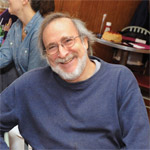
Michael Olesker’s latest book, “Boogie: Life on A Merry-Go-Round,” was recently published by Apprentice House. It’s the life story of Baltimore legend Leonard “Boogie” Weinglass, an original “Diner” guy who grew up to create the Merry-Go-Round clothing chain and contribute millions to charity.
Allow me a few paragraphs of time travel, and let’s go back to Johnny Carson’s monologue the night after Neil Armstrong became the first man to set foot on the moon. I’m paraphrasing here, but I think the joke still works 57 years after Carson first delivered it. “The good Read more

As he gets ready to leave for California, Rabbi Daniel Cotzin Burg looks back on his time in Baltimore and his 10 years writing for Jmore.
Michael Olesker pays tribute to WJZ’s retiring Marty Bass, a longtime fixture on local TV screens.