
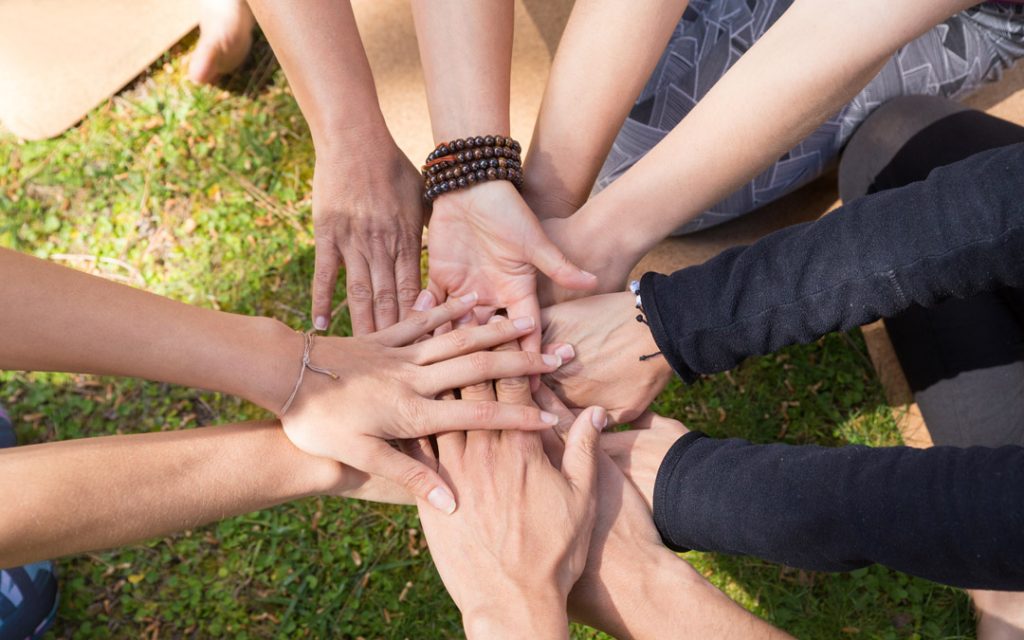
This month, Jews throughout Baltimore and around the world will attend synagogues in significant numbers. Many will open the Machzor, the High Holy Days prayer book, and encounter a language at once familiar and mysterious.
The English language contains over 170,000 words. Modern Hebrew, by comparison, has around 33,000. Biblical Hebrew has far fewer, around 8,200 words. The rabbis were aware of Hebrew’s terse vocabulary — and therefore the rich potential of many words for layered meaning.
The first time I discovered the paucity (and potency) of Hebrew was in Jewish summer camp as a child. A counselor explained there was a linguistic connection between the Hebrew word baruch (blessed) and another word, berech (knee). When we bless God, when we say the words “Baruch Ata Hashem” in our central prayer, we bend our knees. Whether this connection is about humility, flexibility or strength, I’m uncertain. Perhaps all of these.
I write frequently in this column about the concept of a New Jewish Neighborhood where Jewish qualities prevail over Jewish quantity. I also highlight and celebrate my own Reservoir Hill neighborhood in which I live and work. At best, there is holiness to community. It’s a holiness I feel when I encounter friends on the street or welcome newcomers to our shul. Philosopher Martin Buber believed we encounter God in the face of the other, particularly in those with whom we’re more familiar.
So perhaps it shouldn’t surprise me that an important Hebrew word for God, Shechinah, is related to the Hebrew word for neighborhood, shechunah. Judaism is not particularly dogmatic. God is one being but not one thing, not limited to one way of being. Shechinah is the divine presence, sometimes understood to be the divine feminine, the aspect of God we humans can access here on earth. Shechinah is the in-dwelling.
What is a neighborhood, after all? It’s a place in which we and our families dwell, sure, but it’s also sacred if we make it so. A neighborhood can be a place where we live, where we sleep at night or in which we own and occupy a home. Or a neighborhood can be where we discover deeper human connections — and in so doing, the possibilities of God. “Imagine,” said Mr. Rogers, “what our real neighborhoods would be like if each of us offered, as a matter of course, just one kind word to another person.”
And neighborhoods aren’t just about the people who live there now, they also have a history. My house on Eutaw Place was built in 1895. I have images of handwritten deeds going back to its first owners. Sometimes I imagine the Jewish families who lived there in the 1940s lighting their chanukiah in the window just like we do, or African American families listening to Motown in our living room in the 1960s. A sense of people, plus an awareness of history, can equal an experience of meaning, even holiness.
I’ve never been to Japan, but I’m fascinated by Japanese culture. One key difference between Japanese and American neighborhoods is our naming and numbering systems. In America, streets have names and houses have numbers. In Japan, however, instead of streets (the space in between blocks) having names, blocks have numbers and the space in between the blocks (streets) are without designation. A particular home might be located in District 8, Block 27. Like the U.S., the houses have numbers, too, but they don’t necessarily proceed in an orderly fashion up the block. Japanese houses are numbered by the order in which they were built.
To know one’s neighbors in Japan is to know who they are, where they live and, to some extent, the history of one’s community. Isn’t this a standard to which we might hold ourselves? Isn’t the space between our homes (both spatial and temporal) a manifestation of something greater?
As we approach our New Year, greater attentiveness to these dynamics could help fashion meaningful paths forward, blurring the boundaries between shechunah and Shechinah, neighborhood and godhood. The Babylonian Talmud teaches: “Rav Yehuda said in the name of Rav: Hospitality is more important even than welcoming the presence of the Shechinah” (Shabbat 127a).
This year, what if we didn’t have to choose?
Rabbi Daniel Cotzin Burg is spiritual leader of Beth Am Synagogue in Reservoir Hill, where he lives with his wife, Rabbi Miriam Cotzin Burg, and their children, Eliyah and Shamir. This column and others also can be found on The Urban Rabbi. Each month in Jmore, Rabbi Burg explores a different facet of The New Jewish Neighborhood, a place where Jewish community is reclaimed and Jewish values reimagined in Baltimore.

Jmore Publisher Scott Rifkin, M.D., reacts to President Donald Trump's latest poll numbers and the real force behind the growing decline of the Trump movement.
Last weekend's Flower Mart once again demonstrated that there's nothing to fear about downtown Baltimore, writes Michael Olesker.
A junior at Roland Park Country School, Katie Grossman writes about a recent experience that spurred her to take action to fight antisemitism.
At a time when many Jews fear appearing Jewish in public, seeing Judaism depicted correctly onscreen is reassuring, writes Jewish content creator Rabbi Yael Buechler.