
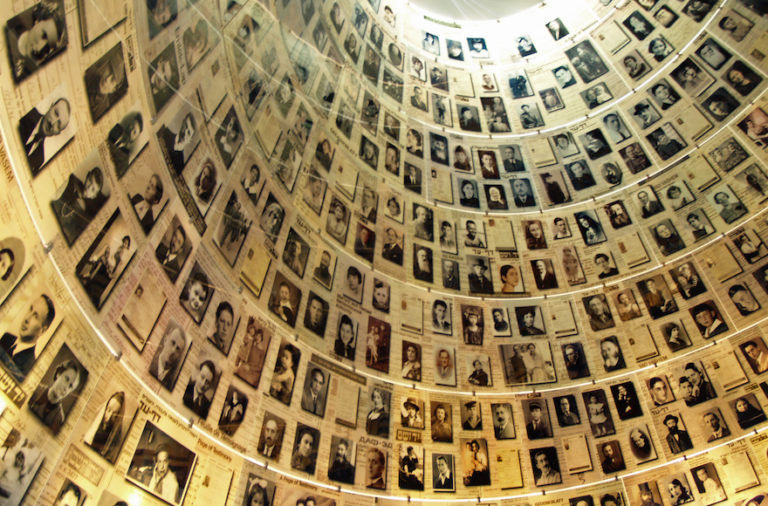
In the 1930s, when there was still a sliver of time, there were relatives begging for someone to help them get out of Europe. My father told me about them one night when the war was long over. They were cousins, uncles and aunts, all crying helplessly as they were swept into Hitler’s madness.
In the past week, their pleas, and millions more, were heard once again with Ken Burns’ latest documentary series, “The U.S. and the Holocaust,” on PBS, six-and-a-half hours over three heart-wrenching nights.
The series brings back that dreadful time when the world was just learning of Hitler’s barbarism. It reminds us of the millions whose American families were touched by the war, and the millions in Europe who might have been saved but for the intransigence and veiled bigotry of some U.S. political leaders and the general indifference of American citizens.

It’s a painful three nights, and an important look at the America of myth — “Give me your tired, your poor, your huddled masses yearning to breathe free …” — and America at its most hypocritical, turning away those in darkest trouble.
It will, inevitably, remind American Jews of their own family history, and the desperation on both sides of the Atlantic. I can hear my late father’s voice now.
“Most of our family never got out of Europe,” he told me one night. I was a young writer taking notes as he related the stories. He was a teenager, living with his parents in The Bronx, when the cries for help arrived.
“Letters would come from Poland, saying, ‘Please get me out,’” he said. “And you feel helpless, because what can you do?”
But there were breakthrough moments of rescue. My father and his father took the ferry to Ellis Island. My father remembered huge crowds, bedlam, and people shrieking, “Look how he looks,” as they embraced relatives who’d managed to get here.
And then, in a description that stayed with me through the years, my father said, “They kept touching each other, as though making sure they really were here.”
He might have said the same thing today, with so many wishing to come to America, and so many Americans wishing to turn them away, no matter the circumstances that drove them here.
More than 75 years since the war’s end, Burns’ documentary touches our emotions, and our sense of perspective, too.
We want to put the sheer cruelty of the war behind us, but its images keep coming back to haunt us. Ours is a time of the “Unite the Right” rally in Charlottesville, Virginia, and the mass killing at a Pittsburgh synagogue, and governors who try to win political capital by putting desperate immigrants on buses to strange cities.
There are still those wanting to put up a wall along America’s southern border to keep away outsiders. These aren’t tourists, they’re people hungry for a safe haven.
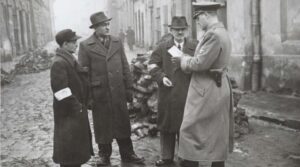
In the PBS series, Burns shows us Kristallnacht, the torching of synagogues, the looting of shops, the mass arrests of thousands of Jews.
That was 1938, when the desperation to get out of Europe was profound. That year, there were 220,000 applications for visas to America at consulates in Germany. But America’s annual quota for German immigration was only 27,000.
And yet, America didn’t even fill this pathetic quota. Only 18,000 Jews were allowed in, when there was still a sliver of time.
The Burns series opens with Anne Frank’s father, Otto, applying for a visa to America. He sees the dangers just ahead, “only to find, like countless others fleeing Nazism, that most Americans did not want to let them in.”
It’s a harsh, unsettling reminder of U.S. history — and of lofty American mythology that doesn’t always match the real thing.

Michael Olesker’s latest book, “Boogie: Life on A Merry-Go-Round,” was recently published by Apprentice House. It’s the life story of Baltimore legend Leonard “Boogie” Weinglass, an original “Diner” guy who grew up to create the Merry-Go-Round clothing chain and contribute millions to charity.
Duke Zimmerman and Lori Gale will talk at Towson University about their new book "People Get Ready" and the role played by Globe Posters in the civil rights movement.
The new exhibition revisits and updates a previous show about ritual hair covering in the observant community.

The Pikesville resident's latest offering "There's a Dragon in the Tree House and He Won't Come out!" was co-written with her grandsons.

A new biography captures the intensity and magic of the musical theater giant, writes Michael Olesker.