
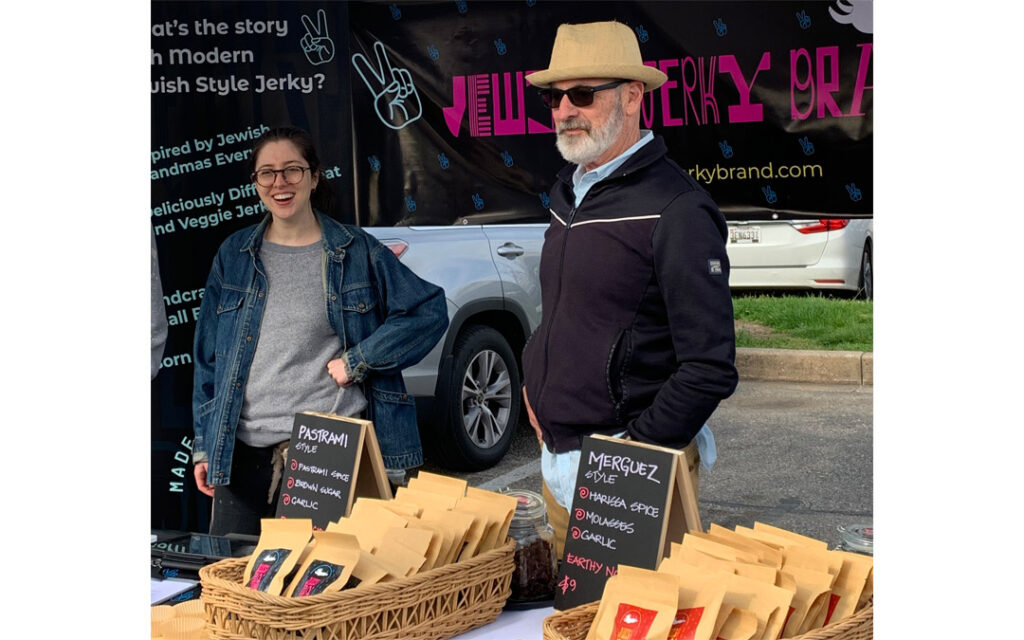
When you think of jerky, you most likely think of strips of dehydrated meat sold at a gas station, convenience store or bait-and-tackle shop.
For Adam Kaufman, founder of the Baltimore-based Jewish Jerky Brand, it’s an exploration of Jewish history, culture and identity, and experimenting with flavors inspired by where Jews live around the world.
A veteran of the marketing and advertising world, Kaufman, who recently moved from his native Los Angeles to Baltimore, currently sells four flavors of Jewish Jerky — Tzimmes Style, Pastrami Style, Charoset Style and Merguez Style – at local farmers markets
With more flavors in the works and ambitions to expand his commercial base, Kaufman, 63, recently spoke with Jmore about his product, what inspires him and how a road trip changed the course of his life
Jmore: What brought you to Charm City?
Kaufman: During the pandemic, my partner and I decided to sell our home in Los Angeles. Our three daughters all were here on the East Coast, and they didn’t seem to want to come back to Los Angeles, and we wanted to be closer to them.
We had been to Baltimore twice before and said, ‘OK, Baltimore is pretty cool.’ And we found this townhouse in Canton, which allowed our two dogs and us to immediately move in. So we said, ‘OK, let’s go do that.’
Where did the idea for your Jewish Jerky Brand come from?
We drove across the country from L.A. to Baltimore. We took the southernly route trying to avoid inclement weather during the winter. That took us through Arizona, and then eventually into Texas — and Texas goes on forever and ever in a day.
Throughout that part of the journey, I kept seeing signs for jerky. I didn’t know people like jerky so much. Somewhere in the middle of Texas, out in the middle of nowhere, I saw this sign that said, ‘Jerky from brisket.’ And I turned to my partner and said, ‘That’s so funny. That’s like Jewish jerky.’ We laughed and I said to her, ‘Wouldn’t it be funny if I were the big Jew jerk making Jewish jerky?’ And we laughed even more.
A few nights later, I thought, ‘I’ll just go online. Does anybody own Jewishjerky.com?’ Lo and behold, I became the proud owner of Jewishjerky.com for $9.95. Once I saw that no one had the URL — that’s a very modern way to gauge things — I knew there was something there. From that moment on, I decided to continue to cultivate this idea.
What exactly makes your jerky Jewish?
At the first level, it’s kind of a joke, like, ‘Come on, Jewish jerky? Jews don’t make jerky. There’s no tradition of making jerky.’
I started to think, ‘What if Jews did make jerky? What would it be like? Where would that inspiration come from?’ And I thought, ‘The diaspora is really interesting. Jews are all over the world. What if Jews in Cuba were to make jerky? What would that kind of flavor profile be? Or what if Jews living in New York were to make jerky?’ All of a sudden, you get this really rich history from Jews living all around the world.
I just started to experiment. What if you had this flavor, that flavor? What if it’s not meat? What if it’s based on vegetables? What about Jewish side dishes? It’s really a culinary exploration.
What’s unique about your flavors? And where do you make the jerky?
Most jerky contains a lot of sugar and salt. It’s sort of a front-loaded flavor, so you get a burst when you bite in. What I’m actually trying to do is a little bit of the opposite, which is more flavor profile and experience a little bit more back. The more you chew, the more flavor comes out. So there’s less salt, and less sugar.
I work out of a commercial kitchen called B-More Kitchen. I’m a one-man band right now. You got to buy the ingredients, you got to make the product, you got to package the product, you got to go sell the product.
What’s your background for an endeavor like this?
I come from a marketing and branding world. Previously, I was the head of marketing for a training software company. I wanted this brand to be lighthearted and a little funky — not too serious, not too hardcore, but have some gravitas.
The ‘North Star’ of this brand is to try to do the right thing. It’s as simple as that. For me, doing the right thing means how do you create something that’s a little bit more sustainable, a little bit more in line with what we understand this planet and our existence to be? As an example, I’m trying to work with as many local suppliers as possible.
What’s the reaction been like so far?
The best reaction is when people walk by in the market and they smile. The next best is when they try it, and they go, ‘Oh, that’s really good!’ I’m very pleased with interest, engagement and satisfaction. I like to say, ‘You don’t have to be Jewish to love Jewish jerky.’
For information, visit jewishjerkybrand.com.
Anna Lippe is a Washington, D.C.-based freelance writer.

Dara Bunjon talks with legendary chef Jimmy Schmidt, a three-time James Beard Award recipient, restaurateur, author, food scientist and innovator about his journey from the Rattlesnake Club restaurants to Chefs Collaborative and JR Ranch Foods.
Stewart, a business attorney, believes trust and affordability are the county's biggest obstacles.
The County Councilman from the 2nd District feels that transit-oriented developments can help meet pressing priorities.
The gathering on June 4 will be part of activities and programming around the world marking "Holocaust Survivor Day."